




How to identify runaway reaction risks in agrochemical manufacturing




A reaction can appear stable during normal production and still be close to a runaway condition. A slight rise in jacket demand, a slower-than-usual temperature response after dosing, unexpected pressure movement, or a batch that requires more agitation to remain uniform may be the first visible sign. In agrochemical synthesis, where reactions may involve concentrated reagents, reactive intermediates, solvents, catalysts, and multi-step additions, a loss of control can quickly threaten people, equipment, product quality, and containment.
The practical way to identify runaway reaction risks is to compare the rate of heat generation with the plant’s real ability to remove heat under credible upset conditions. That comparison must include more than the intended recipe. It should consider raw-material variability, charging errors, cooling failure, mixing limitations, decomposition pathways, venting capacity, and the possibility that an intermediate continues reacting after feed has stopped. Effective agrochemical manufacturing process safety depends on finding these gaps before scale-up or routine production exposes them.
Start with the reaction profile, not the normal batch record
A batch record shows how the process is supposed to run. It does not necessarily reveal what happens when temperature rises, feed is delayed, a concentration changes, or cooling becomes less effective. The first task is to map the reaction’s thermal behavior across the operating range rather than relying only on the target setpoint.
Review each stage where heat is released or where an unstable material may accumulate: reagent charging, catalyst addition, pH adjustment, neutralization, solvent exchange, concentration, distillation, and quench. In agrochemical production, apparently separate operations can interact. For example, a concentrated slurry can retain reactive material in poorly mixed zones, then release it into the bulk when agitation changes. A delayed reaction may begin during hold time rather than during the original addition.
Questions that should be answered for every heat-producing stage include:
- At what temperature does the intended reaction begin, accelerate, and approach completion?
- Can side reactions, polymerization, hydrolysis, oxidation, or decomposition begin at a higher temperature?
- How much unreacted feed or intermediate can exist in the vessel at the worst point in the batch?
- Does stopping the feed stop heat generation, or can the reaction continue accelerating?
- What happens if the reactor temperature rises above the control setpoint before an operator intervenes?
Laboratory reaction calorimetry, adiabatic testing, and decomposition screening are often needed to answer these questions reliably. The goal is not simply to obtain a heat-release value. The useful output is an operating envelope: safe feed temperature, maximum accumulation, acceptable addition rate, required cooling duty, onset temperatures for secondary behavior, and time available for response.
Watch for mismatch between heat release and heat removal
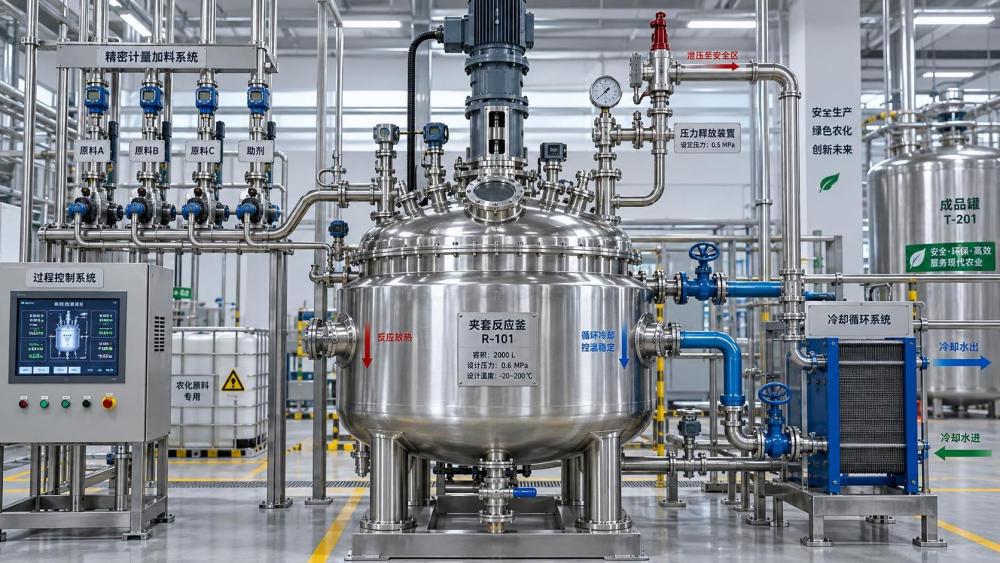
A runaway becomes possible when heat generation exceeds heat removal for long enough to push the batch into a more reactive state. This is often described as a heat balance problem, but the plant-side details matter. A reactor may have adequate cooling on paper while performing poorly because of fouling, low utility flow, high cooling-water temperature, partial jacket coverage, poor circulation, or insufficient mixing.
Do not use the reactor’s installed cooling area as proof of adequate protection. Determine the available cooling capacity at the most demanding credible condition: high batch temperature, reduced utility temperature difference, realistic utility flow, maximum viscosity, and the actual state of heat-transfer surfaces. The same review should account for loss of one cooling source, such as chilled brine or a circulation pump, where that failure is credible.
Find accumulation mechanisms during additions
Controlled dosing is not automatically safe dosing. A feed stream can accumulate when chemical conversion is slower than the programmed addition rate. The danger is greatest when temperature, catalyst activity, pH, mixing quality, or reactant concentration controls the reaction rate. Once the batch crosses a threshold, accumulated material can react rapidly and release heat faster than the cooling system can absorb it.
Examine the relationship between feed rate and reaction rate. A low reactor temperature may reduce immediate heat release and make the trend look calm, while allowing a large reactive inventory to build. Similarly, a feed introduced below the liquid surface may not disperse promptly in a viscous or multiphase system. Local concentrations near the addition point can drive side reactions that bulk sampling does not show.
Conditions that deserve a closer review
- A reaction depends on a narrow pH range, but pH is measured only intermittently.
- A catalyst is charged as a solid, slurry, or solution with uncertain active content.
- Feed concentration can vary because of solvent content, assay variation, or incorrect preparation.
- The batch becomes more viscous, forms solids, or separates into phases during dosing.
- Operators use temperature hold periods to “finish” a reaction without confirmation of residual reactants.
- Scale-up changes the ratio of heat-transfer area to batch volume or changes mixing time substantially.
For these situations, establish operating limits that are tied to measurable process conditions. A feed permissive might require reactor temperature below a defined limit, adequate agitator operation, verified coolant flow, and pressure within its normal control range. Interlocks should be designed around the hazard scenario, not merely around convenient instrument locations. A high-temperature alarm alone is not enough if feed continues while the batch is already accumulating reactive material.
Separate process deviations from early runaway signals
Not every temperature or pressure deviation is a runaway, but repeated “minor” deviations often reveal an underdeveloped control strategy. Quality and safety reviews should examine batch trends rather than only investigating deviations that lead to off-specification material. A gradual extension of reaction time, increasing demand for cooling, recurring foaming, or an unexplained shift in impurity profile can indicate a change in reaction behavior.
Trend review is especially important after changes in raw-material source, solvent recovery ratio, equipment maintenance, batch size, or production schedule. Recovered solvent may carry trace contaminants. A different particle size can alter dissolution speed. A new filter or transfer arrangement can change hold-up and dosing accuracy. None of these changes automatically causes a thermal event, but each can alter the assumptions behind the original safety assessment.
When an abnormal trend appears, preserve the relevant information before restarting: actual feed timestamps, reactor and jacket temperatures, utility flow or pressure, agitator speed and load, pressure trend, sampling results, and operator actions. Comparing these records with a stable batch can identify whether the problem was reaction kinetics, heat transfer, instrumentation, raw material, or procedure execution.
Verify safeguards against the scenario they must control
A safety safeguard is meaningful only when it works fast enough and remains effective during the specific runaway scenario. Review alarms, interlocks, emergency cooling, inhibitor addition, dump systems, quench systems, condensers, scrubbers, and pressure-relief devices as a connected response path. For example, an emergency quench may be ineffective if the vessel is too full, agitation has failed, the quench reagent is incompatible with overheated contents, or the injection point cannot distribute it quickly.
Pressure protection deserves the same level of scrutiny as temperature control. A runaway can generate vapor, permanent gas, foam, solids, or two-phase discharge. Relief design based only on normal solvent boiling may not be suitable for a decomposition reaction. Vent lines, condensers, catch tanks, scrubbers, and downstream equipment must be evaluated for the expected material behavior, including plugging or fouling potential.
Written procedures should make the first response unambiguous: stop or isolate feed, maintain or activate cooling, confirm agitation where safe, control pressure through the intended system, and escalate according to the site emergency plan. Operators also need clear stop-work criteria. A vague instruction to “monitor closely” is not a control measure when reaction temperature is rising independently of the setpoint.
Use change review to prevent old assumptions from becoming new hazards
Runaway risk is frequently introduced by changes that seem operationally small. Increasing throughput, shortening an addition, replacing a solvent, using a different grade of starting material, modifying a condenser, or running closer to a temperature limit can change the heat balance. Even a temporary workaround should be reviewed if it affects concentration, residence time, mixing, utilities, or the sequence of additions.
A useful change review asks whether the maximum heat-release rate, accumulated inventory, cooling capacity, venting demand, and emergency response time remain valid. It should also ask whether analytical controls still detect reaction completion and whether the revised process can be operated within defined limits during credible disturbances.
Where the reaction has significant thermal sensitivity, unexplained self-heating, uncertain decomposition behavior, or limited emergency control margin, the next step should be a structured process hazard review supported by appropriate thermal testing and relief assessment. Identifying that uncertainty early is itself an important part of agrochemical manufacturing process safety; it prevents routine production decisions from becoming the first real test of the process limits.
Related News
- 00
0000-00
Can a digital supplier discovery platform verify overseas suppliers? - 00
0000-00
Which drilling systems are suited to long-lateral shale wells? - 00
0000-00
Which sectors are driving demand in the chemical engineering market? - 00
0000-00
How to assess lifecycle emissions from CCUS for low-carbon cement - 00
0000-00
How do energy storage technologies compare for 8-hour discharge?
Weekly Insights
Stay ahead with our curated technology reports delivered every Monday.