




How to verify chemical material documentation meets safety standards




Start with document relevance, not document presence
A chemical material can arrive with a complete-looking document package and still be unsuitable for use. The practical question is whether each document identifies the exact material, the exact supply batch, and the regulatory and handling conditions that apply to the intended operation. For quality control and safety teams, a document review is therefore an approval gate, not an administrative filing exercise.
Chemical material documentation standards vary by jurisdiction, product class, transport route, and end use. A laboratory reagent, a bulk solvent for manufacturing, and a polymer additive may require different evidence even when they share a supplier or a hazard category. The review should begin by defining the material's intended use, location of use, storage conditions, process exposure, and destination market. Only then can the reviewer judge whether the documents are sufficient.
A useful starting principle is simple: no document should be accepted solely because it carries a supplier logo, a signature, or a recent date. It must agree with the purchase specification, product label, container marking, and receiving record.
Build the review around four linked records
Most approval decisions rely on four document groups: the Safety Data Sheet (SDS), Certificate of Analysis (CoA), regulatory declarations, and traceability records. Each answers a different question. Problems often arise when one document is used as a substitute for another.
1. Safety Data Sheet: can the material be handled safely?
The SDS establishes the hazards and control measures associated with the substance or mixture. Review the document against the material identity first: product name, chemical name where applicable, grade, concentration range, and supplier details should be consistent with the delivered product. A generic SDS for a product family can be inadequate where the delivered grade has a different concentration, stabilizer, impurity profile, or hazard classification.
Focus on the sections that affect site controls. Hazard identification should align with the label and internal hazard inventory. Composition information should be meaningful enough to assess exposure and incompatibility risks. Handling, storage, exposure controls, personal protective equipment, spill response, and disposal instructions should be operationally usable for the receiving site.
An SDS may be formally complete but still create a gap if it assumes conditions that do not exist at the facility. For example, instructions that rely on local exhaust ventilation, a particular type of respirator, or temperature-controlled storage need to be checked against actual site capability. When process conditions involve heating, mixing, transfer under pressure, or confined-space work, the SDS alone may not provide a complete operating risk assessment.
2. Certificate of Analysis: does this batch meet the required specification?
A CoA confirms measured properties for a particular batch. It is not proof that the material is legally compliant, safely handled, or suitable for every application. Its value depends on a clear connection to the purchase specification and lot traceability.
Check that the CoA identifies the batch or lot number shown on the container or delivery documentation. Then compare reported results with the agreed acceptance criteria, including assay, moisture, acidity or alkalinity, particle size, viscosity, density, color, impurity limits, or other relevant parameters. The right tests depend on the material and application; a standard assay result may be insufficient where trace contaminants can affect product quality, emissions, corrosion, or worker exposure.
Reviewers should also examine how results are expressed. A result without units, method reference, specification limit, or pass/fail context is difficult to use in a defensible release decision. A broad specification range may be acceptable for one process but too loose for a sensitive formulation or regulated end product.
3. Regulatory declarations: is the compliance claim specific enough?
Regulatory declarations should be assessed in relation to where the material is manufactured, imported, stored, used, and sold. A statement that a product is “compliant” has limited value unless it identifies the regulation, scope, material identity, and responsible entity behind the claim.
Depending on the supply chain and use case, the file may need declarations concerning chemical inventory status, substance restrictions, hazardous substance content, transport classification, food-contact suitability, pharmaceutical or electronic-material controls, or other sector-specific requirements. The appropriate document set cannot be standardized across every chemical purchase.
Look for declarations that are material-specific and version-controlled. A declaration covering a parent product range may not cover a reformulated grade. Likewise, a statement issued for one market should not automatically be relied upon for another. When a material is a mixture, the review may need to address both the mixture and controlled constituents that could trigger restrictions or reporting duties.
Use traceability to connect paperwork to physical stock
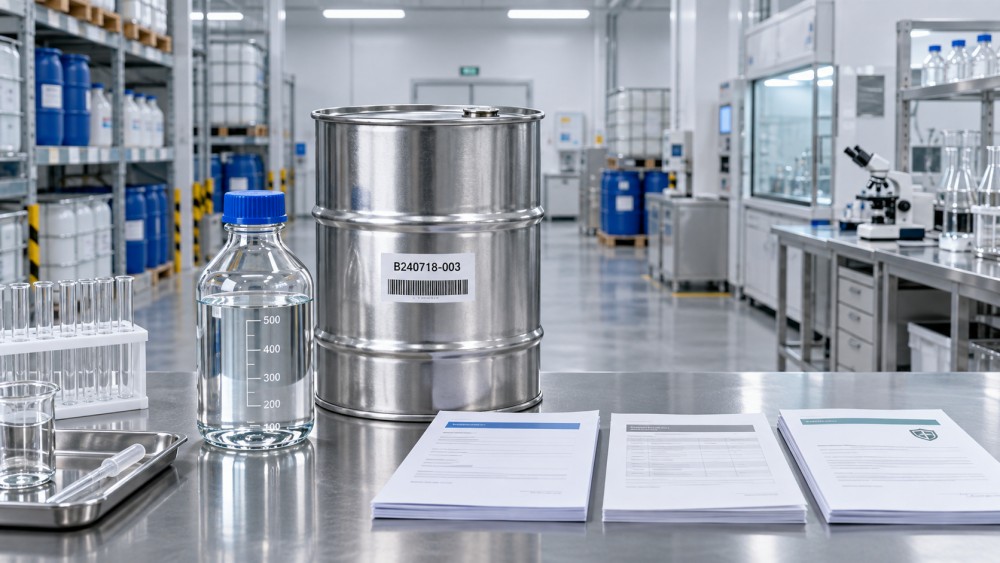
The most serious documentation failures are often traceability failures. An SDS or CoA can be technically valid yet belong to a different lot, production site, packaging configuration, or product revision. The receiving process should connect purchase order, supplier name, product code, batch number, manufacturing or retest date where relevant, container label, quantity, and storage location.
Traceability should remain intact after repackaging or internal transfer. If chemicals are decanted into secondary containers, internal labels and records need to preserve the original identity and hazard information. Without this link, a later quality deviation, exposure incident, or recall can become difficult to investigate.
For higher-risk materials, establish a controlled approval status rather than treating receipt as automatic release. Materials can be categorized as approved for use, quarantined pending evidence, conditionally approved for a defined application, or rejected. That status should be visible to warehouse staff, production users, and the safety function.
Red flags that deserve escalation
Document review should not become a search for formatting defects. The purpose is to identify contradictions that could affect safety, compliance, or product performance. Several warning signs merit a closer check:
- The SDS product name or composition does not match the purchase order, container label, or technical data sheet.
- The CoA does not include the received lot number, or one CoA is supplied for multiple lots without a documented basis.
- Dates appear current, but the revision history, preparation date, or regulatory references are absent.
- A certificate reports results but omits test methods, units, limits, or authorized release information.
- Hazard labeling and SDS classification conflict without explanation.
- A broad compliance statement replaces a jurisdiction- or application-specific declaration.
- The supplier cannot identify the manufacturing site, original producer, or chain of custody for a high-risk or controlled material.
- Critical handling controls in the SDS cannot be implemented at the receiving or use location.
Not every discrepancy requires rejection. Some can be resolved by obtaining a corrected document, confirming a batch linkage, or conducting a technical review. The decision should be recorded with the reason for release, restriction, or escalation. Informal email assurances may help clarify a question, but they should not replace controlled documentation where a certificate or declaration is required.
Match the depth of review to the material risk
A uniform review process for every chemical tends to fail in two ways: it slows routine purchasing while giving insufficient attention to critical materials. Risk-based review is more effective. Materials with high acute toxicity, sensitization potential, environmental hazard, process reactivity, controlled constituents, or use in regulated products generally justify deeper verification and more frequent supplier review.
The same applies when the consequences of variation are high. A small impurity shift may be insignificant in a cleaning application but unacceptable in analytical work, specialty coatings, polymer compounding, or a process with catalyst sensitivity. The document package should reflect the level of control the application actually needs.
Turn verification into a controlled approval process
The strongest process is one that makes document verification repeatable without pretending every material presents the same risk. Maintain an approved-material record containing the current SDS, applicable declarations, technical specification, approval conditions, supplier contacts, and document review date. Link it to purchasing controls so that a change in supplier, grade, manufacturing site, or formulation triggers re-evaluation.
Change control matters because documentation can remain polished while the material behind it changes. A revised SDS, altered classification, different test method, new origin, or changed impurity profile may affect both workplace controls and product suitability. Periodic review should prioritize materials with changing regulations, high hazard profiles, critical end uses, or long intervals between purchases.
For quality and safety managers, the goal is not to collect the largest possible document file. It is to establish a reliable chain of evidence: the material received is the material ordered, the batch meets the intended specification, the hazards are understood under site conditions, and the compliance claims apply to the planned use. That is the standard a defensible chemical approval decision should meet.
- Last One:No more articles
- Next Article:How to verify whether a circular economy certification is credibleSep 19, 2026
Related News
- 00
0000-00
Virgin vs Recycled Resin: How to Switch Without Disrupting Production? - 00
0000-00
Why Bio-Based Plastics Still Have to Prove Themselves on the Molding Floor - 00
0000-00
Industrial decarbonization targets slip when baselines are weak - 00
0000-00
How to verify chemical material documentation meets safety standards - 00
0000-00
How to verify whether a circular economy certification is credible
Related tags
Weekly Insights
Stay ahead with our curated technology reports delivered every Monday.