




2026 Market Demand Shifts Shaping PS Sheet Extrusion Line Procurement




Why 2026 Demand Signals Matter for Sheet Capacity Planning
Procurement decisions for plastic sheet equipment are becoming more complex as buyers prepare for 2026. In many manufacturing segments, demand is no longer driven only by volume growth. It is shaped by shorter product cycles, tighter margin expectations, wider material selection requirements, and stronger pressure to control energy and maintenance costs. For companies involved in thermoforming, packaging conversion, industrial sheet production, and related downstream operations, this means equipment selection is increasingly tied to business resilience rather than simple capacity expansion.
PS sheet remains relevant in a range of applications because it can support stable forming performance, surface consistency, and cost-sensitive production in many scenarios. Yet the way buyers approach line selection is changing. Procurement teams are now expected to weigh flexibility, rebuild quality, spare parts accessibility, and long-term operating economics with greater care. This is especially true when evaluating existing or rebuilt assets, where purchase price may look attractive but hidden technical risk can reshape total ownership cost.
The 2026 market outlook suggests that companies will benefit from a more disciplined procurement framework. Buyers who understand the direction of demand shifts are usually in a better position to choose equipment that matches their production profile, avoids overinvestment, and supports commercial responsiveness in uncertain market conditions.
Demand Shifts That Are Changing Procurement Priorities
One major shift is the increasing need for operational flexibility. Many processors are not planning around one fixed, high-volume product mix for the next several years. Instead, they may need to serve multiple order patterns, different sheet thickness requirements, or changing customer expectations around quality and lead time. In this environment, line adaptability becomes a procurement issue. Buyers often need to assess how easily an extrusion line can be adjusted, maintained, or integrated into current workflows without creating excessive downtime.
A second shift is the stronger focus on cost visibility. Capital budgets in 2026 are likely to be reviewed more closely by finance teams, especially where industrial buyers must justify output gains against uncertain demand. This pushes equipment evaluation beyond headline price. Energy draw, screw and barrel condition, control system reliability, heater performance, roll stack stability, and cooling efficiency all become relevant because they influence whether projected savings are realistic.
A third shift involves supply chain caution. In recent years, many buyers have become more aware that new equipment lead times, component shortages, and service delays can disrupt expansion plans. That has made rebuilt and second-hand machinery more visible in procurement discussions. For some firms, these assets may provide a practical route to faster deployment, but only if technical due diligence is strong enough to separate a properly rebuilt line from one that merely appears usable on the surface.
How These Changes Affect Buyers, Manufacturers, and Distribution Channels
For procurement managers, the main implication is that equipment review now needs cross-functional input earlier in the process. Engineering teams may focus on output stability and maintenance access, while production managers care about changeover time and scrap rates. Finance approvers may emphasize payback period and refurbishment transparency. Senior decision-makers often want assurance that the equipment will still be commercially relevant if demand patterns shift again within two or three years.
Manufacturers and converters face a different but connected challenge. If they select a line that is oversized, too specialized, or difficult to support, they may carry unnecessary cost into a market that rewards agility. On the other hand, choosing equipment based only on the lowest acquisition price can create losses through unstable output, frequent stoppages, or inconsistent product quality. In many operations, the real procurement risk is not the initial spend but the mismatch between the line’s actual condition and the production plan it is expected to support.
Distributors, agents, and resellers are also affected because buyers are asking sharper questions. They increasingly need documentation on rebuild scope, replaced components, test conditions, and post-installation support assumptions. Equipment that cannot be described clearly in technical and commercial terms may struggle to pass internal approval processes, even when the base machine architecture is sound.
What Decision-Makers Should Examine Before Approving a Line
A useful procurement review starts with production reality. Buyers should define target sheet width, thickness range, output expectations, material consistency requirements, and downstream compatibility before comparing machines. Without those operating boundaries, it is easy to evaluate equipment on generic specifications rather than practical fit. A line that performs acceptably for one application may be inefficient or unstable in another.
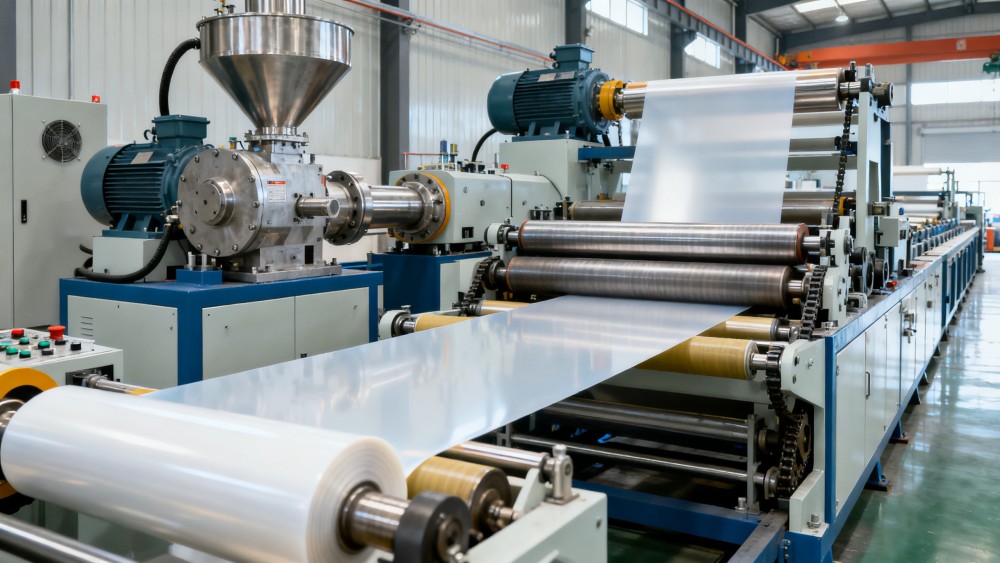
For rebuilt equipment, mechanical condition deserves close attention. The extruder screw and barrel should be assessed for wear because these parts directly affect melt quality, output consistency, and energy efficiency. The gearbox, motor, heaters, die condition, calender or roll section, and cooling components also influence whether the line can maintain steady performance. Control systems are equally important. Even if the main frame is durable, outdated or poorly integrated controls may create avoidable operating issues.
This is where PS sheet extrusion line procurement becomes part of a wider business evaluation rather than a narrow equipment search. Buyers often need to compare whether a rebuilt line can deliver acceptable lifecycle value when measured against throughput needs, maintenance planning, operator familiarity, floor space constraints, and the availability of replacement parts after commissioning.
How to Evaluate a Rebuilt Plastic Extruder Before Purchase
A rebuilt plastic extruder should not be judged only by appearance or by claims that major parts were serviced. Procurement teams usually benefit from asking what was rebuilt, what was replaced, what was tested, and what remains original. A credible rebuild process often includes inspection records, wear measurement, electrical review, and confirmation that key assemblies can operate within expected process windows.
Practical evaluation points often include the following:
- Whether the screw and barrel condition matches the intended resin and output range.
- Whether heaters, sensors, drives, and control interfaces function consistently and can be supported locally.
- Whether the die, roll section, and sheet handling components can deliver the target surface quality and dimensional stability.
- Whether test running was completed under conditions relevant to likely production use.
- Whether maintenance history, replaced parts, and unresolved limitations have been documented clearly.
If possible, buyers should also review how the rebuilt line fits into startup planning. Installation requirements, utility load, operator retraining, calibration time, and spare parts sourcing can materially affect the speed at which the asset begins generating usable output. A lower-cost line that takes too long to stabilize may not be the economical option once lost time is considered.
Common Procurement Missteps in a Shifting Market
One common mistake is focusing on nominal capacity without examining usable capacity. A machine may be rated for a certain output level, but actual performance depends on material condition, wear profile, thermal stability, and downstream coordination. Another mistake is assuming that any rebuilt line offers similar value. Rebuild quality can vary significantly depending on inspection depth, replacement standards, and technical transparency.
Some buyers also underestimate the approval burden inside their own organizations. In 2026, equipment purchases are likely to face more scrutiny from finance and management teams that want evidence of durability and fit. Procurement packages that include only price comparisons may not be sufficient. Decision-makers usually need a clearer picture of operating risk, expected maintenance exposure, and the tradeoff between lower capital spend and future intervention costs.
A Practical Framework for 2026 Procurement Decisions
A practical way to approach the market is to separate evaluation into three layers: production fit, asset condition, and ownership support. Production fit asks whether the line can make the product range the business actually needs. Asset condition tests whether the machine can do so reliably. Ownership support considers spare parts, documentation, service responsiveness, and operator readiness. When all three layers align, procurement decisions tend to be more defensible and commercially realistic.
For firms balancing growth targets with budget discipline, this framework may be especially useful. It helps reduce the risk of buying equipment that looks viable on paper but becomes expensive to run. It also gives distributors and internal stakeholders a shared language for comparing options more objectively.
The market shifts shaping 2026 are not only about higher or lower demand. They reflect a broader change in how industrial buyers define value. In PS sheet operations, procurement is increasingly linked to adaptability, rebuild credibility, process stability, and lifecycle economics. Companies that respond with more rigorous equipment assessment are likely to be better positioned to manage uncertainty while keeping production capabilities aligned with market needs.
Related News
- 00
0000-00
Circular economy polymers: virgin or recycled blends? - 00
0000-00
Bio-based materials still face a performance trust gap - 00
0000-00
Industrial decarbonization targets slip when baselines are weak - 00
0000-00
Non-ferrous alloys are gaining ground in high-heat applications - 00
0000-00
Non-ferrous metals supply risk is no longer just a mining issue
Related tags
Weekly Insights
Stay ahead with our curated technology reports delivered every Monday.