




How to verify supplier data on a supplier discovery platform




Supplier profiles can make a shortlist look credible long before the supplier has proven that it can meet a purchase order. A company name, website, product catalogue, and a few certificates are useful starting points, but they are weak evidence on their own. Before requesting quotations, approving a new vendor, or assigning a supplier to a critical category, procurement teams should verify whether the data describes a real, capable, and relevant business.
A supplier discovery platform can speed up that work by bringing product, technical, trade, and company information into one place. It does not remove the need for due diligence. Its value lies in helping buyers compare claims against independent signals and identify which suppliers deserve deeper qualification.
Start with the purchase requirement, not the supplier profile
Verification is easier when the buying requirement is precise. “Steel supplier,” “chemical manufacturer,” or “plastic materials exporter” is too broad to assess meaningfully. A supplier may be legitimate and still be unsuitable for the grade, process, volume, documentation, or delivery conditions required.
Translate the sourcing need into a short set of testable conditions before reviewing profiles. For industrial purchases, these commonly include:
- Exact product grade, specification, composition, or performance range
- Applicable standards, test methods, and required certificates of analysis
- Manufacturing process or conversion capability, where it affects quality
- Minimum and target order quantities
- Required packaging, handling, storage, or hazardous-material controls
- Destination market requirements, including export documents and regulatory obligations
- Lead time, production capacity, and tolerance for schedule changes
This prevents a common error: treating a broad category match as proof of supply capability. A supplier listed under polymer materials, for example, may trade resins without producing them; a metals company may stock standard forms without being able to provide the specified alloy, dimensions, heat treatment, or traceability records.
Test whether the supplier is what it claims to be
The first verification task is to establish the supplier’s operating role. Procurement risk changes materially depending on whether the company is a manufacturer, processor, stockholder, distributor, agent, or trading company. None of these roles is automatically problematic. The issue is whether the role is disclosed accurately and fits the purchase.
Review the company description alongside its product range. Extremely broad catalogues can be legitimate for large trading businesses, but they should prompt questions when paired with vague technical details, generic factory images, or identical product descriptions across unrelated sectors. A company claiming to manufacture drilling equipment, specialty reagents, industrial batteries, and recycled polymers would require much stronger evidence than a focused producer of one defined product family.
Useful cross-checks include the legal company identity, registered address, operating locations, production-site details, contact consistency, export records where available, and the time pattern of the company’s commercial activity. Differences in spelling, addresses, telephone codes, domains, or legal names do not necessarily indicate misconduct, but they should be reconciled before the supplier enters an approved vendor list.
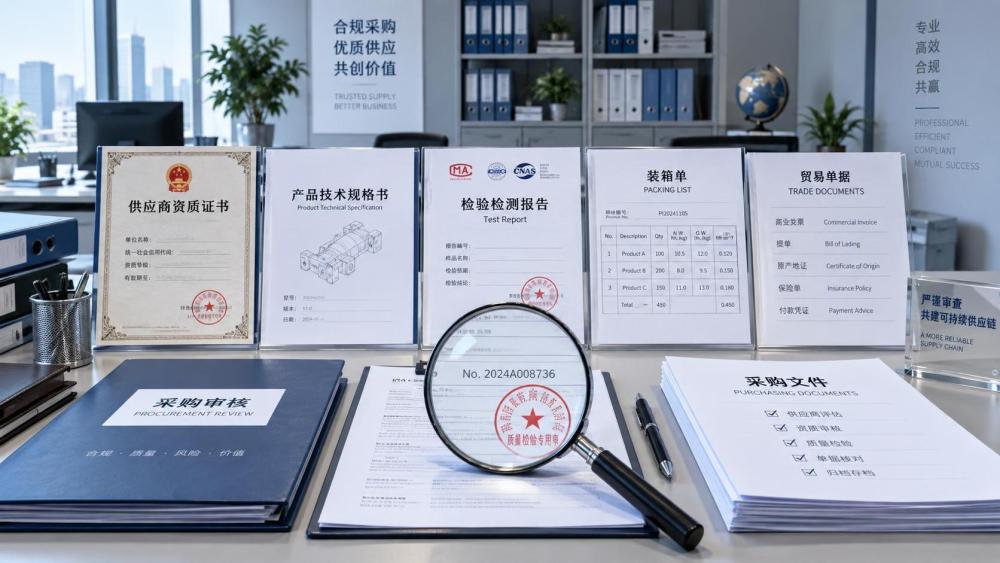
For high-value or safety-critical purchases, request documents that connect the commercial entity to the operational entity: business registration records, manufacturing-site information, quality-system certificates, and authorization to sell branded or regulated products where relevant. Review whether document names, addresses, scopes, dates, and issuing bodies align with the supplier’s account.
Check product capability through technical evidence
A strong profile tells a buyer what the supplier can supply in commercial language. Verification requires evidence that the supplier understands and controls the product technically.
For a material, compare the listed specification with the datasheet, test report format, and product application. Look for information that should be present for that category: chemical composition and impurity limits for metals or chemicals; melt flow, density, mechanical properties, and additive package for polymers; pressure rating, material grade, weld procedure, or inspection requirements for pipeline components.
The documents do not need to be lengthy to be useful. They should be internally coherent. A specification that mixes unrelated standards, uses incompatible units, omits critical property limits, or promises performance without a test basis may reveal that the seller is republishing catalogue text rather than controlling the product.
It is also important to distinguish a sample result from routine production control. A single laboratory report can demonstrate that a sample was tested. It does not establish that every shipment will have equivalent traceability, batch control, calibration discipline, or release procedures. Ask how the supplier links production lots, test results, packaging labels, and shipping documents. For regulated chemicals, food-contact materials, or safety-sensitive components, that chain is often more important than an attractive test value.
Read certifications for scope, not just presence
Buyers often treat a certification logo as a pass/fail signal. The more useful question is what the certificate actually covers. A quality management certificate may apply to one facility, a limited product scope, or an activity such as trading rather than manufacturing. Product compliance declarations should similarly be assessed against the destination market and intended application.
When reviewing a certificate, examine the certified entity, site address, scope statement, validity period, and certificate number. Then compare those details with the company and product being quoted. A valid certificate for a packaging operation does not verify a claimed capability to manufacture a specialty chemical; a management-system certificate does not replace product-specific testing or regulatory documentation.
Use trade and market signals as corroboration
Supplier data becomes more useful when it is compared with external commercial signals. Export activity, shipment patterns, product classifications, destination markets, and recurring product references can help indicate whether a company participates in the category it claims to serve.
These signals must be interpreted carefully. The absence of visible export records does not prove a supplier lacks capacity: it may sell domestically, operate through another entity, or work through distributors. Conversely, a record of exports does not establish product quality or reliable delivery. The purpose is corroboration. Does the supplier’s apparent commercial activity resemble its stated business model, product range, and target markets?
For example, a buyer evaluating a supplier of industrial resins may find that its public materials claim substantial international supply, while available trade information shows only sporadic shipments of unrelated goods. That gap does not settle the question, but it gives procurement a clear reason to ask for product-specific shipment references, production-site evidence, or recent batch documentation.
Market information can also reveal whether a quotation is commercially plausible. Large price differences may result from a different grade, origin, incoterm, package size, payment term, or excluded compliance cost. Treat a low price as a prompt to compare assumptions line by line, not as proof of supplier competitiveness.
Move from desktop verification to controlled engagement
Once the profile, technical documents, and corroborating signals are broadly consistent, the next step is not immediate vendor approval. It is a controlled commercial interaction designed to expose gaps that profiles cannot show.
- Send an RFQ with a clear technical specification and ask for a structured response rather than a general quotation.
- Request a recent certificate of analysis or inspection report for the exact product family, with sensitive commercial details redacted if necessary.
- Ask which facility produces, tests, packages, and ships the goods.
- Confirm lead time from order receipt, not only an estimated shipping date.
- Clarify traceability, nonconformance handling, replacement terms, and change-notification practices.
- For material or component categories with meaningful performance risk, qualify a sample or pilot lot under the intended application conditions.
The quality of the response matters. A capable supplier should be able to address specification revisions, documentation needs, tolerance limits, and packaging instructions with reasonable precision. Repeatedly generic answers, resistance to basic traceability questions, or unexplained changes in the legal seller, bank beneficiary, or shipping entity should pause the process until the structure is understood.
Set an evidence threshold that matches the risk
Not every purchase warrants the same level of verification. Low-value, non-critical consumables may be suitable for a lighter review and a small initial order. A new supplier of specialty additives, pressure-bearing equipment, rare-earth materials, laboratory reagents, or components tied to a plant shutdown should face a higher evidence threshold.
A supplier discovery platform is most effective when it supports this sequence: define the requirement, screen for fit, cross-check supplier claims, request evidence tied to the actual product, and scale qualification to the consequence of failure. The objective is not to prove that a profile is perfect. It is to decide, with evidence, whether the supplier is suitable for the next sourcing step and what controls are required before commercial exposure increases.
Related News
- 00
0000-00
How overcapacity shapes the ferrous metallurgy market outlook - 00
0000-00
How do EU allowances differ from other carbon assets in Europe? - 00
0000-00
Can a digital supplier discovery platform verify overseas suppliers? - 00
0000-00
Which drilling systems are suited to long-lateral shale wells? - 00
0000-00
Which sectors are driving demand in the chemical engineering market?
Related tags
Weekly Insights
Stay ahead with our curated technology reports delivered every Monday.