




Carbon Steel Plate Technical Guide: How Material Grade, Rolling Condition, Thickness, and Processing Method Shape Real Project Performance




Steel plate selection is often discussed through price, thickness, and delivery time, but the technical behavior of the material is shaped by grade, rolling condition, chemical composition, tolerance, surface condition, and the way the plate will be cut, welded, bent, or machined. For buyers comparing Carbon Steel Plate, understanding these technical factors can reduce rework, improve fabrication planning, and prevent mismatches between purchase specifications and project requirements.
This technical analysis guide is written for steel distributors, service centers, fabrication shops, construction contractors, machinery builders, maintenance teams, and procurement departments that need to evaluate carbon plate beyond a basic quotation. Carbon steel plate is used in frames, machinery bases, brackets, tanks, containers, bridges, platforms, agricultural equipment, transport parts, and general structural fabrication. It may look like a simple flat product, but it behaves differently depending on grade, production route, thickness, heat history, surface condition, and downstream processing. A technically sound purchase starts with knowing which material properties matter for the final use.
Why Carbon Steel Plate Behaves Differently Across Grades
Carbon steel is not one single material. It is a broad family of steels where carbon content, manganese, silicon, sulfur, phosphorus, and other controlled elements influence strength, ductility, weldability, hardness, machinability, and toughness. A general structural plate, a higher-strength plate, a wear-resistant plate, and a pressure-related plate may all be described as steel plate, but their performance logic can be very different.
For buyers, grade selection is the first technical filter. The selected grade should match the load condition, fabrication method, service environment, and customer specification. A plate used for a simple welded frame may not need the same toughness or wear behavior as a mining liner, bridge component, heavy base, or machine part. If the plate will be bent or rolled, ductility matters. If it will be welded, carbon equivalent and heat-affected zone behavior matter. If it will be machined, hardness and consistency matter.
Equivalent grade discussions should be handled with care. Grade names from ASTM, EN, JIS, GB, and other systems may appear similar in commercial discussions, but buyers should compare chemical composition, mechanical properties, testing requirements, and acceptance standards before approving substitutions. A grade equivalent for one application may not be equivalent for another.
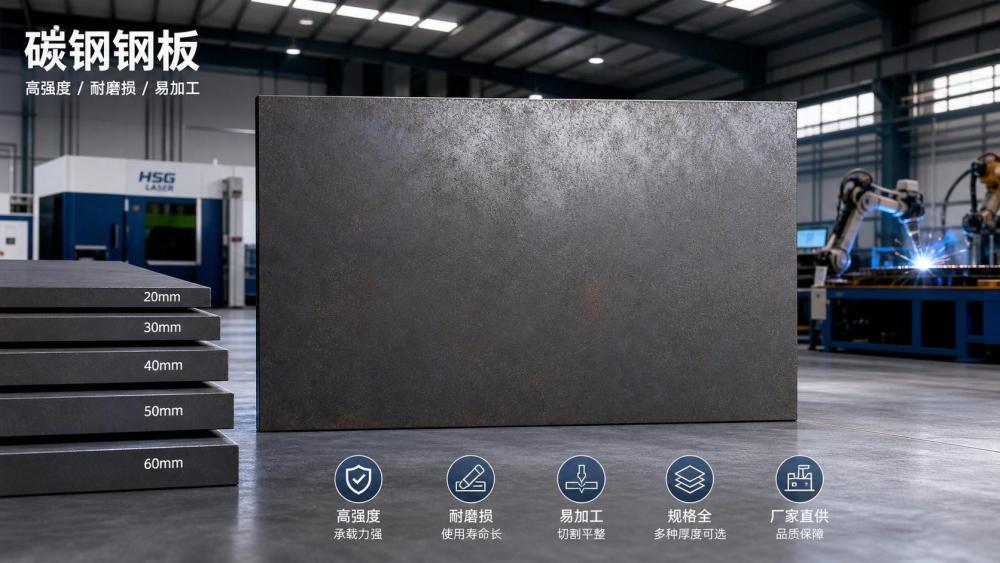
Hot Rolling, Thickness, and Internal Stress
Many carbon steel plates are supplied in hot rolled condition. Hot rolling allows steel to be formed at high temperature into plate dimensions, but the final product may show scale, thickness variation within tolerance, residual stress, and flatness characteristics that influence downstream processing. The thicker the plate, the more important it becomes to understand cutting behavior, heat input, and internal stress release during fabrication.
Thickness is not only a strength question. It affects weight, transport cost, cutting speed, welding preparation, preheating needs in some cases, machining allowance, and distortion risk. A plate that is thick enough for strength may still be inefficient if it creates unnecessary weight or difficult handling. A plate that is too thin may save cost but fail to meet load or wear requirements. Buyers should confirm nominal thickness, tolerance, and whether the final part requires machining or edge preparation.
Flatness is another technical issue. Laser cutting, plasma cutting, machining, and assembly all benefit from predictable flatness. If a plate is out of flat, parts may not nest well, cutting quality may suffer, and welding fit-up may require extra clamping or correction. Flatness requirements should be discussed before ordering when fabrication accuracy matters.
Cutting Behavior and Edge Quality
Cutting is often the first processing step after plate delivery. Different cutting methods create different edge conditions. Oxy-fuel cutting is common for thicker carbon plates and can be cost-effective, but it introduces heat and may require edge cleaning. Plasma cutting can be faster for many thickness ranges but may leave angularity or dross depending on settings. Laser cutting can provide precise edges in suitable thickness ranges, while waterjet cutting reduces heat-affected effects but may involve different cost and speed considerations.
Buyers should consider the final part requirement before selecting plate and cutting route. If the edge will be welded, edge preparation may be needed. If the edge will remain visible, surface and cut quality may matter more. If parts will be machined after cutting, enough allowance should be planned. If the plate has high internal stress, cutting may release stress and cause movement. Fabricators should account for this in nesting, sequencing, and clamping.
Edge quality problems can sometimes be blamed on the cutting machine, but material condition also plays a role. Scale, flatness, thickness variation, and grade can influence cutting results. Buyers who outsource cutting should confirm whether the supplier or service center understands the required final tolerance and edge condition.
Welding and Heat-Affected Zone Considerations
Carbon steel plate is widely welded, but welding performance depends on grade, thickness, chemical composition, joint design, heat input, cooling rate, and fabrication procedure. Thicker plates and higher-strength grades may need more careful welding control than simple thin structural parts. Some applications may require preheat, controlled interpass temperature, or post-weld inspection. Buyers should not assume that every carbon plate can be welded under the same procedure.
The heat-affected zone is the area near the weld that experiences thermal change. If the welding procedure is not suitable, this zone can become a weak point through hardness changes, cracking risk, distortion, or reduced toughness. The risk depends on the material and the application. A simple bracket may have lower requirements than a load-bearing structure, pressure-related component, or heavy equipment part.
When the plate will be welded, buyers should share the fabrication route with the supplier or engineer. Important information includes plate thickness, grade, joint type, welding method, service condition, inspection requirement, and whether the final part will be painted or coated. This helps align material selection with fabrication reality.
Surface Preparation and Corrosion Protection
Carbon steel plate normally requires surface protection in outdoor or corrosive environments. Mill scale may need to be removed before painting. Rust, oil, dust, and contamination can reduce coating adhesion. Buyers should decide whether plates should be supplied with mill finish, pickled surface, shot blasting, primer, or another preparation. The correct surface condition depends on the coating system, storage time, fabrication process, and project environment.
Surface preparation should not be treated as an afterthought. If plates arrive with heavy rust or unsuitable scale, fabrication teams may spend extra time cleaning and grinding. If plates are primed before fabrication, buyers should confirm whether the primer is compatible with welding and final coating. If plates will be galvanized after fabrication, composition and fabrication design may influence results. Early planning reduces rework.
Storage conditions also affect surface quality. Carbon plate should be protected from standing water, aggressive chemicals, and long exposure if corrosion would create problems. For export or long-distance transport, packing, tarpaulin use, moisture control, and handling methods should be reviewed.
Testing, Inspection, and Traceability
Technical buying requires evidence. A mill test certificate can show grade, heat number, chemical composition, mechanical properties, and sometimes additional test results depending on the order. Buyers should compare certificates with the purchase order and product labels. If a shipment includes multiple grades or thicknesses, traceability becomes more important.
Inspection may include dimensional checks, surface inspection, flatness review, quantity confirmation, label verification, and document review. For higher-risk applications, ultrasonic testing, impact testing, hardness testing, or third-party inspection may be required by the customer or project specification. Buyers should define inspection needs before ordering, because additional testing may affect lead time and cost.
Traceability supports future problem-solving. If a quality question appears after cutting or welding, heat number and batch records help isolate the issue. Without traceability, the buyer may have to question the entire shipment. Good documentation reduces uncertainty and supports fair claim handling.
Supplier Technical Evaluation
A useful supplier should be able to discuss grade, thickness, tolerance, surface condition, cutting suitability, welding concerns, document requirements, and packing. For technical products, the buyer should value accurate clarification more than fast but shallow answers. A supplier who asks about application, processing, and inspection may be helping the buyer avoid an unsuitable order.
Commercial comparison should use a consistent scope. If one quotation includes certificates, tight tolerance, export packing, and surface preparation while another includes only basic material, the two offers are not equivalent. Buyers should compare total value, including processing efficiency, documentation, delivery reliability, and claim support.
For repeat purchases, supplier performance records are helpful. Buyers can track dimensional consistency, document accuracy, surface condition, packing quality, delivery reliability, and technical response. Over time, this creates a more reliable sourcing base than making every decision from the most recent unit price.
Technical Buying Checklist
- Define the application, load condition, fabrication route, and service environment before requesting a quotation.
- Confirm grade, standard, thickness, tolerance, plate size, rolling condition, and quantity in writing.
- State whether equivalent grades are acceptable and how substitutions must be approved.
- Review cutting, welding, bending, machining, blasting, priming, and coating requirements before placing the order.
- Request certificates, heat numbers, labels, packing lists, inspection photos, and test records where needed.
- Check flatness, surface condition, and edge quality requirements for the intended fabrication method.
- Plan storage and corrosion protection before the material arrives at the warehouse or jobsite.
- Compare suppliers by technical scope, consistency, document quality, and support, not only by price.
Editorial Review Note
This article is buyer-facing technical guidance for carbon steel plate sourcing and fabrication planning. It avoids fabricated prices, unsupported statistics, invented project cases, false certifications, and guaranteed performance claims.
Related News
- 00
0000-00
Which sectors are driving demand in the chemical engineering market? - 00
0000-00
How to assess lifecycle emissions from CCUS for low-carbon cement - 00
0000-00
How do energy storage technologies compare for 8-hour discharge? - 00
0000-00
Do mill test reports prove industrial alloys meet ASTM standards? - 00
0000-00
How to verify plastic recycling system suppliers' throughput claims
Related tags
Weekly Insights
Stay ahead with our curated technology reports delivered every Monday.