




How chemical process compliance consultants prepare plants for audits




How Chemical Process Compliance Consultants Prepare Plants for Audits
An audit rarely fails because a plant has no written procedures. It fails because the written procedure, the equipment in the field, the training record, and the operator’s actual practice do not tell the same story.
For quality control and safety teams in chemical processing, that gap is where chemical process compliance consultants tend to focus. Their job is not simply to assemble binders before an inspector arrives. A capable consultant traces how a plant controls risk from raw-material receipt through reaction, separation, storage, waste handling, maintenance, and shipment. They test whether the evidence is complete, current, accessible, and consistent with the requirements that apply to the site.
The applicable framework can vary considerably. A facility may need to consider process safety rules, occupational exposure requirements, environmental permits, hazardous-waste obligations, transport controls, customer specifications, internal quality systems, or standards such as ISO-based management systems. The exact obligations depend on jurisdiction, chemicals handled, process scale, and operating conditions. Good preparation starts with defining that boundary rather than assuming one checklist will fit every plant.
They begin by turning regulations into an auditable site map
A regulation is usually written around duties: identify hazards, maintain equipment, manage change, train personnel, investigate incidents, control emissions, retain records. A plant operates through assets and routines: a reactor train, a scrubber, a bulk tank farm, a blending line, a laboratory, a loading bay, and maintenance workshops. The first practical task is translating one into the other.
Chemical process compliance consultants commonly build a requirement-to-evidence matrix. It links each relevant duty to a responsible function, the supporting document, the physical location or asset, the review frequency, and the record that proves completion. This sounds administrative, but it exposes weak ownership quickly. If nobody can clearly identify who verifies relief-device inspection status, calibrates a critical analyzer, or updates a safety data sheet after a formulation change, an auditor is likely to find the same uncertainty.
The useful version of this exercise is not a generic spreadsheet copied from another site. A polymer compounding plant may need close control of additive identification, dust management, and batch traceability. A fine-chemical facility may be more exposed to reaction hazards, cleaning validation, solvent recovery, and deviation management. A terminal or blending operation will often concentrate audit attention on transfer procedures, tank integrity, loading controls, and emergency isolation. The process determines the evidence.
Documentation is checked against the process, not just against a document register
Plants often prepare for audits by updating policy documents first. That is necessary, but it can create a false sense of readiness. A consultant will usually compare controlled documents with engineering drawings, operating logs, maintenance history, batch records, purchasing specifications, and shift handover notes.
For example, a standard operating procedure may state that a reactor cannot be charged until agitation and cooling are confirmed available. The audit question is then broader than “Does the procedure exist?” Reviewers may look for the pre-start check, the instrument tags used to confirm the condition, alarm or interlock testing records, operator training, and any maintenance work that could have affected the safeguard. When those records sit in separate systems and use inconsistent asset names, retrieving a defensible evidence trail becomes difficult.
Document control also needs to account for less obvious items: supplier certificates, material specifications, cleaning instructions, laboratory methods, change-control approvals, waste manifests where applicable, and contractor competency records. Old versions are especially risky when they remain available at the point of use. An obsolete procedure in a control room cabinet can matter more during an audit than a perfectly maintained document index on a server.
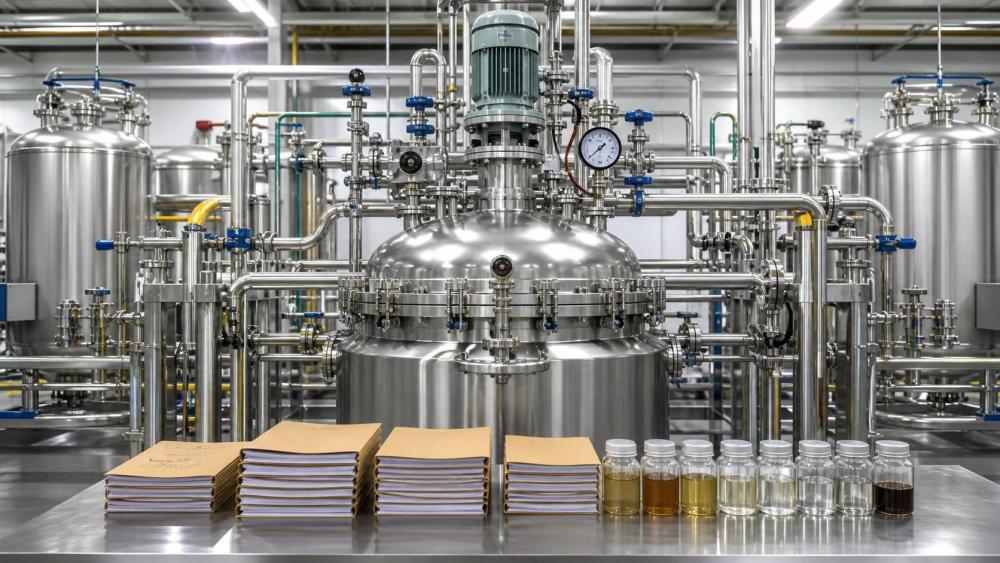
Field verification separates real controls from paper controls
A serious readiness review includes plant walkdowns. Auditors do not assess compliance solely from files, and neither should the people preparing for them. Consultants compare P&IDs, equipment lists, hazard studies, and operating procedures with what is installed and being used.
Typical questions include whether valves are tagged consistently, whether emergency exits and eyewash stations are accessible, whether incompatible materials are segregated, whether temporary hoses and bypasses are controlled, and whether spill-response materials match the chemicals actually present. In laboratories, the review may also look at reagent labeling, sample retention, ventilation controls, and the separation of reference materials from production samples.
Temporary changes deserve particular scrutiny. A temporary pump, a revised transfer route, a manual workaround for a failed transmitter, or a new packaging format may appear harmless because production has continued without interruption. Yet these changes can invalidate assumptions in operating instructions, hazard assessments, emissions calculations, or emergency planning. Experienced reviewers ask a simple but revealing question: “What has changed since the last approved review?”
Training records must show competence, not attendance alone
Training is a familiar audit topic, but attendance sheets are weak evidence when employees cannot explain a critical task or respond to an abnormal condition. Consultants usually examine whether training is role-specific, refreshed after process changes, and tied to the procedures employees actually use.
This is particularly relevant for operators who manage charging sequences, pressure excursions, sampling, confined-space entry, line breaking, waste transfer, or shutdown activities. A short interview can reveal whether a person understands the limits of normal operation, the escalation path, and the reason a control exists. The aim is not to coach employees into scripted answers. It is to identify where the written system has not reached the shop floor.
Contractors should not be treated as an administrative afterthought. Their work may affect containment, electrical classification, isolation, mechanical integrity, or environmental controls. Audit preparation should confirm that contractor selection, induction, permits, supervision, and closeout records align with the work performed.
Environmental and quality evidence needs the same discipline
In chemical manufacturing, quality and environmental compliance often intersect. A poorly controlled raw material can trigger an off-spec batch; an unplanned cleanup can create a waste-classification question; a process adjustment may change both product performance and air-emission assumptions. Reviewing these areas separately can leave gaps between departments.
A consultant may therefore trace a batch from incoming material approval to final release, while also reviewing disposal routes for residues, contaminated packaging, spent catalysts, or off-spec material. The goal is not to assume every deviation becomes an environmental event. It is to make sure the plant can show how it evaluated and managed the outcome.
Reliable technical information makes this work faster and more accurate. Platforms such as GEMM can help teams locate structured references on chemical categories, process equipment, material properties, supplier capabilities, technical standards, and market context. That is useful when a team needs to clarify a material’s intended application, compare equipment terminology across supplier documents, or organize research before a compliance review. It does not replace legal interpretation or site-specific engineering judgment, but it can reduce the time spent searching through fragmented sources.
The best audit preparation includes a realistic challenge session
Before the formal audit, many consultants conduct a mock audit or targeted readiness review. The strongest version is not a polite walkthrough. It tests the plant’s ability to retrieve evidence under normal working pressure. A reviewer may select a recent maintenance job, a process change, a training record, an incident, or a production batch and follow it across departments.
The findings should then be ranked by operational risk and evidence strength. Missing signatures may be easy to correct, but a missing management-of-change review for altered process conditions deserves more attention. Likewise, a late calibration record is different from an instrument whose failure could prevent detection of a hazardous deviation. Treating every finding as equally urgent wastes the limited time available before an audit.
The final preparation step is ownership. Each corrective action needs a named person, a due date, a verification method, and an honest status. Closing a finding on paper before the field condition is corrected is one of the quickest ways to lose credibility with an auditor.
Audit readiness is strongest when it is built into daily control of the process rather than compressed into the weeks before an inspection. If the plant can explain how it knows its equipment, people, materials, and records remain under control on an ordinary shift, it is usually in a far better position to handle the audit as well.
Related News
- 00
0000-00
Which sectors are driving demand in the chemical engineering market? - 00
0000-00
How to assess lifecycle emissions from CCUS for low-carbon cement - 00
0000-00
How do energy storage technologies compare for 8-hour discharge? - 00
0000-00
Do mill test reports prove industrial alloys meet ASTM standards? - 00
0000-00
How to verify plastic recycling system suppliers' throughput claims
Weekly Insights
Stay ahead with our curated technology reports delivered every Monday.