




How to select an offshore drilling steel grade for sour service




Selecting an offshore drilling steel grade for sour service starts with the actual failure risk, not the nominal yield strength shown on a material certificate.
Technical evaluators must confirm that steel chemistry, heat treatment, hardness, weld condition, and service exposure work together under hydrogen sulfide-containing conditions.
A suitable grade should resist sulfide stress cracking while delivering the strength, toughness, fatigue performance, and manufacturability required by the drilling component.
This decision is especially important for well-control equipment, drill string components, riser systems, subsea structures, pressure-containing housings, and high-load connectors.
Start With the Sour-Service Exposure Envelope
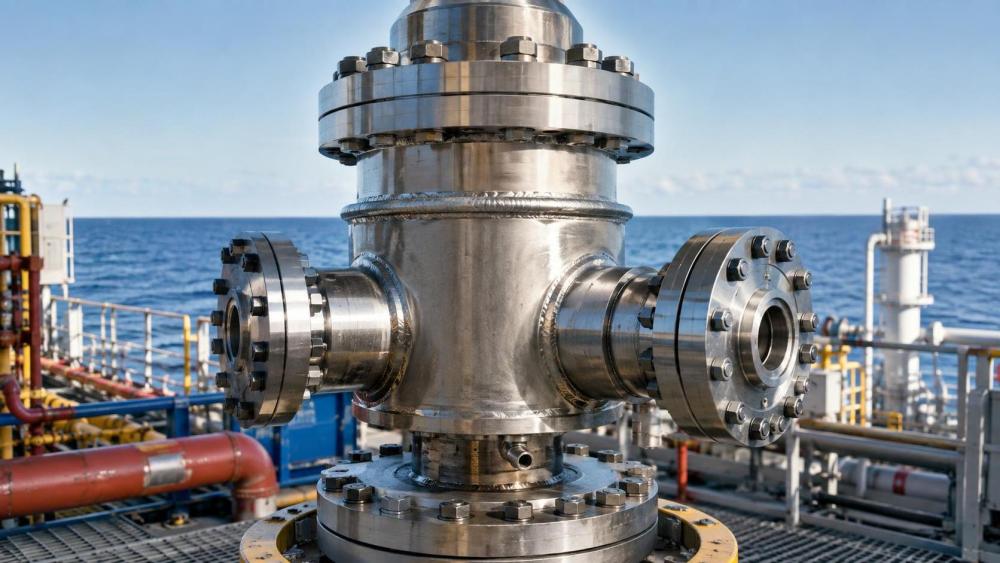
Before comparing an offshore drilling steel grade, define the full service envelope: hydrogen sulfide partial pressure, chloride level, pH, temperature, pressure, and expected exposure duration.
Sour service does not describe one uniform environment. A mildly sour mud system and a high-pressure, high-temperature production environment can impose very different material demands.
Hydrogen sulfide can enter steel as atomic hydrogen, particularly where corrosion or cathodic reactions occur. Absorbed hydrogen may reduce ductility and initiate cracking.
The main concern is sulfide stress cracking, commonly called SSC. It develops when susceptible high-strength steel experiences tensile stress in a wet H2S environment.
Other threats may include hydrogen-induced cracking, stress-oriented hydrogen-induced cracking, chloride-assisted corrosion, localized pitting, galvanic corrosion, and corrosion fatigue during cyclic offshore loading.
Request operating data from the drilling engineer, process team, fluid supplier, and corrosion specialist. Material selection cannot be reliable when the environment remains broadly described as “sour.”
Important inputs include free-water presence, oxygen contamination risk, anticipated shutdown conditions, fluid chemistry changes, chemical treatment plans, and whether crevices can retain aggressive fluids.
Temperature requires particular attention. Higher temperatures may change corrosion rates, alter hydrogen uptake behavior, reduce toughness margins, or move a material outside its qualified service range.
Use NACE and Project Standards as the Baseline
For sour-service steel selection, NACE MR0175 / ISO 15156 is usually the central reference for oil and gas production environments containing hydrogen sulfide.
Its requirements help evaluators determine whether a material is acceptable under specific environmental limits, material conditions, hardness ranges, and manufacturing controls.
For drilling equipment, project specifications may also reference NACE MR0103 / ISO 17945, API requirements, ASTM standards, DNV rules, or client-specific offshore qualification procedures.
Do not assume that a steel grade is sour-service compliant simply because a supplier labels it “NACE material.” Compliance is conditional, not a universal grade property.
A material may be suitable only within a defined hardness maximum, heat-treatment condition, H2S partial-pressure range, temperature limit, or production route.
Ask suppliers to identify the exact standard edition, clause, material group, environmental restriction, and qualification basis supporting their sour-service claim.
Where project conditions exceed published limits, laboratory testing may be required. Common methods include NACE TM0177 testing for sulfide stress cracking resistance.
Test results should represent the proposed product condition. A generic coupon test does not automatically qualify a forged connector, welded housing, threaded part, or cold-worked component.
Balance Strength Against Hardness and Cracking Resistance
Higher strength can reduce section size and improve load capacity, but it often increases susceptibility to hydrogen-assisted cracking in sour environments.
For this reason, the best offshore drilling steel grade is rarely the strongest available option. It is the lowest-risk grade that meets structural requirements.
Hardness is one of the most practical screening controls. Excessively hard microstructures can be more vulnerable to SSC, particularly under residual or applied tensile stress.
Many sour-service specifications set maximum hardness limits for base metal, weld metal, heat-affected zones, repaired areas, and machined surfaces.
Technical evaluators should review both the specified hardness range and the supplier’s demonstrated process capability. A single laboratory result is weaker than consistent production records.
Quenched and tempered low-alloy steels are frequently used where high strength and toughness are needed. Their suitability depends on controlled chemistry and properly qualified heat treatment.
Materials such as 4130, 4140, 4145, 4330V, 8630, and modified low-alloy grades may appear in drilling applications, but each requires condition-specific evaluation.
For more severe corrosion exposure, corrosion-resistant alloys may offer improved resistance. However, CRA selection introduces separate concerns involving cost, galling, welding, and galvanic compatibility.
Check Steel Chemistry, Cleanliness, and Heat Treatment
Steel composition affects hardenability, strength, weldability, inclusion control, and resistance to environmentally assisted cracking. Grade designation alone does not reveal all relevant production details.
Carbon equivalent is particularly useful when evaluating weldability. Higher carbon equivalent can increase hardenability and create brittle heat-affected zones without suitable welding controls.
Low sulfur and phosphorus levels are desirable because nonmetallic inclusions and segregation can contribute to hydrogen-related damage and reduced through-thickness properties.
For critical forged components, ask about vacuum degassing, inclusion rating, grain size, reduction ratio, ultrasonic inspection coverage, and heat-treatment furnace controls.
Heat treatment must deliver stable mechanical properties through the full section thickness. Large offshore forgings can show significant differences between surface and core properties.
Review the actual tempering temperature, quench method, cooling rate, and hardness mapping requirements. These details matter more than a simplified statement such as “quenched and tempered.”
Material traceability should link each component to heat number, chemical analysis, mechanical test results, non-destructive examination records, and final heat-treatment documentation.
Evaluate Welded, Machined, and Repaired Conditions Separately
A steel grade that performs well in parent material may fail near welds. Welding can introduce residual stress, local hardness increases, microstructural changes, and fabrication defects.
For welded offshore drilling equipment, evaluate the complete welding procedure specification, preheat requirements, interpass temperature, consumable selection, and post-weld heat treatment.
Hardness surveys should cover weld metal, fusion line, and heat-affected zone. The highest-risk location is often a narrow hard region beside the weld.
Hydrogen control during fabrication is equally important. Low-hydrogen consumables, dry storage, surface cleaning, controlled deposition, and correct preheat practices reduce cracking risk.
Machining may expose different material zones, create stress concentrators, or leave surface damage. Thread roots, seal grooves, transitions, and sharp radii deserve focused inspection.
Cold work can also alter sour-service performance. If forming, straightening, burnishing, aggressive grinding, or thread rolling is involved, assess residual stress and hardness effects.
Repair welding requires formal approval because it may invalidate the original material qualification. The repair area needs controlled procedures and documented inspection acceptance criteria.
Compare Candidate Grades Using Component-Specific Criteria
Build a comparison matrix rather than choosing by supplier recommendation alone. The matrix should connect each candidate offshore drilling steel grade to the actual component function.
Include required yield strength, tensile strength, fracture toughness, Charpy impact energy, fatigue performance, corrosion allowance, maximum hardness, and sour-service qualification limits.
Also compare section size capability, forging availability, lead time, machining behavior, welding complexity, inspection requirements, and total lifecycle cost.
For pressure-containing equipment, confirm compatibility with design codes and pressure-test requirements. For load-bearing tools, evaluate stress concentration, fatigue loading, and accidental overload cases.
For subsea applications, consider external pressure, seawater exposure, cathodic protection interaction, marine growth, and access limitations for inspection or replacement.
A lower-cost carbon or low-alloy steel may be appropriate when coating, corrosion inhibition, environmental controls, and inspection access provide adequate risk management.
A higher-alloy material may be justified when failure consequences are severe, intervention is costly, service chemistry is uncertain, or the component has limited corrosion allowance.
Verify Supplier Evidence Before Releasing the Purchase Order
The procurement stage should convert the material decision into measurable acceptance requirements. Vague descriptions such as “sour-service grade steel” leave too much room for interpretation.
Purchase specifications should state the accepted material grade, product form, heat-treatment condition, mechanical property limits, hardness limits, testing standards, and documentation requirements.
Require material test certificates that show actual chemical composition, tensile properties, impact results, hardness data, heat-treatment information, and traceable heat identification.
For high-criticality parts, specify independent witness testing, third-party inspection, ultrasonic examination, magnetic-particle testing, dimensional inspection, and positive material identification where appropriate.
Review deviations carefully. A substitute grade may have similar strength but different sulfur limits, temper response, weldability, or qualification status in wet H2S service.
Supplier capability should include proven experience with comparable section sizes and sour-service documentation. A mill or forge shop’s process discipline is part of material performance.
Make the Final Selection Based on Demonstrated Risk Control
The final choice should be supported by a documented engineering rationale, not simply a familiar grade name or the highest minimum strength value.
For most projects, the selection process should demonstrate that the material meets structural demand while remaining within verified sour-service environmental and hardness limits.
When uncertainty remains, reduce it through better environmental definition, targeted testing, stricter fabrication controls, or a more conservative material and corrosion-management strategy.
An offshore drilling steel grade for sour service is suitable only when its metallurgy, processing, component geometry, joining method, and operating environment are evaluated together.
Technical evaluators who use standards, actual service data, supplier evidence, and component-specific risk analysis can reduce sulfide stress cracking exposure before equipment reaches the offshore field.
Related News
- 00
0000-00
Which sectors are driving demand in the chemical engineering market? - 00
0000-00
How to assess lifecycle emissions from CCUS for low-carbon cement - 00
0000-00
How do energy storage technologies compare for 8-hour discharge? - 00
0000-00
Do mill test reports prove industrial alloys meet ASTM standards? - 00
0000-00
How to verify plastic recycling system suppliers' throughput claims
Weekly Insights
Stay ahead with our curated technology reports delivered every Monday.