




What should chemical process compliance monitoring verify in a plant?




When a plant is busy, compliance can appear to be a paperwork exercise: operators complete log sheets, instruments display acceptable values, and batch records move toward release. Yet the most serious gaps often sit between those records. A blocked vent may not be visible in a routine report. A substitute raw material may meet a purchasing description but not the approved process specification. An emission-control unit may be running while its monitoring data are incomplete or poorly calibrated.
That is why chemical process compliance monitoring must verify more than whether forms have been signed. For quality-control and safety teams, its purpose is to establish that the plant is operating within approved limits, that evidence is trustworthy, and that deviations are recognized before they become product, environmental, or personnel incidents.
The exact requirements depend on the chemical, jurisdiction, permit conditions, and site management system. Still, a practical monitoring program should test a consistent set of controls across the process—from incoming materials to final release, waste handling, and corrective action.
Verify the process against its approved operating window
Every controlled chemical process should have defined operating limits. These may include temperature, pressure, flow, pH, agitation speed, residence time, moisture level, reaction endpoint, concentration, and allowable charging sequence. Compliance monitoring needs to confirm not only that these parameters exist in a procedure, but that actual plant conditions remain within the approved window.
A value inside a broad equipment capability range is not automatically compliant. A reactor may safely operate at a certain pressure while the validated or qualified production process allows a narrower limit. The same distinction matters for heating profiles, catalyst addition rates, inerting requirements, and hold times. Quality personnel should compare real-time and historical data with the limits stated in batch instructions, process hazard analyses, control narratives, and applicable operating procedures.
Attention should also be given to alarms and interlocks. Are alarm setpoints aligned with the current risk assessment? Are alarm acknowledgements investigated, or merely cleared? Are safety instrumented functions tested according to schedule? An alarm history with repeated near-limit events can reveal a fragile process even when no formal deviation has yet been opened.
Confirm that materials remain identifiable, suitable, and controlled
Many compliance failures begin before a reaction starts. Monitoring should verify the identity, status, storage condition, and traceability of raw materials, intermediates, solvents, catalysts, additives, and packaging components. This includes checking that containers are correctly labeled; expiry or retest dates are current; quarantine and released materials are physically segregated; and sampling plans match the risk associated with the material.
For plants handling corrosive, toxic, flammable, or moisture-sensitive substances, storage conditions are part of compliance rather than a warehouse detail. Temperature excursions, incompatible-material proximity, damaged grounding connections, missing secondary containment, or inadequate ventilation can affect both safety and product quality.
Supplier changes require particular care. A new source, grade, impurity profile, country of origin, or transport arrangement may trigger technical review under internal change-control rules. The material should not be treated as equivalent simply because its name is familiar. Certificates of analysis need to be assessed against the approved specification, and critical incoming-test results should be traceable to the lot used in production.
Check equipment integrity and the reliability of measurement
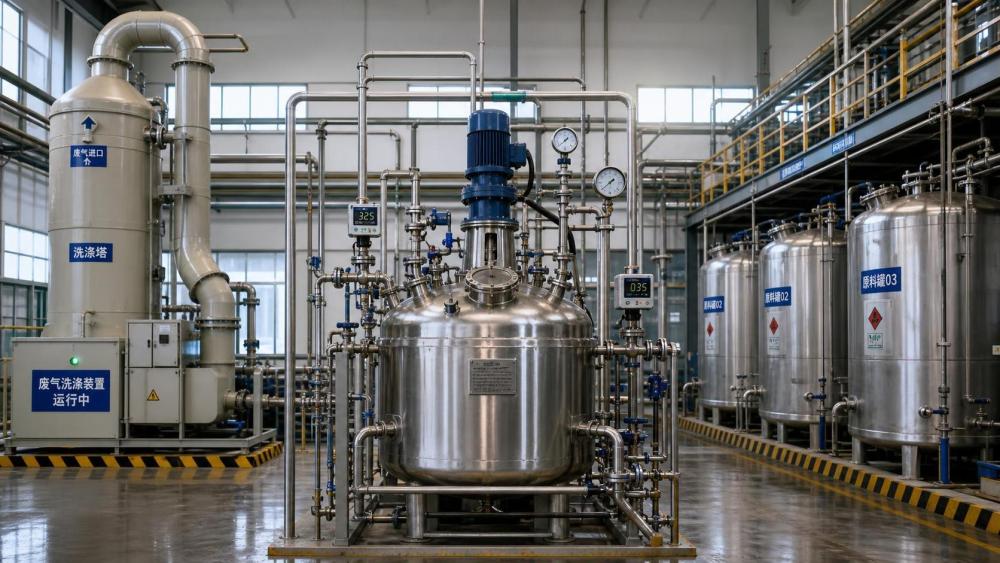
A compliant process cannot be demonstrated with unreliable equipment or unreliable data. Chemical process compliance monitoring should therefore examine the condition and suitability of process vessels, transfer lines, pumps, seals, filters, relief devices, scrubbers, dust collectors, heat exchangers, and containment systems.
Inspections should look beyond visible damage. Teams need evidence that preventive maintenance is being performed, that pressure-relief devices are inspected and certified where required, that corrosion findings are evaluated, and that temporary repairs are controlled rather than allowed to become permanent workarounds. Equipment identification must match drawings, maintenance records, and the approved process configuration.
Measurement systems deserve the same scrutiny. Calibration status for critical sensors, laboratory instruments, weighing systems, gas detectors, and flow meters should be current and traceable. Where an instrument is found out of tolerance, the review should ask a difficult but necessary question: what decisions, batches, releases, or emissions calculations relied on that measurement since its last acceptable calibration?
Monitor emissions, waste, and exposure controls as operating systems
Environmental compliance is not limited to taking a stack sample or filing a discharge report. Plants should verify that emission points, wastewater streams, hazardous-waste containers, and control devices are operating under permit conditions and site procedures. Relevant checks may include emission-monitoring records, scrubber pH or pressure drop, thermal oxidizer operating data, leak detection and repair logs, wastewater pH and contaminant testing, waste characterization, manifests, and storage-time limits.
For safety managers, occupational exposure controls are equally important. Local exhaust ventilation, closed transfer systems, respiratory protection programs, area gas monitoring, eyewash and shower accessibility, and chemical segregation need regular verification. A compliant exposure-control program connects industrial hygiene findings to day-to-day operating reality. If workers routinely open a system intended to remain closed, the procedure may be technically correct but operationally weak.
Make documentation prove what happened—not what should have happened
Documentation is often where an audit becomes uncomfortable. A complete batch record, inspection form, or environmental log has value only when it accurately reflects the work performed. Reviewers should check entries for contemporaneous recording, legibility, authorized signatures, appropriate corrections, and consistent timestamps. Electronic systems should maintain access control, audit trails, data backup, and review practices appropriate to the risk of the records.
Particular attention is needed where data are transferred manually: from field gauges to logs, from laboratory notebooks to certificates, or from operator observations to digital maintenance systems. Transcription errors, copied values, unexplained blanks, and late entries can mask a genuine process issue. Data integrity is not merely an IT concern; it is a core quality and compliance control.
Current versions of procedures, safety data sheets, permits, process flow diagrams, and emergency instructions should also be available where they are used. An outdated operating procedure after an equipment modification is a common warning sign that change management has not kept pace with the plant.
Test the response to deviations and changes
No complex facility operates without deviations. Compliance monitoring should verify how the plant responds when something falls outside expectation: an off-spec result, power interruption, temperature excursion, spill, emission exceedance, utility failure, or near miss. The essential question is not whether an event occurred, but whether it was detected, contained, assessed, documented, investigated, and closed with effective action.
A robust deviation record identifies the immediate correction and the underlying cause. It defines whether affected material was placed on hold, whether regulatory notification was needed, and whether similar equipment, batches, or operating shifts require review. Corrective and preventive actions should have owners, due dates, effectiveness checks, and clear evidence of completion.
Change control deserves a separate check. Changes to formulation, software, equipment, cleaning chemicals, process sequence, suppliers, analytical methods, or control limits can alter risk in subtle ways. Before implementation, the site should assess quality, safety, environmental, and regulatory consequences; update controlled documents; provide training; and confirm that the change performs as intended.
A useful monitoring rhythm for plant teams
The strongest programs combine frequent frontline checks with deeper periodic review. Operators may verify critical parameters and housekeeping each shift. Supervisors can review records, alarms, and permit-sensitive controls weekly. Quality, engineering, EHS, and maintenance teams should periodically examine trends, overdue actions, calibration status, recurring deviations, and changes that cross departmental boundaries.
Rather than treating every item as equally urgent, risk should guide the depth of review. A minor labeling inconsistency and a recurring loss of nitrogen blanketing do not carry the same consequences. Risk-based prioritization helps teams focus attention where loss of containment, uncontrolled reaction, product contamination, or reportable environmental impact is most plausible.
For organizations comparing technical requirements across chemical sectors, structured resources such as process descriptions, material specifications, supplier references, standards summaries, and market intelligence can help frame the questions that a monitoring plan must answer. The final benchmark, however, remains the plant’s own approved process, legal obligations, and demonstrated ability to operate safely and consistently.
The practical test of compliance monitoring
Effective chemical process compliance monitoring should leave a plant able to answer, with evidence: Were the right materials used? Did the process remain within approved limits? Were people, equipment, and the environment protected? Is the data complete and credible? And when conditions changed, did the organization respond before a small warning became a larger failure?
If those answers cannot be shown clearly, more records alone will not solve the problem. The monitoring system needs stronger observation, better escalation, and a closer connection between what happens on the plant floor and what the compliance file says happened.
Related News
- 00
0000-00
Which sectors are driving demand in the chemical engineering market? - 00
0000-00
How to assess lifecycle emissions from CCUS for low-carbon cement - 00
0000-00
How do energy storage technologies compare for 8-hour discharge? - 00
0000-00
Do mill test reports prove industrial alloys meet ASTM standards? - 00
0000-00
How to verify plastic recycling system suppliers' throughput claims
Weekly Insights
Stay ahead with our curated technology reports delivered every Monday.