




How Energy Efficient Refinery Technology Cuts Fuel Use and Payback Risk




For business decision-makers facing rising energy costs and tighter margin pressure, energy efficient refinery technology offers a practical path to lower fuel consumption, reduce operating risk, and improve return on investment. From heat recovery and process optimization to smarter control systems, understanding where efficiency gains come from helps companies make more confident capital decisions and evaluate long-term refinery competitiveness.
In refinery investment discussions, “energy efficiency” is often treated as a technical upgrade issue. In practice, it is a margin protection issue. Fuel burned inside the refinery is not just a utility cost; it affects product yield economics, emissions exposure, maintenance intensity, and the ability to stay competitive when crude slates, product demand, and energy prices shift.
That is why procurement and capital allocation decisions around refinery efficiency are rarely about buying a single piece of equipment. They are about deciding which technologies can deliver measurable fuel savings without creating unacceptable shutdown risk, integration complexity, or a payback period that depends on overly optimistic assumptions.
Why refinery fuel use has become a board-level cost issue
For many operators, the old logic was straightforward: as long as throughput remained high and product cracks supported margins, incremental energy losses could be tolerated. That assumption is weaker today. Gas and power costs are more volatile, carbon-related compliance pressure is increasing in many markets, and customers in downstream value chains are paying closer attention to embedded emissions.
In this environment, inefficient refining assets face a double penalty. They consume more fuel per barrel processed, and they are less resilient when market conditions tighten. A refinery that runs with poor heat integration, aging fired heaters, unstable control loops, or oversized utility systems may still operate reliably, but it will usually need stronger market conditions to justify that cost structure.
For decision-makers, the question is no longer whether efficiency matters. The more useful question is where efficiency improvements are most bankable.
Where the real savings usually come from
The strongest efficiency gains in refining typically do not come from a single “breakthrough” technology. They come from layered improvements across thermal recovery, process control, combustion, and utilities.
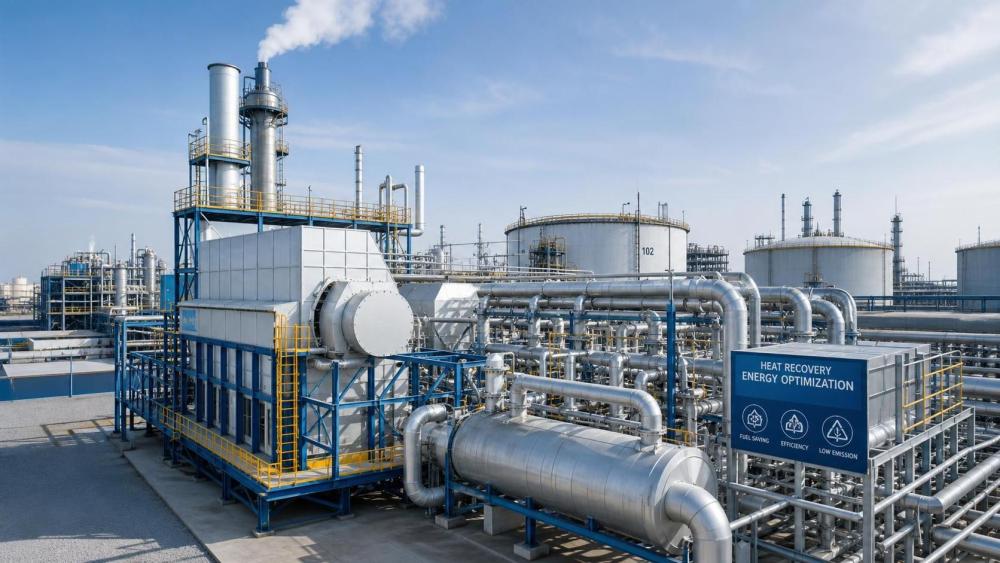
Heat integration is usually the first place serious buyers look. Refineries reject large amounts of recoverable heat through stacks, product cooling, and process imbalances. Upgrading heat exchanger networks, improving preheat trains, and reducing unnecessary temperature gaps can materially lower fired duty. These projects are often less visible than major unit revamps, but they can offer some of the most durable savings because they reduce base energy demand rather than simply optimizing operations around waste.
Fired heater and boiler efficiency is another high-value area. Burners, excess oxygen control, air preheating, improved refractory condition, stack heat recovery, and tighter combustion management can reduce fuel use without changing core process chemistry. These projects tend to be attractive when existing assets are reliable but inefficient. They are less attractive when heater metallurgy, fouling, or turnaround timing creates a larger execution burden than expected.
Advanced process control and digital optimization often generate faster payback than heavy mechanical upgrades, especially in mature facilities. Better control logic can stabilize unit operation, reduce overfiring, improve steam balance, and lower energy use associated with off-spec operation. But buyers should be careful: software-led savings are real only when instrumentation quality, operator discipline, and process data integrity are already strong enough to support them.
Utility systems also deserve closer scrutiny than they often receive. Steam networks, condensate recovery, pumps, compressors, flare gas recovery, and variable-speed drives can all affect total site energy intensity. In some cases, the utility system is where fuel waste is hidden, particularly in sites that expanded over time and accumulated design mismatches across units.
Not every “efficient” technology has the same payback risk
From a procurement perspective, the central mistake is to compare technologies only by expected energy savings. Payback risk depends just as much on implementation conditions as on nameplate efficiency.
A heat recovery project with moderate projected savings may be financially safer than a higher-return unit retrofit if it can be installed with limited shutdown impact, uses proven components, and does not rely on aggressive fouling assumptions. By contrast, a project with an impressive vendor model may underperform if refinery operations are too variable, maintenance capabilities are stretched, or integration with existing control architecture is weak.
Decision-makers should test at least five variables before approving a project:
- Baseline quality: Is current energy performance well measured, or is the saving estimate built on broad averages?
- Integration complexity: Will the new system affect unit reliability, throughput, or turnaround schedules?
- Operational dependence: Are savings automatic, or do they depend on sustained operator behavior?
- Maintenance burden: Will efficiency gains erode quickly if cleaning, calibration, or controls support are inconsistent?
- Economic sensitivity: Does the payback still work if fuel prices soften or if throughput drops?
These questions matter because refinery projects often fail financially in predictable ways. The technology itself may be sound, but the business case is overstated, the implementation window is unrealistic, or the savings are not durable under real operating conditions.
How buyers should think about ROI beyond simple payback
Simple payback remains useful, but it is not enough for refinery efficiency decisions. A two-year payback can still be unattractive if it introduces reliability risk into a constrained production system. A four-year payback may be entirely acceptable if it strengthens energy resilience, reduces exposure to emissions costs, and extends asset competitiveness.
That is why experienced buyers increasingly look at lifecycle economics rather than isolated savings claims. A credible investment case should include at least:
- fuel cost reduction under multiple price scenarios;
- shutdown and installation cost;
- maintenance and performance degradation over time;
- impact on throughput, yield, and product quality;
- potential emissions or compliance value where relevant;
- availability of internal operational capability to sustain benefits.
In some markets, carbon pricing, energy efficiency mandates, or financing preferences for lower-emission industrial assets can improve project economics, but specific policy treatment varies by jurisdiction and should be checked case by case. Any compliance-related value assumption should be marked internally as jurisdiction-specific unless verified.
Common procurement mistakes in refinery efficiency projects
One recurring mistake is buying at the equipment level when the value sits at the system level. For example, an efficient pump or compressor may not deliver meaningful site-level savings if piping design, control logic, or process demand remains unchanged. Similarly, a high-performance burner package will not solve structural heat integration losses upstream.
Another mistake is overvaluing best-case simulations. Vendor models are useful, but refineries operate with fouling, feedstock variability, maintenance delays, and human workarounds. Buyers should ask what performance looks like six months after commissioning, not only at acceptance testing.
There is also a tendency to underestimate data requirements. If an efficiency project cannot be monitored clearly, commercial accountability weakens after installation. Measurement and verification planning should be part of procurement from the beginning, especially when internal stakeholders need to defend capital spending outcomes.
What a stronger sourcing process looks like
For business decision-makers, better sourcing starts with narrowing the problem definition. Are you trying to reduce fired fuel per barrel, lower steam imbalance, improve utility efficiency, or defer larger capital spending by optimizing existing assets? Each objective points to a different technology path and vendor profile.
Once that is clear, supplier evaluation should extend beyond product specification. The stronger questions are practical ones: Has the supplier delivered in similar refinery configurations? Can it support integration with legacy systems? What assumptions sit behind the projected savings? What outages are required? Who carries performance risk if actual site conditions differ from design conditions?
For cross-border procurement, after-sales capability matters more than many buyers initially assume. A technically suitable system can become a poor investment if commissioning support, spare parts access, controls troubleshooting, or compliance documentation are weak. This is particularly important for refineries operating in regions where turnaround windows are tight and specialist support is limited.
What to watch over the next few years
The next phase of refinery efficiency investment is likely to be less about isolated upgrades and more about coordinated site optimization. Energy costs, emissions pressure, and capital discipline are pushing operators toward projects that combine hardware improvements with digital control, better monitoring, and more selective revamps of legacy systems.
That does not mean every refinery should pursue large transformation projects. In many cases, the best returns will still come from targeted improvements with manageable execution risk. But the market is moving toward tougher scrutiny of asset efficiency, especially for plants competing in export-driven or cost-sensitive product markets.
For decision-makers, the practical takeaway is clear: energy efficient refinery technology should not be evaluated as a general sustainability label. It should be assessed as a capital efficiency and operating resilience tool. The best projects are not simply the ones with the largest promised fuel savings. They are the ones that reduce energy intensity in a way the site can realistically install, operate, verify, and sustain.
That is where fuel savings become financially meaningful—and where payback risk becomes manageable rather than theoretical.
Related News
- 00
0000-00
Virgin vs Recycled Resin: How to Switch Without Disrupting Production? - 00
0000-00
Why Bio-Based Plastics Still Have to Prove Themselves on the Molding Floor - 00
0000-00
Industrial decarbonization targets slip when baselines are weak - 00
0000-00
When does carbon management consulting pay off for manufacturers? - 00
0000-00
How pipeline integrity data analysis identifies corrosion before failure
Related tags
Weekly Insights
Stay ahead with our curated technology reports delivered every Monday.