




How to Evaluate Low Carbon Sustainable Material Solutions for Cost and Performance




How to Evaluate Low Carbon Sustainable Material Solutions for Cost and Performance
Evaluating low carbon sustainable material solutions sounds straightforward until the shortlist starts to form. A material may look strong on carbon claims but fail on processing stability. Another may meet performance targets yet introduce supply risk, certification gaps, or a cost profile that only works on paper. In real projects, technical assessment is rarely about finding the “greenest” option. It is about finding the option that fits the application without creating hidden downstream problems.
That is especially true across industries where the decision context changes fast: polymers behave differently from metals, recycled feedstocks raise different questions than bio-based inputs, and a material suitable for packaging may be a poor choice for pressure systems, electrical housings, or chemical-contact parts. A practical evaluation framework has to combine carbon impact, mechanical fit, standards, processing behavior, supplier capability, and commercial resilience.
Start with the application, not the sustainability claim
One of the most common mistakes is to begin with environmental marketing language instead of service conditions. Technical assessors usually get better results by defining the real operating envelope first: temperature range, load, chemical exposure, expected life, maintenance access, dimensional tolerances, flame or electrical requirements, and whether the part is structural, cosmetic, or sacrificial.
A low carbon steel, recycled polymer compound, bio-based resin, or alternative filler system cannot be judged in isolation. If the material causes thicker wall sections, extra coatings, tighter processing windows, or shorter replacement intervals, the carbon and cost picture changes immediately. In other words, material substitution should be assessed at component or system level, not just by comparing two datasheets side by side.
This is where structured industry intelligence becomes useful. Platforms such as GEMM help organize fragmented technical knowledge across metals, chemicals, plastics, energy systems, and industrial equipment, which matters when a decision involves both material properties and broader supply or application context. For technical teams, that kind of cross-category visibility is often more useful than a simple supplier catalog.
Treat carbon data as one input, not the decision itself
Carbon footprint data matters, but it needs interpretation. Ask what boundary the claim uses. Is it cradle-to-gate, gate-to-gate, or does it include transport, use, and end-of-life assumptions? Two materials may appear comparable until you realize one value includes recycled content allocation and the other does not. The numbers are not automatically wrong; they may just be built on different accounting rules.
For many industrial buyers, the more reliable path is to compare materials only when the functional unit is clear. For example, compare by required service life, per qualified component, or per installed system, not merely per kilogram. This matters a lot in alloys, engineered plastics, insulation materials, and composite systems where lower-density or higher-strength options can shift total material use significantly.
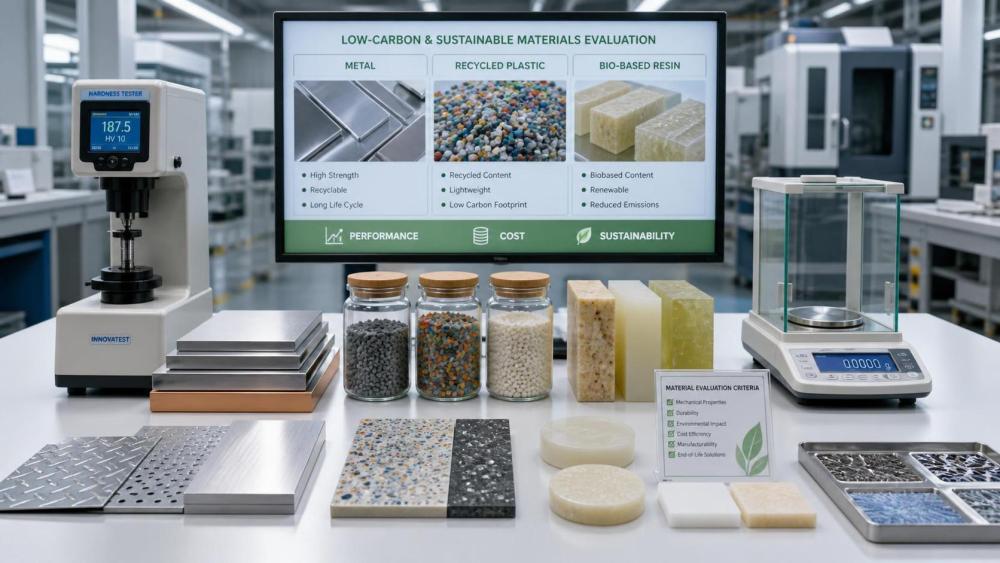
If verified lifecycle data is available, use it. If not, keep the conclusion cautious. A material marketed as low carbon may still depend on energy-intensive conversion, long logistics routes, or unstable recycled feedstock quality. Those variables often sit outside the headline claim but show up later in procurement and production.
Performance screening should go beyond nominal properties
Nominal tensile strength or melt flow index is not enough for a serious evaluation. Assessors usually need to look at property retention under actual use conditions: creep, fatigue, environmental stress cracking, corrosion behavior, thermal aging, UV stability, impact at low temperature, or dimensional stability after molding or machining. In many substitutions, the issue is not initial performance but variability over time.
Recycled and alternative-feedstock materials deserve extra attention here. A recycled polymer may be acceptable for non-critical housings but unsuitable for tight-tolerance parts if lot-to-lot consistency is weak. A lower-emission metal route may still meet specification, but weldability, surface finish, or downstream heat treatment response should be checked rather than assumed. Performance failures rarely arrive as dramatic lab disasters; more often they appear as elevated scrap rates, assembly drift, or shortened maintenance cycles.
Compliance and specification fit can narrow the field quickly
In regulated or specification-heavy sectors, technical suitability is only half the job. The candidate material also needs documentation that fits the target market and application. That may involve chemical restrictions, recycled content declarations, food-contact or medical rules, pressure-equipment requirements, electrical standards, fire performance, or customer-specific approval systems. The exact requirement depends on the industry and destination market, so it usually needs project-level confirmation.
Experienced teams often use compliance as an early filter. There is no point optimizing carbon and cost if the grade cannot support the relevant certificates, traceability expectations, or audit trail. GEMM’s value in this stage is not that it replaces formal qualification, but that it helps teams compare standards, product categories, supplier references, and application guidance before they spend time on a dead-end option.
The cheapest quote is rarely the lowest-cost decision
Cost evaluation needs to include more than unit price. In practice, low carbon sustainable material solutions should be reviewed through total landed and operating cost:
This is often where a seemingly attractive option loses ground. A resin with lower embedded carbon may require slower molding and tighter moisture control. A sustainable alloy may carry a premium that is acceptable only if weight reduction or durability offsets it. A recycled-content grade may be commercially viable in stable regions but risky where import timing, customs changes, or feedstock shortages affect supply continuity.
Supply chain quality is part of performance
Technical assessors sometimes separate material performance from supply conditions, but on real projects they are linked. If a supplier cannot maintain formulation consistency, publish usable technical documentation, or support traceability during claims review, the material is not truly low-risk no matter how good the initial sample looked.
This is particularly relevant in recycled plastics, specialty chemicals, battery-related materials, and certain metals where regional production routes can differ sharply. Looking at supplier references, export updates, category structure, and price movement trends can reveal whether a material is commercially maturing or still dependent on a narrow producer base. That broader visibility is one reason technical teams increasingly rely on industry intelligence platforms rather than vendor statements alone.
A workable evaluation flow
In most cases, a sensible process looks like this: define the service and compliance requirements, create a short technical list, compare lifecycle claims on a like-for-like basis, estimate full cost impact, then test the most credible options under realistic conditions. Not every candidate needs the same depth of validation. High-criticality applications deserve deeper qualification; non-critical substitutions can move faster if the documentation and processing history are solid.
The main point is simple: low carbon sustainable material solutions should earn their place through fit, not rhetoric. If the option meets performance needs, can be sourced with reasonable stability, aligns with applicable standards, and does not hide costs elsewhere in the system, then it is worth serious consideration. If any one of those pieces is weak, the material may still be promising, but it is not ready for an uncomplicated decision.
Related News
- 00
0000-00
Virgin vs Recycled Resin: How to Switch Without Disrupting Production? - 00
0000-00
Why Bio-Based Plastics Still Have to Prove Themselves on the Molding Floor - 00
0000-00
Industrial decarbonization targets slip when baselines are weak - 00
0000-00
How carbon capture regulations affect project permitting timelines - 00
0000-00
When does carbon management consulting pay off for manufacturers?
Weekly Insights
Stay ahead with our curated technology reports delivered every Monday.