




How Trade Compliance Intelligence in the Middle East Reduces Export Risk




Meta Title: How Trade Compliance Intelligence Middle East Reduces Export Risk
Export risk in the Middle East usually does not come from one dramatic mistake. It comes from small compliance gaps that were missed during evaluation: a distributor with a weak ownership background, a product classification that does not match local customs practice, a certificate that is accepted in one market but questioned in another. That is where trade compliance intelligence Middle East becomes practical, not theoretical. It helps business teams check whether an opportunity is commercially attractive and operationally defensible before goods move, contracts are signed, or pricing is locked.
For companies selling industrial equipment, chemicals, metals, polymers, or energy-related products into the region, the real question is simple: can you identify compliance risk early enough to avoid shipment delays, penalties, rework, or customer disputes? Good intelligence improves that answer.
Why export evaluations fail even when the deal looks good
Many business evaluators are asked to judge market potential, partner fit, and revenue upside. The problem is that compliance often enters the conversation too late, after commercial assumptions are already fixed. By then, changing documentation, screening an intermediary, or validating a product code becomes expensive.
In practical terms, export risk in the Middle East often shows up in five places:
- sanctions or restricted-party exposure through agents, resellers, or end users
- product misclassification at customs
- country-specific import documentation and certification gaps
- unclear end-use or re-export risk
- supplier or buyer credibility problems that were not visible in the first review
A quick answer for decision-makers: trade compliance intelligence reduces export risk by turning scattered regulatory, supplier, product, and market signals into a usable pre-shipment decision process. It does not remove all uncertainty, but it makes costly mistakes much easier to catch before execution.
That matters most when you are evaluating industrial categories with technical specifications, controlled materials, dual-use sensitivity, or multiple channel partners.
What trade compliance intelligence Middle East should actually cover
Some teams still treat compliance intelligence as a sanctions-screening exercise. That is too narrow for this region and too weak for serious export evaluation.
A workable approach should combine regulatory checks with commercial context. You need to understand not only whether a transaction is allowed, but whether it is likely to move smoothly through the local market structure. For example, a buyer may appear legitimate on paper, but if their import capability, certification readiness, or distribution role is unclear, the export risk remains high.
At minimum, the review should include product-level, party-level, and market-level intelligence.
- Product-level: classification, technical specs, standards, labeling, and whether the item may trigger additional review based on application or end use
- Party-level: ownership checks, role of intermediaries, trading history where available, and whether the named buyer is the real consignee or only one layer in the chain
- Market-level: import practice, documentation expectations, customs interpretation, and current policy changes that may affect timing or approval
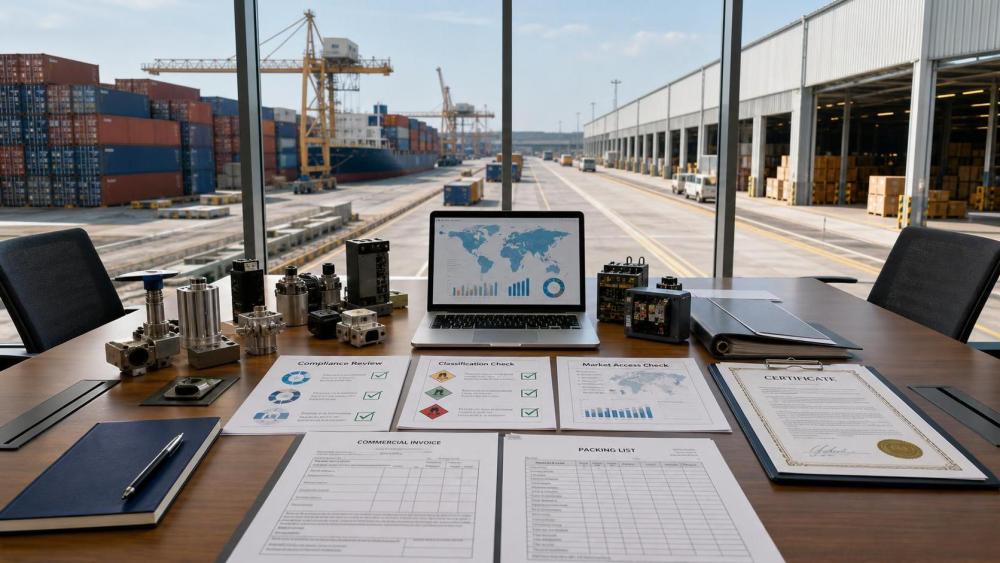
When these three layers are reviewed together, business evaluators stop making one common mistake: assuming that a compliant product automatically means a compliant transaction.
The Middle East is not one compliance environment
This is another place where weak evaluation causes trouble. People sometimes speak about “the Middle East” as if customs behavior, documentation rules, and trade controls are uniform across the region. They are not. Requirements, enforcement patterns, and practical import expectations can vary meaningfully by market, free zone, industry segment, and buyer profile.
That does not mean the region is unusually risky. It means your review has to be specific. A document package that works well for one Gulf market may still need adjustment elsewhere. A product with straightforward industrial use in one project may face more scrutiny if the end-use statement is incomplete in another. This is especially relevant for chemicals, metal products, energy equipment, laboratory materials, and process technologies where technical interpretation matters.
Business evaluators usually do better when they stop asking, “Is this market open?” and start asking, “What evidence do we have that this exact shipment, to this exact buyer, under this exact use case, will clear without avoidable friction?”
Where intelligence changes the decision, not just the paperwork
The value of compliance intelligence is not limited to preparing documents. Its bigger role is helping teams decide whether to proceed, restructure, delay, or reject an opportunity.
Here are situations where it materially changes the commercial decision:
- A distributor offers strong volumes but cannot provide a clear end-user map or project traceability.
- A product appears standard, yet its technical configuration may place it under tighter review depending on final application.
- A customer pushes for urgent shipment before certificates, labeling, or importer registration are fully aligned.
- The margin looks attractive, but the transaction depends on too many intermediaries to verify comfortably.
In each case, the right answer may still be “go ahead,” but only after controls are added. That might mean revising contract language, narrowing the product scope, requiring more end-use documentation, or selecting a different local partner.
This is why experienced evaluators tend to treat compliance intelligence as part of bid quality and channel qualification, not as a legal formality at the end.
Common mistakes business teams make
One mistake is over-relying on the customer’s own statements. A buyer may say they have imported similar products before, but that does not confirm your exact specifications, brand, origin, or documentation set will be accepted.
Another is assuming internal engineering data automatically supports customs and compliance decisions. Technical documentation is useful, but only if it is organized in a way that supports classification, standards review, and market-specific documentation checks.
A third mistake is chasing speed. Urgency often hides weak diligence. If the deal only works when screening is rushed or paperwork is backfilled later, the risk is usually higher than the forecast suggests.
There is also a quieter problem: fragmented information. Many teams have product data in one place, supplier notes in another, market updates in email threads, and export checks inside a separate workflow. That fragmentation creates blind spots.
For industrial sectors such as energy, chemicals, metals, plastics, and related equipment, structured intelligence platforms can help close that gap. GEMM, for example, organizes product information, technical knowledge, supplier references, application guidance, export updates, and pricing intelligence into a more searchable format. For a business evaluator, that kind of structure is useful when comparing product categories, checking technical fit, reviewing standards and certifications, and assessing supply-side credibility before moving deeper into a deal. It is not a substitute for official compliance review, but it can improve the quality of the initial decision.
A practical evaluation sequence that works better
If you are reviewing an export opportunity into the region, a simple sequence is often more effective than a long checklist copied from policy manuals.
- Confirm the exact product identity, technical specification, and intended application.
- Check whether the buyer, intermediary, and end user are clearly identified and consistent across documents.
- Review market-specific import and documentation requirements based on the actual destination.
- Test whether the margin still makes sense after realistic compliance cost, lead time, and control measures are added.
- Escalate cases where end use, routing, ownership, or product sensitivity is still unclear.
This approach is especially useful when evaluating high-value industrial shipments or products with specification-sensitive clearance outcomes.
When trade compliance intelligence is most useful, and when it is not enough
It is most useful when you are entering a new Middle East market, onboarding a new distributor, shipping technically complex products, or dealing with categories where standards, certifications, or end use affect clearance risk.
It is less helpful if a team expects it to replace formal legal advice, official customs rulings, or current regulatory confirmation. Intelligence improves judgment; it does not override law. Where regulatory exposure is material, official guidance and qualified compliance review still matter.
That distinction is important. Strong trade compliance intelligence Middle East gives evaluators a better basis for saying yes, no, or not yet. In real export work, that is often the difference between a manageable transaction and an expensive lesson.
FAQ
Is sanctions screening alone enough for Middle East export evaluation?
No. It is necessary, but it does not cover classification, documentation, certification, end-use risk, or partner capability.
Which products need deeper review?
Usually products with technical complexity, regulated materials, dual-use sensitivity, special certification needs, or unclear end-use context.
Can compliance intelligence help with partner selection?
Yes. It can reveal whether a partner is credible, properly positioned in the supply chain, and realistic about import execution.
Should business evaluators wait for the legal team before assessing risk?
No. Early-stage intelligence helps filter weak opportunities before they consume commercial and legal resources.
Image Placeholder List
Suggested placement: after the section explaining product-level, party-level, and market-level intelligence
Suggested image content: a simple export risk review flow showing product, partner, market, and documentation checks
Suggested alt text: Trade compliance intelligence workflow for evaluating export risk in Middle East markets
Internal Link Anchor Text Suggestions
- export documentation requirements for industrial products: documentation guidance page
- how to verify overseas suppliers and distributors: supplier evaluation page
- product classification and technical specification review: product compliance resource page
- Middle East market entry risk assessment: regional trade insight page
- industrial standards and certifications by product category: standards reference page
External Authority Source Suggestions
- government customs and trade control authority pages
- official sanctions and export control regulator guidance
- industry association resources on product standards and certification practice
Related News
- 00
0000-00
Which sectors are driving demand in the chemical engineering market? - 00
0000-00
How to assess lifecycle emissions from CCUS for low-carbon cement - 00
0000-00
How do energy storage technologies compare for 8-hour discharge? - 00
0000-00
Do mill test reports prove industrial alloys meet ASTM standards? - 00
0000-00
How to verify plastic recycling system suppliers' throughput claims
Related tags
Weekly Insights
Stay ahead with our curated technology reports delivered every Monday.