




How to Evaluate a Market Insight Content Platform for Reliable Industry Trend Analysis




A market insight content platform is not the same as a data feed
The main mistake buyers make is assuming that any platform with charts, price updates, and news alerts can support serious industry trend analysis. It usually cannot. A true market insight content platform does more than collect information. It organizes fragmented signals from products, technologies, trade flows, supplier activity, standards, and pricing into a structure that people can actually evaluate.
That distinction matters when decisions involve long procurement cycles, capital planning, specification reviews, or entry into unfamiliar sectors. A dashboard may tell you that steel prices moved, polymer demand softened, or export conditions changed. It does not necessarily tell you which grade, which region, which application segment, which downstream use case, or whether the movement is temporary, structural, policy-driven, or simply a reporting gap.
When evaluating a market insight content platform, the real question is not whether it contains a lot of information. It is whether the platform helps a decision-maker move from raw industry noise to a defensible point of view.
What reliable trend analysis actually requires
Reliable analysis sits on three layers that are often confused.
The first is coverage. A platform needs broad visibility across products, materials, technologies, supply chains, and regions. In industries such as energy, chemicals, metals, plastics, and industrial equipment, trend interpretation breaks quickly when the content only covers one part of the chain. Resin pricing without feedstock context, alloy discussion without application standards, or refinery equipment coverage without maintenance and project timing context leads to shallow conclusions.
The second is structure. Information should be classified in a way that matches how industry people think: by product category, technical function, grade, process, end use, supply source, and geography. Without this layer, users spend time searching but still cannot compare like with like.
The third is interpretation. This is where many platforms fall short. Reliable trend analysis depends on editorial judgment, taxonomy discipline, and context around what changed, why it changed, and what should not be overread. That is especially important in volatile sectors where short-term movements are common and not every change deserves a strategic response.
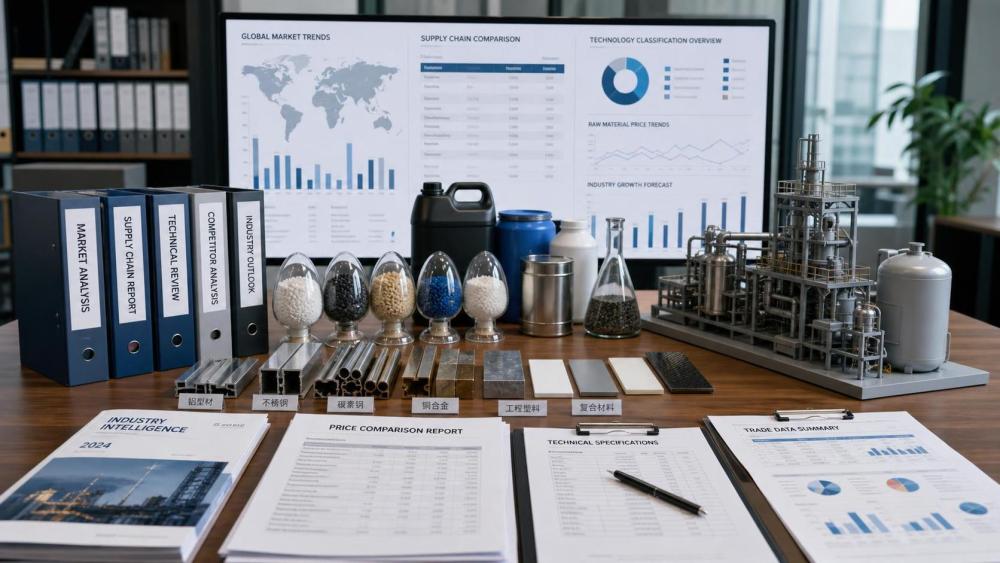
A platform such as GEMM is more useful when it treats industry information as linked professional knowledge rather than isolated content items. If product information, technical references, supplier context, application guidance, export developments, and pricing intelligence can be read together, users are in a better position to test assumptions before making sourcing or investment decisions.
The evaluation criteria that matter in practice
A good selection process is less about feature lists and more about how the platform behaves when you ask a difficult business question.
For example: Can it help distinguish between a broad market shift and a movement limited to one product form or export route? Can it connect a materials trend to application-level implications? Can it help a buyer compare supply options without flattening important technical differences? These are practical tests, and they reveal more than a sales demo.
Notice what is not on that list: visual polish alone, generic AI summaries, or content volume without relevance control. Those things may improve usability, but they do not make analysis more reliable.
Where many platforms mislead buyers
One common misunderstanding is to treat content breadth as proof of insight quality. A platform may cover drilling equipment, pipeline systems, rare-earth materials, smelting technologies, agrochemicals, laboratory reagents, recycled plastics, biofuels, and energy storage. That sounds impressive, but breadth only becomes valuable if the user can navigate within each domain at an appropriate level of specificity.
Another problem is the false precision of simplified market narratives. If a platform states that a sector is “rising” or “under pressure” without showing product scope, regional boundaries, or downstream relevance, it is asking the reader to accept a conclusion that may not hold outside a narrow segment.
There is also a recurring gap between commercial content and technical content. Decision-makers often need both. A procurement lead may care about price direction and supplier availability, while engineering or project teams need material compatibility, production process context, standards alignment, or application constraints. When these are separated into disconnected tools, the business loses time reconciling them manually.
A practical way to test fit before selection
The simplest evaluation method is to run real internal questions through the platform. Not hypothetical ones. Use the kind of questions that usually trigger meetings, spreadsheets, and conflicting opinions.
For instance, if your team is comparing polymer options for a manufacturing program, the platform should help connect material category, processing method, supplier landscape, pricing direction, and application notes. If your business is assessing metals exposure, it should be possible to distinguish between product types, alloy families, and market signals that affect actual purchasing decisions rather than just headline sentiment. In energy or chemicals, the same principle applies: users need linked context across equipment, feedstocks, process technologies, and trade developments.
If the answer requires opening ten unrelated pages and rebuilding the logic manually, the platform may still be a useful reference library, but it is not yet functioning as a dependable market insight content platform.
What a strong platform looks like over time
The best platforms become more valuable as users return to them, because the structure teaches the market as much as it reports on it. Over time, teams begin to recognize category relationships, specification differences, supply patterns, and recurring price drivers more quickly. That is a sign the platform is not just publishing information; it is improving decision quality.
For businesses operating across raw materials, industrial technologies, and global sourcing networks, that kind of platform usually sits between a news source and a specialist consulting engagement. It does not replace internal judgment, and it should not pretend to. What it should do is make industry complexity easier to interpret, compare, and challenge.
When choosing one, look past content quantity and ask whether the platform helps your team understand what a trend actually means in product, technical, and supply terms. That is the threshold between information access and decision-grade intelligence.
- Last One:No more articles
- Next Article:How to Evaluate Low-Carbon Materials for Construction Projects?Aug 01, 2026
Related News
- 00
0000-00
Circular economy polymers: virgin or recycled blends? - 00
0000-00
Bio-based materials still face a performance trust gap - 00
0000-00
Industrial decarbonization targets slip when baselines are weak - 00
0000-00
How to Evaluate a Market Insight Content Platform for Reliable Industry Trend Analysis - 00
0000-00
Injection Molding Machine Specifications Explained: What Parameters Matter Most?
Weekly Insights
Stay ahead with our curated technology reports delivered every Monday.