




Injection Molding Machine Specifications Explained: What Parameters Matter Most?




Start with the part and resin, not the machine brochure
When technical teams compare injection molding machine specifications, the most common mistake is reading the machine sheet before defining the molding window. That flips the job upside down. A machine is only suitable in relation to the part geometry, resin family, gate layout, expected cycle time, and quality tolerance. If those are still vague, the numbers on the machine nameplate will look precise while telling you very little.
A practical review starts with four questions:
- What is the finished part weight, and what is the total shot weight including runners or cold slug?
- What resin will actually run on the line: commodity PP, glass-filled nylon, flame-retardant PC/ABS, recycled blend, bio-based polymer?
- What quality risk matters most: flash, short shot, warpage, cosmetic defects, dimensional drift, or material degradation?
- What is the required output profile: frequent changeovers, long stable production, multi-cavity scaling, or engineering-grade low-volume work?
Once those are clear, the important parameters become easier to rank. Some are hard constraints. Others are only useful if they match the process you are trying to control.
Check clamping force, but do not treat tonnage as the headline number
Clamping force is usually the first number buyers compare, and it is also the one most often overvalued. More tonnage does not automatically mean better molding. What matters is whether the machine can resist cavity pressure across the projected area of the part and runner system without creating flash or forcing an unnecessarily large machine into service.
In evaluation, look at projected area, part geometry, cavity count, and the pressure profile expected for that resin and gate design. Thin-wall parts, high-flow cosmetic parts, and engineering materials running at high injection pressures may need more clamp support than their weight suggests. On the other hand, a bulky but low-pressure part can often run on a smaller press than a quick glance would imply.
The trap here is simple: teams oversize tonnage for comfort, then inherit higher energy use, bigger molds, more floor space demand, and worse economics on low-weight parts. Treat clamp force as a calculated requirement, not a prestige metric.
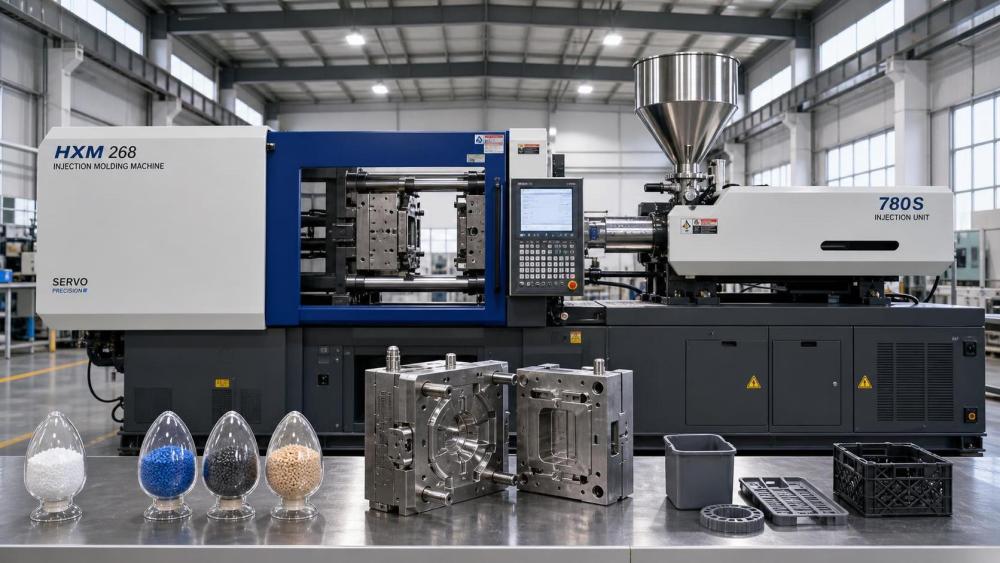
Shot size should sit in a usable operating range
Shot size is not just about whether the machine can fill the mold once. The better question is whether the planned shot weight sits in a stable portion of barrel capacity. If the shot is too small relative to the barrel, residence time can become excessive, especially with heat-sensitive resins or materials that are prone to color change and degradation. If the shot is too close to the machine maximum, cushion control becomes tight and process repeatability starts to suffer.
For technical review, compare:
- Total shot weight versus rated injection capacity.
- Required cushion stability at the end of fill and pack.
- Expected residence time for the selected polymer family.
- Whether future cavity expansion will push the machine too close to its limit.
This is where machine matching often breaks down in multi-material plants. A press that looks flexible on paper may be inefficient for small medical-style runs, then undersized for a larger family mold. If the operation expects wide product variation, shot-size range deserves more attention than catalog tonnage.
Injection pressure and injection rate solve different problems
These two are often mentioned together, but they answer different process questions. Injection pressure tells you whether the machine can overcome flow resistance. Injection rate, usually tied to screw diameter and maximum injection speed, tells you how quickly melt can enter the cavity.
For thick parts with relaxed fill times, pressure margin may matter more than peak speed. For thin-wall packaging or parts with long flow paths and early freeze-off risk, injection rate becomes critical. A machine can have nominally high pressure capacity and still fail to fill a part consistently if the available volumetric injection rate is too low for the gate and wall design.
Ask for the actual machine data that affects filling behavior: screw diameter, theoretical injection volume, maximum injection speed, and pressure capability under the selected screw configuration. Do not review pressure in isolation from screw size. A larger screw may increase shot capacity while reducing achievable injection pressure.
Screw design matters more than many purchase checklists admit
If you work with more than one resin family, screw design deserves a line of its own in the evaluation file. General-purpose screws can run a lot of materials adequately, but “adequately” is not the same as “well.” Filled polymers, flame-retardant compounds, recycled materials, heat-sensitive resins, and demanding color changes all react differently to compression ratio, mixing behavior, and shear history.
What to review:
- Screw diameter relative to shot size and pressure demand.
- Whether the screw is intended for commodity resins, engineering plastics, or abrasive/glass-filled materials.
- Barrel and screw metallurgy if wear is a known risk.
- Non-return valve design and how it affects cushion repeatability.
A machine that struggles with melt consistency will usually show the problem somewhere else first: unstable part weight, gloss variation, burn marks, black specks, inconsistent packing, or unexplained cycle drift. Teams often blame the mold or dryer before checking whether the plasticizing unit is actually suited to the resin.
Tie bar spacing, platen size, and daylight decide whether the mold is really compatible
Machine compatibility is not solved by tonnage alone. Plenty of projects stall because the mold technically fits in force range but not in physical envelope. Tie bar spacing, platen dimensions, mold thickness range, and maximum opening stroke all need to be checked against the actual tool, not a simplified mold outline.
This becomes more important when the mold carries side actions, hot runners, larger locating rings, robotic part take-out constraints, or deep core pull requirements. Technical evaluators should request the mold layout drawing and compare it against machine mounting dimensions early, before discussing cycle optimization or future cavity additions.
A short checklist helps:
Look beyond cycle time claims and inspect dry cycle versus molded cycle
Suppliers like to quote fast machine movements. That is useful, but only in context. Dry cycle numbers can look impressive while having limited relevance to a process dominated by cooling, plasticizing, valve-gate timing, robot handling, or mold temperature control. Technical evaluators should separate what the machine can do empty from what it can do under melt load and production conditions.
Pay attention to how the machine manages parallel motions. Can charging occur efficiently during cooling? How stable is back pressure control? Does the control system allow repeatable velocity-to-pressure transfer? These details affect real output far more than a headline open-close speed.
Control resolution and repeatability are where good machines separate themselves
For technical and standards-focused buyers, repeatability is usually more valuable than peak capability. A machine that can theoretically hit extreme settings is less useful than one that returns to the same fill, transfer point, hold pressure, and decompression behavior cycle after cycle.
Review the control platform with process engineering in mind:
- Position, pressure, and speed control granularity.
- Recipe storage and revision traceability.
- Alarm history tied to process events.
- Data export for quality review and production analysis.
- Permissions management if process changes must be controlled.
This matters even more in regulated or multi-site operations where process documentation, change control, and fault tracing are part of machine selection.
Utilities and material handling can quietly invalidate a machine choice
A machine may be technically capable and still be the wrong fit if plant utilities cannot support it properly. Power supply, cooling water conditions, hydraulic oil management, compressed air demand, dryer integration, and resin conveying all influence real performance. This is especially true when moving from standard resins to hygroscopic engineering plastics or temperature-sensitive compounds.
Do not evaluate the press as a standalone asset. Review the whole process cell. If the machine’s plasticizing unit can process nylon correctly but the upstream drying and dew point control are inconsistent, the specification match is only half solved.
Energy and drive type should be judged by process profile, not by labels
All-electric, servo-hydraulic, and hybrid machines each make sense in different production environments. The better comparison is not ideological. It is operational. Tight precision parts, clean environments, and rapid dry cycling may favor one architecture. Heavy molds, broader process tolerance, or certain maintenance preferences may favor another.
For evaluators, the useful questions are concrete: how does the drive system affect repeatability under your load case, maintenance access, power demand profile, and long-run thermal stability? A machine that looks efficient in a sales sheet may perform differently under frequent starts, material changes, or 24-hour production.
What to verify before you sign off
If you need a disciplined approval path, run the review in this order:
- Confirm part weight, total shot requirement, resin family, and quality-critical defects.
- Match clamp force to projected area and expected cavity pressure, not to habit.
- Check shot size in relation to usable barrel capacity and residence time risk.
- Verify injection pressure and injection rate against wall thickness, flow length, and gate design.
- Review screw design, wear resistance, and non-return valve suitability for the actual material mix.
- Compare mold dimensions, daylight, opening stroke, and automation clearance with the real tool drawing.
- Assess controls, repeatability, and process data functions for your quality system.
- Validate utility support and cell integration before treating the machine as production-ready.
The point of reading injection molding machine specifications is not to collect bigger numbers. It is to remove mismatch before it becomes scrap, downtime, unstable quality, or a mold that only runs well on paper. If the evaluation team keeps the part, resin, and process window at the center of the review, the right machine usually becomes obvious well before the sales comparison is over.
Related News
- 00
0000-00
Virgin vs Recycled Resin: How to Switch Without Disrupting Production? - 00
0000-00
Why Bio-Based Plastics Still Have to Prove Themselves on the Molding Floor - 00
0000-00
Industrial decarbonization targets slip when baselines are weak - 00
0000-00
Can biofuels for aviation meet ASTM fuel certification requirements? - 00
0000-00
Galvanized Steel Rebar Procurement: How Project Buyers Compare Long-Term Value
Related tags
Weekly Insights
Stay ahead with our curated technology reports delivered every Monday.