




How to Evaluate Low-Carbon Materials for Construction Projects?




Start with the project constraint, not the material brochure
Choosing low-carbon materials for construction is now a project control issue as much as an environmental one. The wrong decision can create cost drift, redesign work, delayed approvals, procurement gaps, or performance problems that show up long after handover. The teams that do this well usually begin from a simple discipline: define what the material has to do in the project before comparing carbon claims.
For a project manager or package lead, that means checking four things in parallel: where the carbon number comes from, whether the material is technically fit for the application, whether the supply chain can actually deliver it at the required scale, and whether the documentation will stand up in design review, client reporting, and compliance checks. If one of those fails, a low-carbon option can quickly become a high-risk choice.
A reliable evaluation process for low-carbon materials for construction usually looks less like a marketing comparison and more like a structured screening exercise. The checklist below follows that logic.
Check what problem you are trying to solve
Not every package needs the same level of carbon reduction, and not every substitute has the same project value. Before reviewing products, pin down the decision target.
- Is the goal to reduce embodied carbon in the structure, improve the building’s whole-life profile, meet a client brief, satisfy a green building rating pathway, or prepare for public procurement disclosure?
- Which packages matter most: concrete, steel, insulation, aluminum, glass, polymers, interior finishes, roofing, or MEP components?
- Is this an early design decision, a value engineering exercise, or a late-stage procurement substitution?
This sounds basic, but it prevents a common mistake: spending weeks comparing low-impact materials in low-volume categories while the structural package drives most of the embodied carbon and most of the commercial risk.
Make sure you are comparing equivalent materials
A low-carbon claim is only useful if the compared options perform the same job. That means checking the functional unit, the intended application, and the design assumptions behind the carbon data.
For example, one concrete mix may show lower embodied carbon per cubic meter, but if it needs a larger section, slower curing, extra cementitious adjustment in cold weather, or different placement controls, the project outcome changes. The same issue appears with recycled-content steel, bio-based polymers, insulation systems, and composite products. A lower number on paper does not automatically mean a lower-impact installed solution.
When screening alternatives, ask for the basis of comparison in plain terms: same strength class, same fire performance, same durability target, same service environment, same design life, same warranty position.
Read the carbon document, not just the carbon number
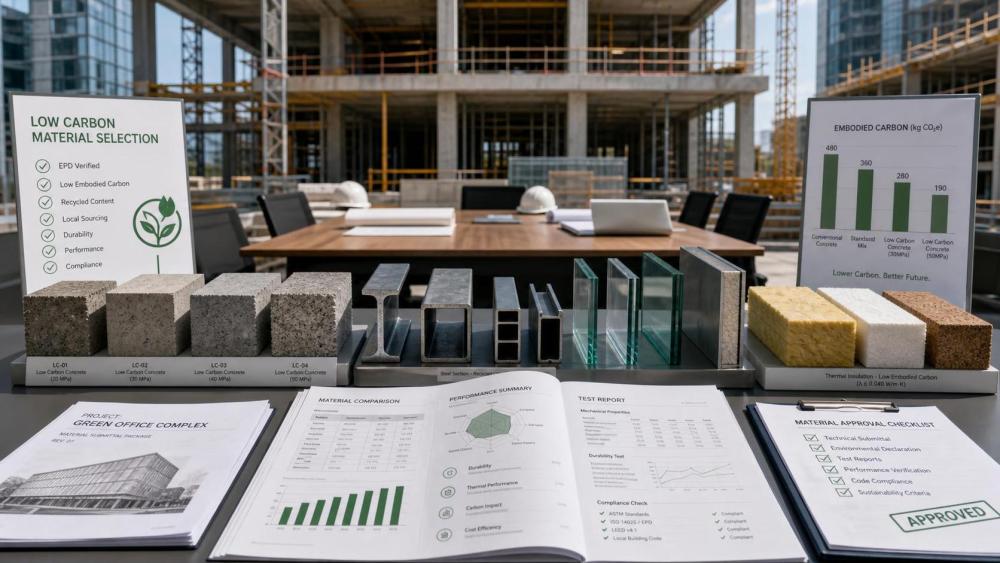
Most procurement disputes around low-carbon materials start here. The carbon figure gets copied into a spreadsheet, but nobody checks what is included. Use the source document, typically an Environmental Product Declaration or an equivalent third-party formatted environmental disclosure, and review the scope before accepting the value.
What to check:
- Product name and exact grade or formulation
- Declared unit or functional unit
- System boundary: cradle-to-gate, cradle-to-site, cradle-to-grave, or another defined scope
- Geographic relevance of the manufacturing data
- Publication and validity dates
- Whether the document is product-specific, manufacturer average, or industry average
If you compare one supplier’s product-specific cradle-to-gate number with another supplier’s broader or older dataset, the result may be directionally wrong. For project decisions, bad comparability is often more dangerous than missing data.
Separate embodied carbon from recycled content and “green” branding
Recycled content can matter. So can bio-based feedstocks, renewable energy in manufacturing, lower-clinker cement blends, electric arc furnace steel, and circular polymers. But none of those should be treated as a shortcut for low embodied carbon without checking the underlying documentation.
A material may contain recycled input and still carry a high footprint because of processing intensity, transport distance, additives, or yield losses. Another product may have modest recycled content but lower total carbon due to process efficiency and energy sourcing. Keep the claim categories separate:
Do not relax technical performance requirements
This is where experienced teams save themselves from expensive reversals. Low-carbon materials still have to meet structural, thermal, fire, chemical, acoustic, durability, and maintenance requirements for the actual use case.
In practice, the risk is rarely that a product fails every test. The risk is that it performs differently enough to affect installation method, curing time, protection measures, tolerances, connection details, surface finish, or maintenance access. Those knock-on effects can erase the original benefit.
Ask your design and site teams to review substitution impacts in the same pass as carbon review. If the answer changes sequencing, temporary works, inspection hold points, or commissioning assumptions, treat it as a project change, not a simple material swap.
Look hard at supply chain credibility
Many low-carbon options are viable in principle but fragile in procurement. Availability can depend on regional manufacturing routes, feedstock access, import exposure, batch consistency, or a limited number of approved plants.
A practical supplier review should cover:
- Can the supplier provide the same formulation or grade for the full project volume?
- Is the carbon documentation tied to the plant that will actually manufacture the product?
- Are lead times stable, or dependent on imported scrap, specialty additives, biomass feedstock, or constrained energy inputs?
- What happens if the supplier switches plant, feedstock, or blend ratio mid-project?
If the project depends on a carbon threshold for reporting or bid compliance, that last point matters a lot. A supply substitution can change both technical performance and reported embodied carbon.
Check transport and installation effects before calling it low-carbon
Some materials look attractive at factory gate but become less compelling once transport, wastage, packaging, special storage, or site handling are included. This is especially relevant for imported finishes, bulky insulation, prefabricated assemblies, specialty polymers, and materials that require controlled logistics.
You do not need a full life-cycle model for every procurement decision, but you do need a reality check. If one option travels much farther, requires more protection, produces more offcut waste, or increases installation rework, it deserves a second look. On large projects, these operational effects are often visible well before financial closeout.
Map the compliance path by market and building type
Low-carbon selection is rarely just a design preference. It can sit inside planning conditions, public-sector procurement criteria, investor reporting, green building frameworks, and product compliance obligations. The exact path depends on where the project is located and what is being built.
Instead of asking a vague question like “is this compliant,” check the actual project documents and market-facing evidence chain:
- Employer’s requirements or technical specifications
- Tender carbon reporting requirements
- Project sustainability framework submissions
- Product declarations, test reports, and classification documents relevant to the application
- Country or regional rules affecting product disclosure, import documentation, or environmental claims
That review often exposes a practical issue: the material may be acceptable, but the documentation package is not ready for approval timing.
Watch for common traps in “lower carbon” substitutions
A few patterns show up repeatedly across construction packages:
- Concrete: lower-cement or blended systems may affect early strength gain, curing windows, and weather sensitivity.
- Steel: recycled-route claims need to be matched to the actual supply route and product form, not assumed across all sections or batches.
- Polymers and composites: bio-based or recycled-content variants can behave differently under UV exposure, heat, solvents, or long service cycles.
- Insulation and finishes: a product with favorable carbon data may still create issues in moisture control, fire classification, or detailing compatibility.
None of these automatically rule out the material. They simply mean the evaluation needs to stay tied to use conditions, not broad category claims.
Use a short decision matrix before approval
Before sign-off, reduce the discussion to a small set of project decisions. This keeps the team from getting lost in supplier presentations.
Build the approval sequence around risk
The best way to evaluate low-carbon materials for construction projects is to review them in order of consequence. Start with high-volume, high-carbon packages. Confirm equivalence. Read the underlying carbon documentation. Test the supply chain story. Then check submission readiness for the project’s market and contract structure.
If a material clears those gates, it is usually a serious candidate. If it fails one of them, do not try to rescue the decision with branding language or broad sustainability intent. In project terms, a low-carbon material is only a good choice when the carbon claim, the engineering case, and the procurement reality all line up at the same time.
Related News
- 00
0000-00
Circular economy polymers: virgin or recycled blends? - 00
0000-00
Bio-based materials still face a performance trust gap - 00
0000-00
Industrial decarbonization targets slip when baselines are weak - 00
0000-00
How to Evaluate a Market Insight Content Platform for Reliable Industry Trend Analysis - 00
0000-00
Injection Molding Machine Specifications Explained: What Parameters Matter Most?
Weekly Insights
Stay ahead with our curated technology reports delivered every Monday.