



Common Quality Risks When Sourcing Monel Alliage in 2026 — Traceability, Certification, and Mill Test Report Gaps




Traceability Breaks, Certification Gaps, and Missing MTRs: Why Monel Alloy Sourcing Still Fails Quality Audits in 2026
Monel alloy—particularly grades like Monel 400, K-500, and R-405—is routinely specified for critical applications in offshore oil & gas, chemical processing, marine propulsion, and nuclear support systems. Its resistance to chloride-induced stress corrosion cracking and high-velocity seawater erosion makes it irreplaceable where failure carries safety, environmental, or regulatory consequences. Yet in 2026, quality assurance teams continue to reject incoming Monel shipments—not due to metallurgical defects, but because of systemic documentation failures that undermine traceability, invalidate certification, and leave mill test reports (MTRs) incomplete or unverifiable.
These are not edge-case incidents. They occur across procurement channels: direct from primary mills, via regional distributors, and increasingly through consolidated global sourcing platforms that aggregate inventory across multiple smelters and toll processors. The risk isn’t that the material is inherently substandard—it’s that the chain of evidence proving its conformity has been fractured, obscured, or omitted entirely.
When “As-Supplied” Doesn’t Match “As-Specified”
A common trigger during incoming inspection is mismatched heat numbers. A purchase order specifies Monel 400 per ASTM B164, with full MTRs covering tensile strength, hardness, and intergranular corrosion testing. The physical coil arrives with a heat number stamped on the tag—but the accompanying MTR references a different heat number, or no heat number at all. In some cases, the MTR lists chemical composition within specification limits but omits required mechanical test results; in others, the report is signed by a lab without ISO/IEC 17025 accreditation—or worse, bears no signature or date.
This isn’t merely administrative sloppiness. For a safety-critical component—say, a seawater-cooled valve body in a floating production unit—the absence of a valid, heat-specific MTR means the end user cannot demonstrate compliance with API RP 14E, ASME BPVC Section II, or NACE MR0175/ISO 15156. Regulatory auditors treat such omissions as nonconformities with zero tolerance. Corrective action requires either full retesting (costly and time-consuming) or outright rejection—even if the material itself performs to spec.
Certification That Doesn’t Certify Anything
Certificates of Conformance (CoC) and Certificates of Analysis (CoA) are frequently misused as substitutes for proper MTRs. A CoC stating “Material conforms to ASTM B164” carries no evidentiary weight unless it explicitly ties the statement to a specific heat number, lot, and test record. In practice, many suppliers issue generic CoCs that lack heat traceability, omit test method references (e.g., ASTM E8 for tensile testing), and fail to identify the testing laboratory. Worse, some CoCs list chemical values only—no mechanical data—despite ASTM B164 requiring both.
Third-party certifications add another layer of ambiguity. A supplier may present EN 10204 3.1 or 3.2 documentation—but without verifying whether the issuing body is authorized under the relevant national accreditation scheme (e.g., UKAS, DAkkS, or ANAB), the certificate holds no enforceable validity. In 2026, several regional certifiers have been found issuing documents for Monel heats they never tested—relying solely on supplier-submitted data. Without independent verification of the certifier’s scope and competence, these documents offer false assurance.
Traceability Gaps That Extend Beyond the Heat Number
True traceability for Monel alloy goes deeper than matching a heat number to an MTR. It requires continuity across the entire supply chain: from raw nickel-copper feedstock origin (including cobalt and iron content controls), through melting and casting practices (vacuum induction vs. air-melt), to final hot/cold working parameters and heat treatment history. A single MTR may confirm tensile strength at room temperature—but if the material will operate at 150°C under cyclic loading, the absence of elevated-temperature fatigue or creep data leaves a performance gap unaddressed.
Some suppliers provide partial traceability—e.g., a heat number linked to a melt log—but omit forging or rolling logs. Others use batch numbering instead of heat numbers, making it impossible to isolate material from a single pour. In one documented case, a refinery ordered Monel 400 pipe for sour service; the delivered coils passed dimensional checks and basic chemistry, but the MTR lacked sulfur content verification. Subsequent analysis revealed sulfur segregation exceeding NACE limits—undetectable without microprobe mapping tied to the original heat log.
Why These Risks Persist in 2026
Three structural factors explain why these gaps remain widespread:
- Supply chain fragmentation: Monel is produced by a limited number of primary mills (e.g., Special Metals, Haynes International, and select Asian producers). But downstream distribution involves multiple tiers—including brokers, stockists, and fabricators—who may repackage, relabel, or consolidate heats without maintaining original documentation integrity.
- Standard interpretation variance: ASTM B164 allows certain test requirements to be “reported upon request.” Suppliers often treat this as optional—unless explicitly mandated in the purchase order. Buyers who omit precise MTR language (“full mechanical and chemical testing per Table 1, certified by ISO/IEC 17025-accredited lab”) get what’s minimally provided.
- Verification inertia: Many QA departments rely on visual MTR review rather than cross-checking heat numbers against mill databases, validating lab accreditation status, or auditing supplier documentation control procedures. Automated MTR parsing tools exist—but adoption remains low outside Tier-1 OEMs.
What Quality and Safety Teams Can Do Now
Preventive action starts before PO issuance. Require MTRs to include:
- Heat number matching the physical tag and packing list;
- Full chemical composition (including residuals like Pb, Bi, Sb);
- Mechanical properties at specified temperatures and orientations;
- Test method references (e.g., “Tensile test per ASTM E8, transverse direction”);
- Accreditation details for the testing lab (scope number, issuing body, expiry date);
- Signature, date, and official stamp—not just a printed name.
For high-risk applications, mandate third-party witnessed testing at the mill—especially for corrosion testing (ASTM G48, G28) or ultrasonic examination (ASTM A388). Audit supplier documentation control processes annually, not just product conformance. And treat any deviation—missing heat number, unsigned MTR, mismatched test method—as an automatic hold point, not a minor paperwork issue.
Material selection matters too. Not all monel alliage variants perform identically under identical conditions. Monel K-500’s precipitation-hardened structure delivers higher strength but reduced ductility compared to annealed Monel 400—making MTR verification even more critical when substituting grades. If your application demands specific aging treatments or grain size controls, those parameters must appear in the MTR—not just implied by the grade designation.
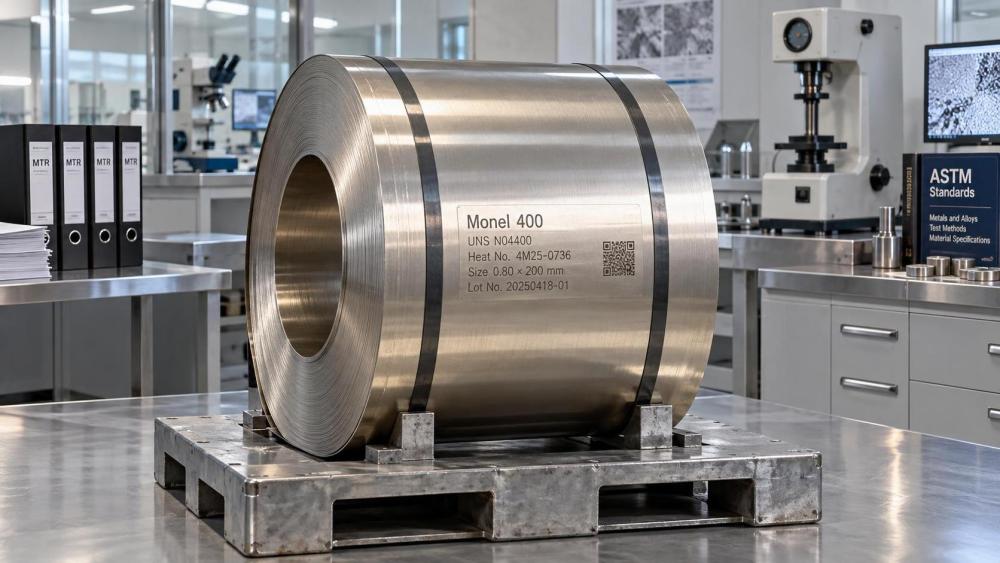
Ultimately, Monel alloy’s value lies in its predictability under extreme conditions. That predictability depends less on the alloy itself and more on the rigor with which its provenance is documented, verified, and preserved. In 2026, the most expensive failure isn’t a cracked flange—it’s accepting material without closing the traceability loop.
Related News
- 00
0000-00
Virgin vs Recycled Resin: How to Switch Without Disrupting Production? - 00
0000-00
Why Bio-Based Plastics Still Have to Prove Themselves on the Molding Floor - 00
0000-00
Industrial decarbonization targets slip when baselines are weak - 00
0000-00
What should companies assess before selecting sustainable energy developers? - 00
0000-00
Can biofuels for aviation meet ASTM fuel certification requirements?
Related tags
Weekly Insights
Stay ahead with our curated technology reports delivered every Monday.