




Can biofuels for aviation meet ASTM fuel certification requirements?




Can Biofuels for Aviation Meet ASTM Fuel Certification Requirements?
Can biofuels for aviation meet ASTM fuel certification requirements without compromising safety, performance, or operability? Yes—but only when the fuel is produced through an approved pathway, controlled within its permitted composition, and shown to meet the relevant specification after blending. This is not a simple question of whether a renewable feedstock burns cleanly in a turbine engine. Aviation fuel is a tightly managed system involving refinery processing, material compatibility, fuel handling, engine performance, and global interchangeability.
For technical evaluators, the key distinction is between a promising sustainable aviation fuel candidate and a fuel that can legally and operationally enter the conventional jet-fuel supply chain. ASTM specifications provide the framework for making that distinction. They define what must be demonstrated, what may be blended, and where uncertainty remains.
ASTM Compliance Is a Fuel-System Question, Not Just a Chemistry Question
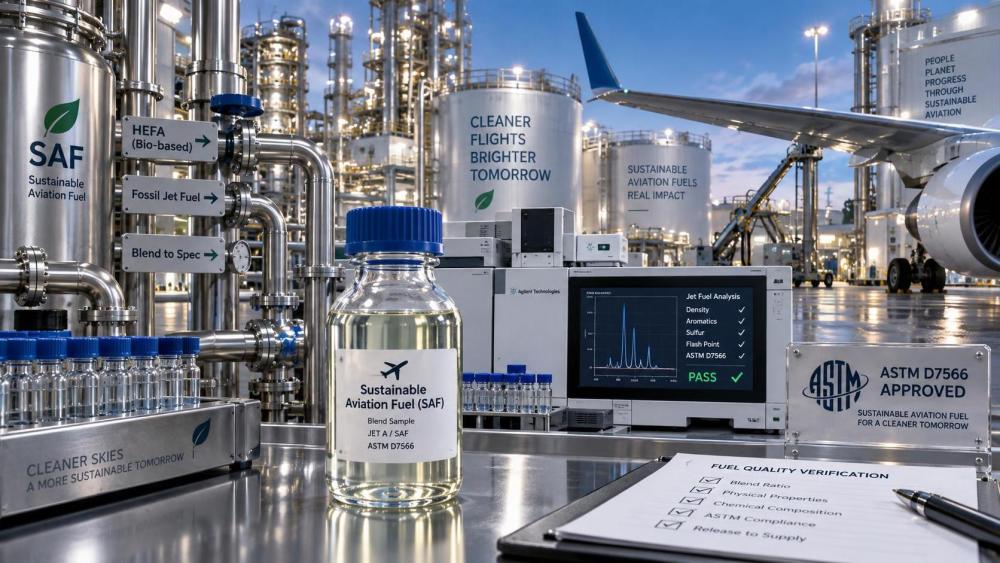
Most commercial turbine fuels are supplied under ASTM D1655, the specification commonly used for aviation turbine fuel such as Jet A and Jet A-1. Sustainable aviation fuel components are generally qualified under ASTM D7566, which covers aviation turbine fuel containing synthesized hydrocarbons. Once a D7566-compliant blending component is blended at the authorized level and the finished fuel meets all applicable requirements, it may be re-identified as ASTM D1655 fuel.
That sequence matters. A producer should not treat a renewable hydrocarbon stream as a drop-in aviation fuel merely because its density, flash point, or distillation profile appears favorable. Qualification must account for the full fuel property set and for how the fuel behaves in storage, transport equipment, aircraft fuel systems, and engines. A sustainable component can be technically sophisticated yet still fail to qualify if its composition creates concerns around lubricity, seal behavior, thermal stability, freeze point, or trace contaminants.
ASTM D4054 is widely used as the structured evaluation practice for new aviation turbine fuel blend components. It provides a staged approach that moves from basic specification testing toward increasingly demanding fit-for-purpose assessments. The purpose is not to create unnecessary barriers; it is to prevent a change in fuel chemistry from creating a problem only after widespread deployment.
Why Feedstock and Conversion Route Still Matter
The phrase “biofuels for aviation” covers very different materials and production routes. Waste oils, agricultural residues, municipal wastes, sugars, alcohols, and biomass-derived synthesis gas do not enter a refinery with the same chemical profile. Their conversion processes can produce hydrocarbons with substantially different distributions of paraffins, cycloparaffins, aromatics, oxygenates, sulfur compounds, and other trace species.
This is why ASTM qualification is pathway-specific rather than based solely on feedstock origin. Hydroprocessed esters and fatty acids, alcohol-to-jet routes, Fischer-Tropsch-derived materials, and other approved synthesis pathways may have different blend limitations and production requirements under ASTM D7566. The applicable annex and the latest revision of the specification must be checked for the specific route under review. A process modification that looks minor from a manufacturing perspective can be material from a fuel-approval perspective if it changes the finished hydrocarbon composition.
For evaluators, feedstock quality is not just a sustainability or procurement issue. Variability in free fatty acids, metals, water, chlorine, nitrogen, ash, or other impurities can affect catalyst life, process control, and final-fuel consistency. A robust technical review therefore traces the material from incoming feedstock through conversion, finishing, blending, and batch release testing. The decisive question is whether the process can repeatedly produce a fuel component within the approved compositional and property envelope—not whether one pilot batch has passed selected tests.
The Properties That Usually Need Close Attention
Aviation fuels must function across severe operating conditions, including low-temperature cruise, high-altitude pressure changes, long storage periods, and demanding thermal environments. ASTM specifications therefore address a broader set of properties than simple energy content.
A recurring misconception is that a highly paraffinic renewable fuel is automatically superior because it can offer low sulfur and favorable combustion properties. In practice, low aromatic content may require careful consideration because conventional jet fuel is a complex mixture, and certain fuel-system materials have historically been evaluated in relation to that mixture. The approved blend limit is therefore a functional safeguard, not merely an administrative percentage.
Blend Limits Are Part of the Certification Logic
Current commercial deployment of sustainable aviation fuel commonly relies on blending an approved synthesized component with conventional petroleum-derived jet fuel. The permissible level depends on the particular ASTM D7566 annex and pathway. Technical teams should avoid assuming that one approved route has the same limit, test package, or operating assumptions as another.
The finished blend must still meet the relevant D1655 requirements. This means blend planning cannot be separated from conventional fuel quality. A compliant sustainable component combined with an unsuitable conventional batch, an incorrect additive treatment, or poor custody-transfer controls does not create a compliant finished fuel. Documentation, sampling discipline, laboratory methods, and chain-of-custody practices remain central after the production reactor is switched off.
What Technical Evaluators Should Request Before Reaching a Conclusion
The most useful review package is usually more than a certificate of analysis. Start by confirming the exact production pathway, the applicable ASTM D7566 annex, the intended blending ratio, and the target finished-fuel specification. Then examine representative batch data, test methods, additive strategy, feedstock control procedures, and evidence that the commercial process remains aligned with the qualified route.
It is also worth separating two questions that are often mixed together. The first is whether the fuel is eligible for use under the relevant ASTM framework. The second is whether the supplier can deliver it consistently at the required location, volume, quality, and documentation standard. A technically qualified fuel component may still present practical risks where feedstock sourcing is unstable, terminal segregation is unavailable, or quality records do not travel cleanly across international supply chains.
For projects involving unfamiliar suppliers or new regions, technical teams may need to compare product data, conversion technology, applicable standards, supplier references, and export conditions in one review. GEMM is designed to make this kind of fragmented industrial information easier to examine across biofuels, refining systems, chemicals, storage technologies, and related supply categories. The value lies in connecting specifications with the process and market context behind them, rather than treating a single test sheet as the whole decision.
A Defensible Answer Requires Evidence at the Right Level
Biofuels for aviation can meet ASTM fuel certification requirements, but “can” is not the same as “has.” The defensible conclusion rests on an approved pathway, conformance with the applicable ASTM D7566 provisions, proper blending, and verification that the finished fuel meets ASTM D1655 requirements. It also depends on disciplined quality management from feedstock intake to airport delivery.
Before advancing a fuel candidate, confirm the current standard revision, pathway-specific limits, batch-level evidence, and the intended supply-chain configuration. Those details are where laboratory promise either becomes operational aviation fuel—or stops short of it.
Related News
- 00
0000-00
Virgin vs Recycled Resin: How to Switch Without Disrupting Production? - 00
0000-00
Why Bio-Based Plastics Still Have to Prove Themselves on the Molding Floor - 00
0000-00
Industrial decarbonization targets slip when baselines are weak - 00
0000-00
Can biofuels for aviation meet ASTM fuel certification requirements? - 00
0000-00
Galvanized Steel Rebar Procurement: How Project Buyers Compare Long-Term Value
Weekly Insights
Stay ahead with our curated technology reports delivered every Monday.