




How to verify recycled plastics certification before sourcing material




Before sourcing recycled resin, buyers need more than supplier claims. They need verified documentation, traceable material flows, and certification that matches the intended product, customer commitments, and regulatory requirements. A recycled plastics certification can provide important assurance, but only when its scope, chain-of-custody model, material category, and validity are checked against the material actually being purchased.
The central risk is simple: a supplier may hold a valid certificate while the quoted resin, production site, recycled-content claim, or shipment is outside that certificate’s scope. Certification is therefore not a document-collection exercise. It is a process of connecting a specific purchase order to a certified facility, a defined input stream, an approved traceability model, and supporting transaction records.
Start by defining the claim that must be verified
“Recycled plastic” is not a single technical or commercial category. Before requesting certificates, define the claim required for the end use. The distinction between post-consumer recycled (PCR) and post-industrial or pre-consumer recycled content is particularly important.
PCR material originates from products that have completed their intended use and entered a waste stream. It is commonly requested for consumer packaging, durable goods, retail commitments, and circularity reporting. Pre-consumer material generally comes from manufacturing scrap diverted from the waste stream before reaching consumers. Both may be recycled under relevant standards, but they do not carry the same commercial or regulatory value in every market.
A sourcing specification should therefore state:
- the required recycled-content type: PCR, pre-consumer, or a permitted combination;
- the minimum recycled-content percentage and whether it applies by mass;
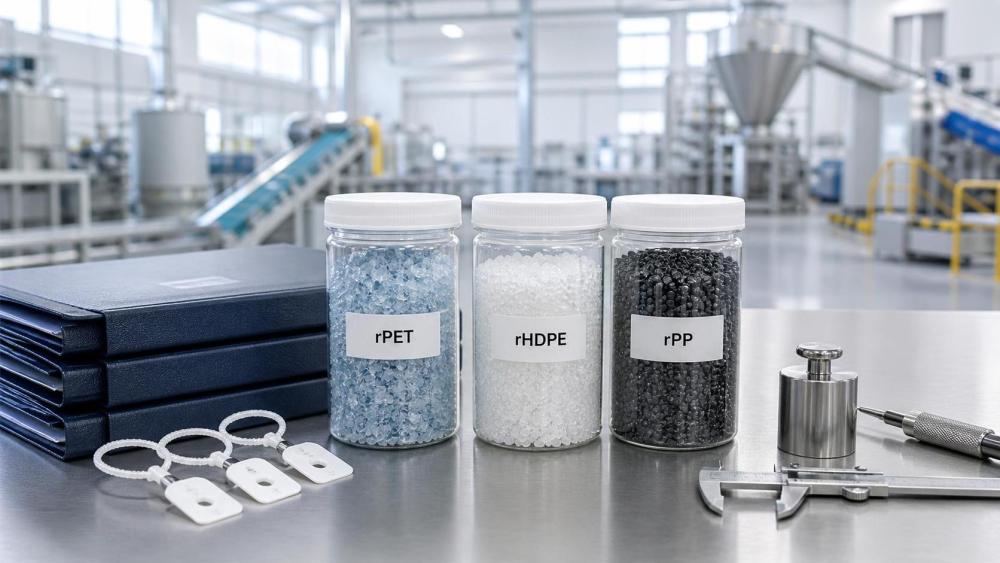
- the polymer and grade, such as rPET, rHDPE, rPP, rLDPE, ABS, or engineering resin;
- whether the claim applies to the resin itself, a compound, or the finished component;
- the accepted chain-of-custody model; and
- the destination market and end-use restrictions, especially for food contact, toys, medical applications, and packaging.
Without this definition, it is easy to compare certificates that prove different things. A material certified for recycled content may not meet a customer’s PCR definition. A mass-balance claim may not satisfy a requirement for physically segregated recycled resin. A certification related to the recycler may not cover the converter supplying pellets or compounds.
Understand what major certification schemes actually cover
There is no universal recycled plastics certification that answers every sourcing question. The best-known schemes differ in purpose, geographic relevance, material coverage, and claim methodology.
Global Recycled Standard (GRS) and Recycled Claim Standard (RCS), developed by Textile Exchange, are chain-of-custody standards used across material supply chains. GRS has additional environmental, social, and chemical requirements for certified operations, while RCS focuses more narrowly on verifying recycled content and chain of custody. Their relevance extends beyond textiles where certified recycled polymer inputs are used, but buyers should confirm that the supplier’s certified scope covers the exact resin, facility, and transaction.
EuCertPlast is widely recognized in the European recycling market and audits plastic recycling processes, traceability, and related operational controls. It can be valuable when assessing recyclers handling post-consumer plastic waste, particularly where evidence of compliant waste input and processing practice is required. It should not be treated as a blanket guarantee that every outgoing product has a stated recycled-content percentage or is suitable for every end use.
RecyClass offers schemes that can address recycled plastic traceability and recycled-content claims, alongside recyclability evaluation for plastic packaging. Its traceability approach is relevant to European packaging supply chains and is aligned with the principles of EN 15343, the European standard covering plastic recycling traceability and assessment of recycled content.
UL 2809 is a recycled-content validation framework used for product and material claims, including pre-consumer and post-consumer content. SCS Recycled Content Certification is another third-party option used to substantiate recycled-content claims. These certifications may be useful where a brand, customer, or project specification names the relevant program, but the certificate must still be reviewed for covered products and facilities.
ISCC PLUS is often encountered in chemically recycled or circular feedstock supply chains. It uses mass-balance chain-of-custody approaches and may support circular-material claims for polymers made from allocated recycled feedstock. That is not the same as physically measuring recycled polymer in each pellet batch. The distinction must be clear in contracts, product declarations, and downstream marketing claims.
Check the certificate as a controlled document, not a logo
A certificate should be independently verifiable through the certification body or scheme owner where a public database is available. Do not rely solely on a PDF sent by a sales contact. Certificates can expire, be suspended, be issued to an affiliated entity rather than the seller, or apply only to a different site.
The review should cover five points.
1. Legal entity and production location. Confirm that the company name, registered address, and facility address match the organization producing or trading the resin. A group certificate may list multiple facilities, but only listed sites are within scope. This matters when suppliers operate recycling, compounding, warehousing, and trading activities in separate locations.
2. Scope of activities. Read the scope statement rather than assuming the certificate covers all operations. It may authorize collection, sorting, recycling, compounding, trading, or conversion, but not all of them. A trader with a valid chain-of-custody certificate does not demonstrate recycling capability. Conversely, a recycler’s certification may not extend to a compounded grade made at another plant.
3. Product and polymer coverage. Ask whether the certificate explicitly covers the resin family being quoted. “Recycled plastics” is too broad for a purchase decision. The document or associated scope should identify relevant material categories, such as recycled PET flakes, HDPE regrind, PP pellets, or compounded polymer.
4. Validity and certification body. Check issue and expiry dates, certificate number, and the accredited or authorized certification body. An audit date alone is not proof that the certificate remains valid. For recurring supply, include an obligation to notify the buyer of suspension, withdrawal, scope reduction, or change of certification body.
5. Chain-of-custody model. Certification may rely on physical segregation, controlled blending, or mass balance. Each model can be legitimate under its applicable rules, but they support different claims. Physical segregation gives the clearest direct link between recycled input and output. Mass balance permits allocation of certified attributes through a defined accounting system and requires careful communication to avoid implying physical recycled content where that is not what the model establishes.
A certificate must be linked to the shipment
The most frequent verification failure occurs after the annual certificate has been checked. A facility certificate establishes that a site operates under a certified system; it does not automatically certify every invoice or every lot.
For schemes that use transaction certificates, request the transaction certificate or equivalent shipment-level evidence for each certified sale. Match it to the purchase order, invoice, bill of lading, resin grade, weight, production period, seller, buyer, and claimed recycled-content category. Quantity reconciliation is important: a supplier cannot sell more certified output than permitted by its certified inputs and accounting rules.
Where transaction certificates are not the normal mechanism, require a lot-specific declaration that references the production batch and identifies the applicable certification. It should be supported by internal traceability records, batch certificates of analysis, packing lists, and material balance information when justified by risk level.
Traceability should survive common commercial arrangements. If resin moves through a distributor, toll compounder, or third-party warehouse, ask who takes legal title and who physically handles the material. Every organization making a certified claim or transferring certified status may need to be within the relevant chain-of-custody system. A break in the documented chain can invalidate the downstream claim even when the original recycler is properly certified.
Do not confuse recycled-content certification with material qualification
Recycled plastics certification addresses origin and traceability. It does not replace technical qualification of the resin. A certified PCR polypropylene grade can still vary in melt flow rate, ash content, odor, color, contamination profile, impact performance, or batch consistency. These properties are often decisive in injection molding, extrusion, blow molding, film production, and automotive components.
The purchase specification should separately define acceptable test methods, target ranges, sampling frequency, and corrective-action requirements. Depending on the polymer and application, this may include melt flow rate, density, moisture, volatile content, tensile and impact properties, color, gel count, filter pressure value, odor, residual contaminants, and restricted-substance compliance.
Food-contact applications require an additional level of scrutiny. In the United States, a recycled-plastic process may be reviewed by the Food and Drug Administration through a Letter of No Objection process, but such letters are process-specific and do not constitute a general food-contact certificate for all recycled resin. In the European Union, recycled plastic materials intended for food contact are subject to specific requirements under Regulation (EU) 2022/1616. A recycled-content certificate alone is therefore insufficient evidence for food-contact suitability.
Build verification into supplier onboarding and contracts
The most reliable approach is to make certification verification part of normal supplier approval rather than a last-minute request before shipment. A practical file should include the current certificate, scope statement, scheme rules relevant to the claim, transaction documentation, technical data sheet, safety documentation where applicable, and a signed recycled-content declaration.
Contracts should define the exact claim language permitted on invoices and product documentation. They should also specify the evidence required per shipment, document-retention periods, audit rights, consequences of invalid certification, and responsibility for regulatory or customer claims. For high-risk materials, periodic site audits or independent document reviews can be justified, especially where material passes through multiple intermediaries.
Certification is most valuable when it reduces uncertainty rather than merely satisfying a checklist. The right question is not whether a supplier has a recycled plastics certificate. It is whether the available evidence proves that the ordered grade, from the named facility and specified batch, carries the recycled-content claim required for the intended market and application. That standard of verification protects both material availability and the credibility of downstream sustainability claims.
Related News
- 00
0000-00
Which sectors are driving demand in the chemical engineering market? - 00
0000-00
How to assess lifecycle emissions from CCUS for low-carbon cement - 00
0000-00
How do energy storage technologies compare for 8-hour discharge? - 00
0000-00
Do mill test reports prove industrial alloys meet ASTM standards? - 00
0000-00
How to verify plastic recycling system suppliers' throughput claims
Weekly Insights
Stay ahead with our curated technology reports delivered every Monday.