




How is the biofuel industry in Europe changing after RED III?




The biofuel industry Europe is entering a more disciplined phase after the revision of the Renewable Energy Directive, widely known as RED III. The change is not simply a higher renewables target. It shifts attention toward lifecycle emissions, eligible feedstocks, traceable supply chains, and the fuels that can decarbonise transport sectors with few practical alternatives.
For market researchers, the central question is no longer whether biofuels remain relevant in Europe. They do. The more useful question is which fuel pathways can remain compliant, scalable, and economically viable as national rules are implemented. That distinction matters because RED III sets an EU framework, while Member States still determine many practical obligations through their own transport policies, quota systems, tax treatment, and verification procedures.
A transport target that changes the value of carbon performance
RED III raises the ambition for renewable energy in transport by 2030. Member States can pursue either a reduction in greenhouse-gas intensity from transport energy or a renewable-energy share target. This design places more commercial weight on a fuel’s verified emissions profile rather than on volume alone.
For suppliers, a litre of biofuel is therefore not interchangeable with another litre. The feedstock origin, transport distance, processing energy, co-product allocation, methane management, and chain-of-custody documentation can all affect the reported greenhouse-gas result. Producers that once competed mainly on blending economics increasingly need to demonstrate how their fuel performs under the methodology applied by the relevant national scheme.
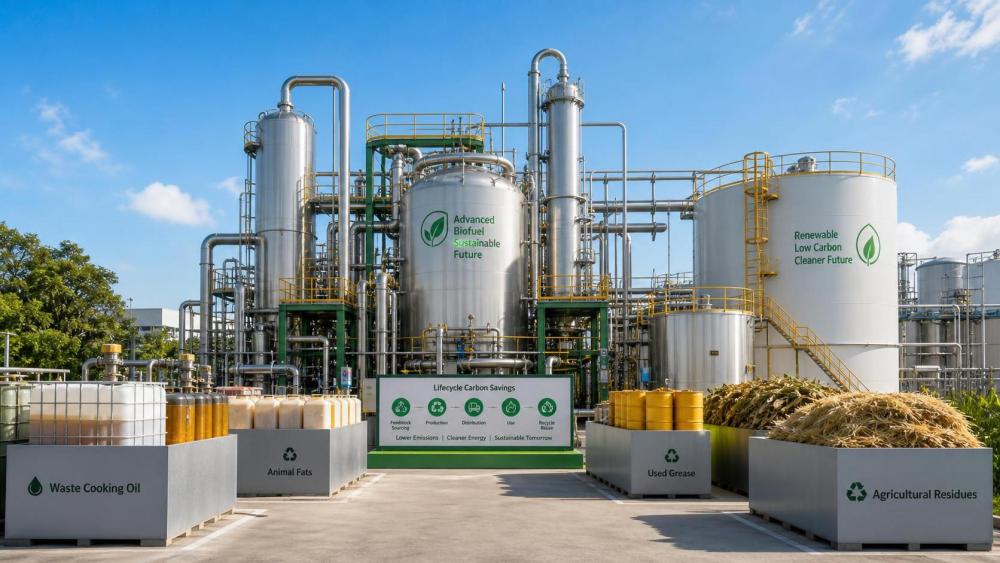
This is especially important for fuels made from residues and wastes. Their market appeal often depends on favourable lifecycle performance, but eligibility cannot be assumed from a feedstock label. Used cooking oil, animal fats, agricultural residues, municipal waste fractions, and industrial by-products each raise different questions around classification, collection practices, competing uses, and traceability. A material may be technically suitable for conversion but still create compliance risk if its status in the supply chain is unclear.
Advanced biofuels move closer to the centre of policy
One of RED III’s clearest market signals is the dedicated role for advanced biofuels and renewable fuels of non-biological origin, or RFNBOs. The directive includes a combined minimum target for these fuels in transport by 2030, with a specific minimum contribution from RFNBOs. In practice, this creates a more defined demand space for fuels produced from listed advanced feedstocks and for renewable hydrogen-derived transport fuels.
That does not mean conventional biofuels disappear overnight. Crop-based fuels remain part of the European fuel mix, subject to sustainability criteria and limits designed to address indirect land-use change concerns. But investment logic is changing. New projects are more likely to be judged on whether they can secure long-term access to compliant wastes, residues, lignocellulosic materials, biomethane feedstocks, or other advanced inputs.
The practical bottleneck is often upstream. Many advanced pathways are technically proven or close to commercial maturity, yet dependable feedstock aggregation, pre-treatment capacity, contamination control, and cross-border documentation remain difficult. Competition for waste lipids, biogenic residues, and renewable electricity is already affecting project assumptions. A project with an attractive conversion technology but weak feedstock visibility may be more exposed than its initial model suggests.
A more divided market by fuel type and end use
The European market is unlikely to develop as one uniform biofuel sector. Road transport is increasingly influenced by electrification, particularly in passenger vehicles, which changes the long-term role of liquid fuels. Heavy-duty road fleets, however, still need practical options that work with vehicle availability, refuelling infrastructure, payload requirements, and fleet operating patterns. Biodiesel, renewable diesel, biomethane, and emerging renewable fuel pathways may all have a role, depending on the country and fleet segment.
Aviation and maritime transport are becoming more important demand centres because direct electrification is harder in these sectors. Sustainable aviation fuel, including bio-based pathways, has gained policy attention alongside separate aviation requirements. Shipping is also creating demand for renewable and low-carbon fuel options, although fuel selection will depend on vessel design, bunker infrastructure, fuel standards, and the treatment of emissions across the wider regulatory environment.
This segmentation means broad claims such as “Europe needs more biofuel” are not enough for market analysis. The relevant question is whether a specific fuel can meet the needs of a specific transport mode while satisfying the applicable sustainability and reporting rules. Renewable diesel may fit one distribution model; biomethane may suit another; ethanol, biogas, bio-methanol, and aviation fuel intermediates face different logistics and conversion constraints.
Certification is becoming a commercial infrastructure issue
RED III reinforces a trend that has been building for years: sustainability verification is no longer a back-office task. It affects whether a shipment can be counted toward an obligation, whether a buyer will accept it, and whether a producer can defend its claimed carbon intensity. Voluntary certification schemes recognised under the EU framework are widely used to support this verification, but participants still need to understand the exact scope of certification, audit expectations, mass-balance rules, and national implementation requirements.
Importers face particular complexity. Europe relies on international flows of feedstocks, intermediates, and finished biofuels, yet cross-border trade brings scrutiny of origin records and supply-chain integrity. The commercial risk is not limited to a rejected cargo. Questions around feedstock classification or documentation can disrupt contracting, delay settlement, and change the value of a fuel already in storage.
Researchers should also avoid treating sustainability certification as a simple pass-or-fail label. It is better understood as a system of evidence. The quality of records, the consistency between physical material and administrative claims, and the treatment of changing regulations all matter. Where material passes through collectors, traders, processors, terminals, and blenders, the chain is only as reliable as its weakest handover.
What to watch as national implementation develops
The directive’s impact will become clearer through national transposition and enforcement. Countries may choose different approaches to transport obligations, greenhouse-gas accounting, penalties, multipliers, and support mechanisms. As a result, demand for the same fuel can look materially different across neighbouring markets. A fuel producer assessing Europe should not rely only on an EU-level target; it should compare country-level rules with available feedstock, port access, blending infrastructure, and likely off-taker demand.
Several indicators deserve continued attention:
- How Member States translate RED III transport obligations into domestic law and compliance markets.
- Whether approved feedstock availability keeps pace with announced advanced-fuel capacity.
- The price relationship between conventional biofuels, waste-based fuels, renewable diesel, biomethane, and RFNBO pathways.
- Changes in audit practice, traceability expectations, and enforcement against fraudulent feedstock claims.
- Demand signals from aviation, maritime transport, and heavy-duty fleets rather than passenger-car blending alone.
Better market research now requires connected evidence
After RED III, a useful view of the biofuel industry Europe needs to connect policy language with physical supply chains. Looking only at production capacity can overstate available supply; looking only at feedstock volumes can miss certification limitations; looking only at fuel prices can ignore the value created by verified carbon performance.
This is where structured industry intelligence becomes more useful than a basic supplier list. GEMM brings together product categories, technical knowledge, supplier references, application guidance, market trends, export updates, and pricing intelligence across biofuels and adjacent sectors such as chemicals, refining, recycled materials, carbon capture, and industrial energy storage. For a researcher, the value lies in comparing the pieces that influence a real decision: feedstock route, conversion process, applicable standards, supply capability, trade exposure, and market context.
RED III does not create one predictable European biofuel market. It creates a market in which compliance quality, feedstock credibility, and end-use fit carry more weight. Before drawing conclusions about demand or investment, it is worth checking the relevant national rules, the fuel’s lifecycle assumptions, and the evidence available across the supply chain. Those details will increasingly determine which projects move from policy promise to durable market position.
Related News
- 00
0000-00
Which sectors are driving demand in the chemical engineering market? - 00
0000-00
How to assess lifecycle emissions from CCUS for low-carbon cement - 00
0000-00
How do energy storage technologies compare for 8-hour discharge? - 00
0000-00
Do mill test reports prove industrial alloys meet ASTM standards? - 00
0000-00
How to verify plastic recycling system suppliers' throughput claims
Weekly Insights
Stay ahead with our curated technology reports delivered every Monday.