




How to select corrosion-resistant agrochemical manufacturing reactors




Selecting corrosion-resistant agrochemical manufacturing reactors starts with the process, not a material’s reputation. A vessel may withstand the main reaction yet fail during charging, cleaning, or an upset. Temperature, pressure, water content, impurities, and acceptable product contamination can all change the material choice. Technical evaluators should compare the complete operating envelope with evidence from material suppliers, corrosion testing, and reactor manufacturers.
Define the exposure before comparing reactor materials
Prepare a corrosion assessment for every stage of the batch: raw-material charging, reaction, quench, transfer, cleaning, and idle storage. Include the concentrations and temperatures reached locally, not just the nominal bulk conditions. An acid addition, for example, can create a short-lived concentrated zone before mixing is complete.
Record the full range of credible conditions, including startup and abnormal operation. A cleaning solution can be more aggressive than the product mixture, particularly when it is heated or left in contact with the vessel longer than intended.
- Chemistry: List reactants, solvents, catalysts, intermediates, by-products, and cleaning agents. Identify halides, oxidizers, acids, alkalis, water, and abrasive solids.
- Operating envelope: Specify temperature, pressure or vacuum, concentration, exposure time, and expected batch frequency. Include excursions and foreseeable cooling or mixing failures.
- Physical conditions: Identify high-velocity zones, solids loading, deposits, dead legs, and areas where vapor may condense.
- Product constraints: Define limits for metal contamination, particles, and carryover between formulations, using the product specification and applicable quality requirements.
Where corrosion data do not cover the actual mixture, ask for testing under representative conditions. Single-component compatibility charts are useful for screening; they cannot reliably predict every mixed-solvent or multiphase reaction.
Compare corrosion-resistant reactor materials
The following table narrows the initial shortlist. It does not replace a review of the exact chemistry, fabrication details, or test results.
Glass lining: evaluate mechanical exposure as well as chemistry
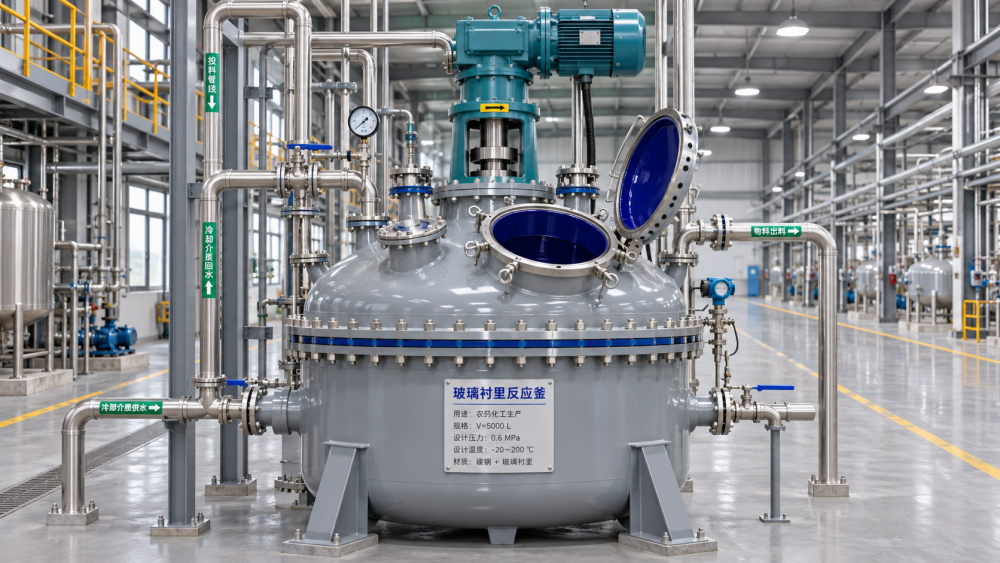
Glass-lined steel is a candidate when the process needs a corrosion-resistant, nonmetallic surface. Its weakness is that a breach can expose the steel substrate. Review charging methods, agitator clearances, solids handling, and maintenance access for potential impact or abrasion. Confirm allowable heating and cooling practices with the manufacturer, including the effect of adding a cold charge to a hot vessel.
Ask how the supplier inspects the lining before shipment and how damage will be located and assessed in service. A repair may restore operation, but its suitability depends on the location, duty, and process acceptance criteria. Define those criteria before purchase.
Metallic vessels: specify the grade and fabricated condition
“Stainless steel” is not a complete material specification. Compare candidate grades against the chemical mixture and temperature, then assess welds, heat-affected zones, surface finish, crevices, and deposits. These features can influence localized corrosion even when the bulk material appears suitable.
Specialty alloys deserve consideration where common stainless grades do not meet the exposure requirements. Avoid assuming that a more expensive alloy is universally resistant: an alloy that performs well in one acid may have a different limitation in an oxidizing mixture. Request corrosion evidence for the proposed grade and fabricated condition.
Check the whole wetted assembly
The vessel shell is only one part of the corrosion boundary. An otherwise sound material choice can be undermined by an incompatible gasket, seal, dip pipe, sampling valve, or heat-transfer surface. Build a wetted-parts list and identify the material and expected exposure for each item.
- Agitator and internals: Review shafts, impellers, baffles, probes, thermowells, and their attachments for chemical compatibility and mechanical wear.
- Seals and joints: Check gasket and elastomer compatibility across solvents, temperature changes, cleaning cycles, and vacuum conditions.
- Nozzles and transfer lines: Examine injection points, flange interfaces, and narrow passages where concentrated chemicals or deposits may accumulate.
- Heat-transfer surfaces: Assess both product-side and utility-side exposure, including the consequences of leakage between circuits.
For dissimilar metals, evaluate whether electrical contact and a conductive liquid could create galvanic corrosion. Also consider how a failed component would be detected before it affects a batch or the vessel boundary.
Turn the shortlist into a defensible specification
Give each bidder the same process envelope and require responses against the same acceptance criteria. A useful inquiry package includes the process description, batch schedule, design temperature and pressure, vacuum requirements, cleaning procedure, utility conditions, and allowable contamination limits. Identify any information that remains provisional.
- Screen materials. Reject candidates with known incompatibilities for any credible operating or cleaning condition. Record the basis for each decision.
- Resolve uncertainty. Agree on representative corrosion tests where published data or supplier experience do not cover the mixture. Define specimen condition, temperature, duration, and pass criteria before testing.
- Review vessel design. Confirm working volume, agitation, heat-transfer duty, nozzle arrangement, pressure relief interfaces, inspection access, and maintenance requirements.
- Verify fabrication and documentation. Specify the applicable pressure-vessel design code and jurisdictional requirements with the manufacturer. Request material traceability, inspection records, welding documentation where relevant, and lining inspection records where applicable.
- Compare lifecycle cost. Include purchase price, delivery, installation, spares, inspection, repairs, cleaning downtime, and the potential cost of lost batches. State assumptions so competing bids remain comparable.
Corrosion coupons can help compare candidates, but interpretation needs care. General metal loss may not reveal a susceptibility to pitting, crevice attack, or cracking. Test exposure should also represent vapor and liquid phases where both contact the equipment.
Evaluate suppliers against operating risk
Ask each supplier to identify the limiting conditions for its proposed design and explain which recommendations rely on test data, published guidance, or experience. Review the availability of replacement agitators, seals, lined components, and repair services at the installation site. A shorter quoted lead time has less value if a damaged component cannot be inspected or replaced promptly.
Before placing an order, reconcile every open process assumption with the design and purchasing teams. The preferred reactor is the one whose materials, fabricated details, inspection plan, and support arrangements can be justified against the full batch cycle—and whose remaining uncertainties have an agreed method of resolution.
Related News
- 00
0000-00
How to verify product purity claims from chemical feedstock distributors - 00
0000-00
Will feedstock availability constrain biofuel production in 2026? - 00
0000-00
How to select corrosion-resistant agrochemical manufacturing reactors - 00
0000-00
How to verify an injection molding supplier in China - 00
0000-00
How to account for supplier lead times in raw material supply chain planning
Weekly Insights
Stay ahead with our curated technology reports delivered every Monday.