




Will feedstock availability constrain biofuel production in 2026?




Will limited supplies of used cooking oil, agricultural residues and energy crops slow biofuel growth in 2026? In some markets, yes—but a physical shortage is only one possible constraint. Feedstock may be available in aggregate yet difficult to secure at a price, specification or sustainability profile that allows a plant to operate profitably.
For commercial evaluators, the key question behind biofuel production feedstock availability in 2026 is therefore not simply “How much biomass exists?” It is “How much eligible material can reach a particular facility, consistently and at an acceptable delivered cost?” The answer varies by fuel pathway, location and competing use.
Where feedstock availability is most likely to constrain growth
Biofuel markets do not draw from one interchangeable pool. Ethanol producers, renewable diesel plants and sustainable aviation fuel (SAF) projects can require different inputs and conversion technologies. Even where facilities can process the same material, their willingness to pay depends on product prices, incentives and technical yields.
The International Energy Agency identifies feedstock availability, costs and sustainability as important considerations for biofuel expansion, alongside policy and technology deployment. Its analysis also distinguishes conventional crop-based fuels from advanced fuels made from wastes and residues. These categories face different supply constraints and should not be combined in a single procurement forecast. Source: International Energy Agency, Renewables 2024: Transport biofuels (https://www.iea.org/reports/renewables-2024/transport-biofuels).
The commercial implication: feedstock scarcity may appear as margin compression or lower plant utilization before it appears as an outright production halt. A project can have nameplate capacity and still struggle to secure enough economically viable material.
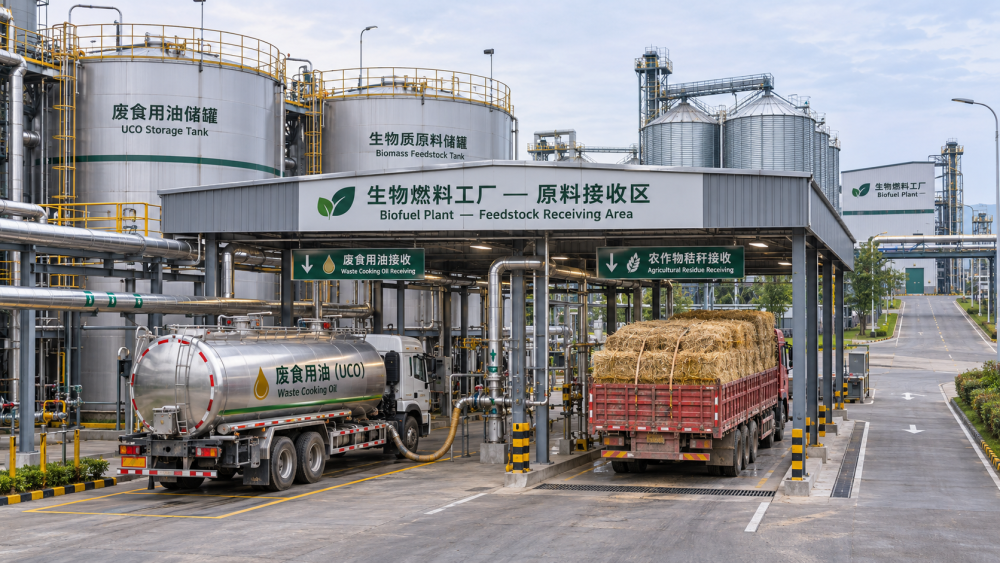
Three feedstock markets, three different bottlenecks
Waste oils: supply is collected, not simply produced
Used cooking oil is attractive to producers seeking waste-based feedstocks, but theoretical generation does not equal available supply. Restaurants and processors need collection services; material must be aggregated, transported and often cleaned before conversion. Existing buyers may already have contracts, while fraud and misclassification risks make traceability commercially significant.
Competition can also cross borders. A plant that relies on imported waste oil should assess not only supplier capacity but also export documentation, shipping exposure and whether the claimed origin is accepted under the destination fuel scheme. The European Commission’s Union Database is designed to support traceability of relevant renewable fuels and feedstocks in the EU market; buyers should verify the requirements applicable to their transaction. Source: European Commission, Union Database for Biofuels (https://energy.ec.europa.eu/topics/renewable-energy/bioenergy/union-database-biofuels_en).
Residues: abundant on paper can mean expensive at the gate
Straw, corn stover and forestry residues can be geographically widespread, but a refinery buys material delivered to its gate—not an estimate of everything left in a field or forest. Removal rates must account for soil protection and other uses; collection depends on weather, equipment and producer participation. Bulky material can make transport and storage decisive cost factors.
The U.S. Department of Energy’s 2023 Billion-Ton Report examines biomass supply under specified price and scenario assumptions. Its estimates are useful for screening opportunities, but they are not equivalent to contracted, plant-ready supply in 2026. Source: U.S. Department of Energy, 2023 Billion-Ton Report (https://www.energy.gov/eere/bioenergy/2023-billion-ton-report).
Energy crops: a larger resource, with different trade-offs
Crop-based feedstocks may benefit from established farming and trading infrastructure, but their economics remain exposed to harvest variability and demand from food, feed and other industries. New dedicated energy-crop acreage also requires grower confidence, suitable land and an offtake arrangement; it cannot necessarily be mobilized within a single procurement cycle.
Eligibility matters as much as yield. Rules governing crop-based fuels and land-use impacts differ by jurisdiction, so a project should assess the actual route to its intended market rather than assuming that a feedstock accepted in one program qualifies everywhere.
Biofuel production feedstock availability in 2026: a commercial assessment
Start with the planned fuel pathway and work backward to the supply catchment. A procurement model should distinguish technically usable feedstock from material that is documented, financeable and deliverable under realistic conditions.
- Define the specification. Check moisture, impurities, free fatty acids or other relevant quality parameters against the conversion technology and pretreatment system.
- Build a bottom-up supply estimate. Separate potential generation from collectable volume, existing commitments and material available to the project.
- Calculate delivered cost. Include collection, storage, transport, pretreatment, losses and verification—not only the quoted feedstock price.
- Check eligibility and carbon accounting. Confirm the documentation, chain-of-custody and lifecycle assessment rules for the intended fuel market and incentive program.
- Stress-test alternatives. Model a poor harvest, supplier default, trade disruption or stronger competing demand, and check whether alternative inputs are technically and contractually usable.
Be cautious with “flexible feedstock” claims. A facility may process several inputs, but switching can change pretreatment requirements, product yield, operating cost and the documentation needed to claim an incentive. Flexibility has value only when those limits are reflected in the financial model.
Regional signals worth monitoring
- United States: Follow renewable fuel policy, crop and fats markets, and announced versus operating processing capacity. The U.S. Environmental Protection Agency publishes Renewable Fuel Standard program information and annual volume requirements; check the applicable rule rather than relying on a project announcement. Source: EPA, Renewable Fuel Standard Program (https://www.epa.gov/renewable-fuel-standard-program).
- European Union: Track implementation of renewable energy rules, feedstock traceability and national measures. Eligibility and documentation can affect which imported materials are commercially usable. Source: European Commission, Renewable Energy Directive (https://energy.ec.europa.eu/topics/renewable-energy/renewable-energy-directive_en).
- Import-dependent markets: Monitor supplier concentration, freight routes and the difference between export availability and volumes already committed to domestic or overseas buyers.
These are exposure indicators, not forecasts of shortages. Announced capacity may be delayed or never reach full utilization, while higher prices can attract additional collection. Evaluators should update assumptions as contracts, policy decisions and operating data become available.
Questions commercial evaluators should ask
Will feedstock scarcity stop biofuel production growth in 2026?
Not necessarily. Constraints are more likely to be uneven: some plants may secure supply, while others face higher costs or lower utilization. The outcome depends on feedstock, location, competing demand and policy eligibility.
Is a long-term supply contract enough to reduce risk?
It helps, but only if the counterparty can deliver the specified material. Review volume commitments, quality tolerances, origin records, price-adjustment terms and remedies for non-delivery. Test how the contract performs under a supply shock.
What is the most useful early warning sign?
Watch the relationship between delivered feedstock costs and the revenue a plant can earn from fuel and applicable incentives. A narrowing margin, combined with difficulty securing documented volumes, can reveal a constraint before a headline shortage becomes visible.
Related News
- 00
0000-00
How to verify product purity claims from chemical feedstock distributors - 00
0000-00
Will feedstock availability constrain biofuel production in 2026? - 00
0000-00
How to select corrosion-resistant agrochemical manufacturing reactors - 00
0000-00
How to verify an injection molding supplier in China - 00
0000-00
How to account for supplier lead times in raw material supply chain planning
Weekly Insights
Stay ahead with our curated technology reports delivered every Monday.