




How to verify product purity claims from chemical feedstock distributors




To verify a purity claim from chemical feedstock distributors, match a batch-specific certificate of analysis to the delivered material, check how purity and critical impurities were measured, and confirm the result through risk-based independent testing. A high purity percentage is not sufficient unless the remaining impurities, test methods, sampling basis, and safe handling requirements are acceptable for the intended process.
A material can meet its stated assay yet still contain enough water, metal, residual solvent, or reactive contaminant to cause a failure. Supplier approval and shipment acceptance should therefore use a written specification that connects analytical results to process performance and safety limits.
Define what purity means before comparing chemical feedstock distributors
“Purity” can refer to different measurements. An assay may quantify the main compound directly, calculate it by subtracting measured impurities from 100%, or report a result on a dry basis. These approaches do not necessarily produce interchangeable numbers.
For example, a feedstock reported as 99.5% pure on a dry basis may contain water that is excluded from the calculation. If moisture affects a reaction or storage stability, a separate water limit is needed. Likewise, an assay that meets its limit does not establish the absence of impurities outside the method’s scope.
Build the specification around the intended use: identity, assay, critical impurities, physical properties, packaging, and shelf-life or retest requirements where relevant. Include the analytical method or an agreed equivalent, as well as units and the basis for each limit.
Check whether the certificate describes the delivered batch
A certificate of analysis, or CoA, is useful evidence only when its scope and identity are clear. A generic specification sheet describes what a product is supposed to meet; it does not establish that a particular shipment was tested and passed.
Match the product name, grade, manufacturer, and batch or lot number on the CoA against the container labels and shipping documents. Review the reported results against the agreed specification, not just the supplier’s own limits. A distributor’s internal lot number should be traceable to the original manufacturer’s lot, including any repacking or blending records.
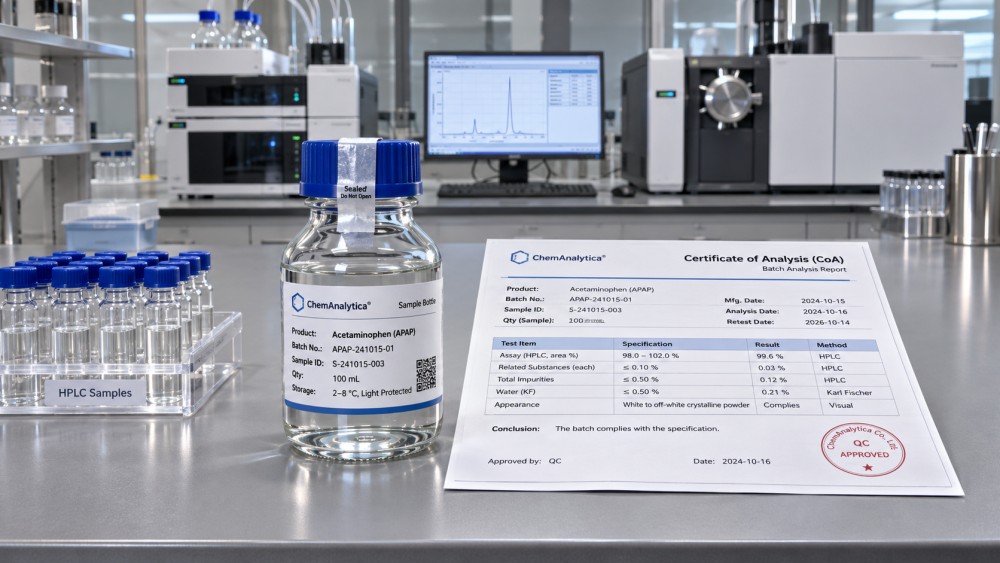
- Document control: Check the issuing organization, issue date, authorization, and whether the certificate is an original manufacturer CoA or a distributor-issued document based on transferred data.
- Results: Look for numerical results and units where required, rather than only “conforms.” Confirm that every critical specification is represented.
- Batch history: Identify the manufacturing, sampling, and test dates where available, together with the expiry or retest date if one applies.
- Changes after testing: Determine whether the material was blended, diluted, transferred, or repacked after the original sample was taken. These operations can affect whether the original CoA remains representative.
- Discrepancies: Hold the shipment if lot numbers, material identity, limits, or document versions do not reconcile. Obtain an explained and controlled correction before release.
A retest date is not automatically an expiry date. It indicates when material should be reassessed according to the applicable control system; suitability after that point depends on storage conditions, the specification, and an appropriate retest.
Examine the test method, not just the reported number
Request enough method information to understand what the result covers: the method identifier and version, analytical technique, sample preparation, reporting basis, and relevant detection or quantitation limits. A recognized standard method can support comparability, but only if its scope fits the substance, concentration range, and impurities of concern.
“Not detected” is not the same as “absent.” The result must be considered against the method’s detection capability and reporting convention. If a critical impurity limit is lower than the laboratory’s reliable quantitation capability, the result cannot demonstrate compliance with that limit.
Check whether the method distinguishes the desired substance from related compounds or interferences. For instance, a method suited to measuring total organic content may not identify a specific residual solvent. Similarly, a test for total metals does not necessarily establish the concentration of an individual metal that affects a catalyst.
Ask whether the laboratory has demonstrated the method’s suitability for the material, including applicable accuracy, precision, specificity, and range. Accreditation to ISO/IEC 17025 can provide confidence in laboratory competence, but verify that the relevant test is within the laboratory’s accredited scope; accreditation alone does not validate every result it issues.
Design independent verification around the risk
Independent testing is most valuable when it addresses a specific uncertainty: a new source, a process-sensitive impurity, a changed manufacturing route, or a mismatch in documentation. The testing plan should state which batches to sample, which attributes to test, the methods and limits, and who can authorize release.
Sampling is part of the evidence. A laboratory result describes the sample received, so use a documented plan appropriate to the material, container configuration, and risk of nonuniformity. Confirm sample identity and chain of custody, use clean compatible equipment, and protect samples from contamination, moisture, evaporation, or degradation.
Consider a hypothetical solvent feedstock with an acceptable main-component assay but a tight water limit. Testing only the assay on receipt would leave the process-sensitive parameter unverified. A suitable plan would include a representative sample and a water method capable of measuring below the agreed acceptance limit.
For an established source with consistent performance and effective change controls, periodic verification may be justified by a documented risk assessment. Increase scrutiny after a source change, unexplained trend, failed result, transport incident, or change in packaging or storage conditions. Define how to investigate differences between supplier and independent results, including sampling, method, measurement uncertainty, and potential material changes before deciding on disposition.
Link purity verification to safe receipt and handling
Review the current safety data sheet alongside the technical specification and CoA. Confirm the material identity, hazard classification, storage and segregation requirements, exposure controls, incompatible materials, and emergency measures under the rules applicable in the destination jurisdiction. A safety data sheet supports hazard communication; it is not a substitute for a batch-specific purity test.
Check container integrity, seals, labels, transport conditions, and evidence of leakage or contamination at receipt. If an impurity can create a safety hazard, such as an incompatible contaminant or a substance that changes stability, its control should appear in the specification and verification plan rather than relying on the headline purity value.
Set a clear release decision
Approve a shipment only when identity and traceability are established, documentation is consistent, critical results meet the agreed specification, and required safety and receipt checks are complete. Where independent testing is part of the plan, keep the material under controlled hold until the defined release criteria are met.
If evidence is incomplete or a result fails, quarantine the affected material, document the discrepancy, and agree on an investigation and disposition with the supplier. Do not resolve an unexplained purity gap by accepting the percentage alone: the decision depends on what was measured, what was not, and whether the delivered batch remains suitable for its intended use.
- Last One:No more articles
- Next Article:Will feedstock availability constrain biofuel production in 2026?Nov 23, 2026
Related News
- 00
0000-00
How to verify product purity claims from chemical feedstock distributors - 00
0000-00
Will feedstock availability constrain biofuel production in 2026? - 00
0000-00
How to select corrosion-resistant agrochemical manufacturing reactors - 00
0000-00
How to verify an injection molding supplier in China - 00
0000-00
How to account for supplier lead times in raw material supply chain planning
Related tags
Weekly Insights
Stay ahead with our curated technology reports delivered every Monday.