



How to verify an injection molding supplier in China




Finding a reliable supplier for injection molding China projects requires more than comparing quotes and product photos. Procurement teams need evidence that the company is legitimate and can consistently manufacture the required parts.
Verify its registration, production equipment, quality controls, tooling terms, and export arrangements before placing an order. A documented sample and trial run should support the final purchasing decision.
Start with the supplier’s legal identity
Ask for the supplier’s Chinese business license, official Chinese company name, unified social credit code, registered address, and the name of its legal representative.
Check these details against China’s National Enterprise Credit Information Publicity System. Confirm that the registration is active and review available information on administrative penalties or abnormal operating status.
Match the legal entity on the license with the name on the quotation, contract, invoice, and beneficiary bank account. Investigate discrepancies before sending deposits.
A trading company can be a useful sourcing partner, but establish who operates the factory, who owns the contract, and who is responsible for quality and delivery.
Registration confirms that a company exists; it does not prove manufacturing competence. Use it as an initial screen, then verify the actual production site separately.
Confirm who will make your parts
Request the factory address and a live video walkthrough covering the entrance, molding machines, tooling area, inspection equipment, raw material storage, and finished goods.
During the call, ask the supplier to show a current production order or machine display, subject to customer confidentiality. Check whether the site matches its earlier claims.
For higher-value projects, commission an independent factory audit or visit in person. Agree on the audit scope in advance, including production capacity, maintenance, labor conditions, and quality controls.
Ask whether molding, toolmaking, surface finishing, and assembly happen in-house or through subcontractors. Identify each production location and require approval before critical processes are transferred.
A supplier that resists reasonable verification, provides inconsistent addresses, or cannot explain subcontracting arrangements warrants further investigation before you commit funds.
Can the factory meet your part requirements?
Send shortlisted suppliers a controlled technical package: drawings, 3D files, material grade, expected annual volume, cosmetic requirements, tolerances, and relevant test standards.
Ask for a manufacturing feasibility review covering gate locations, parting lines, draft angles, shrinkage, weld lines, and features that may require side actions or secondary operations.
Compare the proposed press tonnage and shot capacity with the part and mold design. Confirm available machine sizes and whether capacity is reserved for your expected schedule.
Request examples of comparable parts and materials, while respecting customer confidentiality. Experience with a similar polymer or application is more useful than a broad equipment list alone.
For critical resins, specify the approved manufacturer and grade, permitted regrind content, color requirements, and substitution rules. Require written approval before any material change.
Check quality systems against actual records
Ask for the current quality management certificate, its scope, issuing body, and covered manufacturing address. Verify its status with the certification body where possible.
ISO 9001 certification can indicate a structured management system, but it does not guarantee compliant parts. Sector-specific requirements may call for additional certifications or customer approvals.
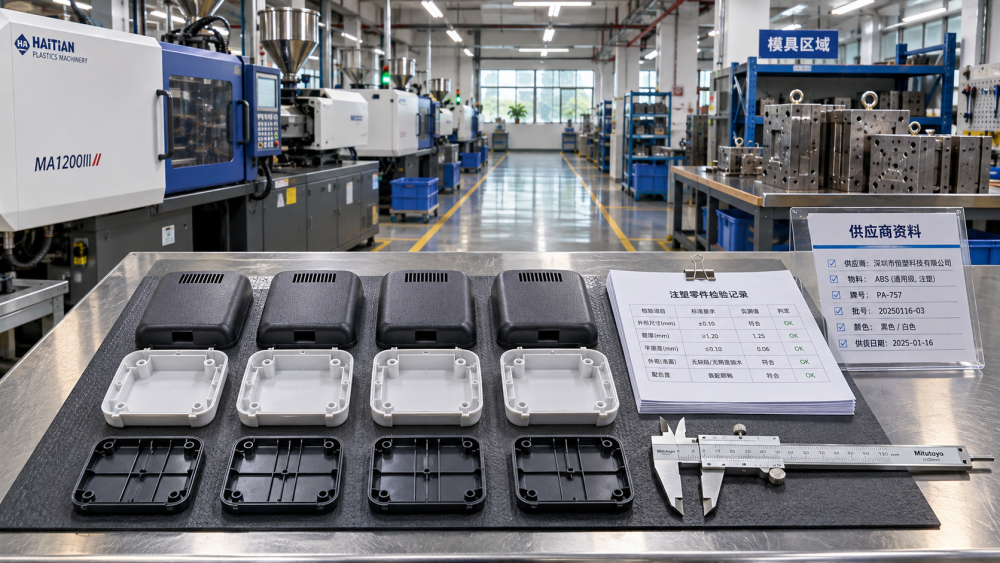
Request a sample inspection report, a list of measuring equipment, and evidence of calibration. Confirm that the factory can measure your critical dimensions and functional characteristics.
Agree on the inspection plan before tooling starts: sampling method, acceptance criteria, critical dimensions, test frequency, and how nonconforming parts will be identified and contained.
For regulated or safety-critical parts, define the required material documentation, traceability, validation tests, and approvals. A generic certificate or supplier declaration may not satisfy your application.
Protect your mold and define tooling costs
Tooling often represents a significant upfront investment. The contract should identify the mold, its owner, storage location, permitted use, and the conditions for release or transfer.
Specify the number of cavities, mold materials, expected maintenance responsibilities, and what happens if the tool wears out or requires repair. Avoid relying on verbal ownership assurances.
Ask for an itemized tooling quotation covering design, fabrication, trials, modifications, and spare components. Define which design changes are included and how additional work is approved.
Clarify whether you will receive final mold drawings and maintenance records. If ownership or transfer is important, have qualified counsel review terms under applicable law.
Use samples and a trial run to verify performance
Approve production-intent samples against the drawing and agreed inspection plan. Record dimensions, appearance, material identification, and functional test results rather than approving from photographs alone.
If samples fail, request a corrective action report explaining the cause, proposed fix, and verification method. Approve revised samples before authorizing full production.
A small trial run can reveal issues that isolated samples miss, including inconsistent dimensions, excess scrap, packaging damage, and delays during routine production.
Agree on a retained reference sample, revision level, and change-control process. Require notice and written approval for changes to material, tooling, production site, or critical processes.
Compare quotations on total purchasing risk
Request quotations using the same specifications and forecast volumes. Separate mold charges, unit prices, finishing, inspection, packaging, freight, and any recurring setup costs.
Check price breaks, minimum order quantities, production lead times, and capacity assumptions. A low unit price may depend on volumes or delivery schedules your business cannot support.
Specify the agreed Incoterms rule and named place, payment milestones, currency, and responsibilities for export clearance, freight, insurance, and import duties.
Ask for evidence of relevant export experience and confirm who prepares shipping documents. Check destination-country product requirements with an appropriate specialist when the application demands it.
Before payment, independently confirm bank details through a trusted contact channel, especially if account information changes. The beneficiary should match the contracting entity or be clearly explained.
Make the final supplier decision
Choose the supplier whose evidence best supports your requirements across legal identity, factory capability, quality records, tooling terms, sample performance, and commercial reliability.
For an injection molding China project, a competitive quote is only the starting point. Document unresolved risks, assign corrective actions, and release production after the agreed checks pass.
Related News
- 00
0000-00
How to verify product purity claims from chemical feedstock distributors - 00
0000-00
Will feedstock availability constrain biofuel production in 2026? - 00
0000-00
How to select corrosion-resistant agrochemical manufacturing reactors - 00
0000-00
How to verify an injection molding supplier in China - 00
0000-00
How to account for supplier lead times in raw material supply chain planning
Related tags
Weekly Insights
Stay ahead with our curated technology reports delivered every Monday.