




How much chemical manufacturing capacity do you really need?




How much chemical manufacturing capacity do you really need?
Determining the right chemical manufacturing capacity is not just a technical calculation—it is a strategic decision that affects cost control, supply reliability, market responsiveness, and long-term competitiveness. For business decision-makers, understanding how much capacity is truly needed means balancing current demand, future growth, operational flexibility, and investment risk before committing to production, sourcing, or expansion plans.
In practice, this question rarely has a clean answer. A plant that looks “large enough” on paper can still become a bottleneck if raw material logistics, maintenance cycles, or batch changeovers are overlooked. On the other hand, overbuilding capacity can lock up cash, raise unit costs, and leave you carrying idle assets during slow demand periods. The right number is usually somewhere between what sales forecasts suggest and what the operation can safely and consistently deliver.
Start with the demand pattern, not the installed number
A common mistake is to ask, “What is the maximum capacity this line can reach?” when the better question is, “What demand pattern do we actually need to serve?” Chemical businesses do not all behave the same way. Some are driven by steady repeat orders, where utilization and uptime matter most. Others face seasonal swings, project-based spikes, or export orders that arrive in batches. A specialty chemical producer serving multiple grades may need more changeover flexibility than headline tonnage.
That is why capacity planning should begin with customer structure. If a small number of accounts account for most of your volume, you may need redundancy and buffer stock to protect service levels. If demand is fragmented, the challenge is often not total capacity but scheduling, cleaning, and production sequence efficiency. In those cases, a lower nominal capacity with better line discipline can outperform a larger but poorly managed plant.
Nominal capacity and usable capacity are not the same thing
This gap is where many expansion plans go wrong. Nominal capacity is what the equipment can theoretically produce under ideal conditions. Usable capacity is what remains after you account for maintenance, cleaning, yield loss, raw material interruptions, operator availability, quality holds, and utility constraints. In chemical manufacturing, those losses can be meaningful, especially when the process is sensitive to temperature control, moisture, contamination, or precise dosing.
For buyers and project teams, that means a supplier’s stated capacity should always be read with caution. Ask whether the figure reflects one shift or continuous operation, a single product or mixed product runs, new equipment or mature operating conditions. If you are sourcing from an external manufacturer, it helps to review not only the machine list, but also the production flow, tank farm layout, storage limits, and testing bottlenecks.
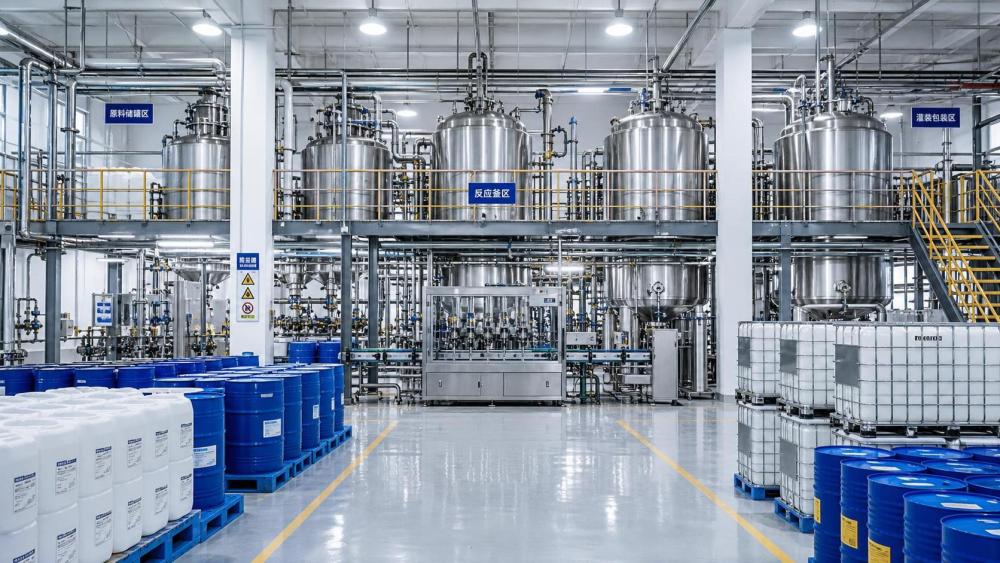
The real decision is usually about flexibility versus efficiency
A highly optimized plant is not always the right plant. If your product mix is stable and volumes are predictable, a tighter setup with higher utilization can make sense. But if you expect formula changes, customer-specific specs, or market expansion into adjacent grades, you may need more slack in the system. That could mean modular reactors, multiple packaging lines, extra storage, or a contract manufacturing backup plan.
The key trade-off is simple: more flexibility usually costs more upfront and may lower short-term efficiency, but it can save a business when demand shifts or one production line goes down. For decision-makers, the wrong move is often trying to maximize both at once. A plant built only for low-cost output can become fragile. A plant designed for every possible scenario can become too expensive to operate. Capacity should match the commercial model, not just the engineering instinct.
Don’t ignore the supply chain behind the capacity
Chemical manufacturing capacity is not only about reactors or mixers. Raw material supply, packaging availability, labor, utilities, waste handling, and compliance checks all shape what can actually be produced. A plant may have the equipment to make more, but if feedstock delivery is inconsistent or export documentation slows shipment, the effective capacity is lower than expected.
This is where broader industry intelligence becomes useful. Platforms like GEMM help users compare supplier capabilities, application requirements, technical specifications, production processes, pricing movements, and standards-related information across chemicals, materials, and related industrial sectors. That kind of structured comparison is especially helpful when a company is deciding whether to expand in-house production, outsource part of the volume, or source from multiple manufacturers to reduce risk.
A practical way to think about capacity
Instead of looking for one perfect capacity number, many teams work better with three thresholds:
- the minimum level needed to serve core demand reliably;
- the normal operating range that keeps the plant profitable;
- the upper limit you can reach without creating quality or maintenance problems.
That frame is more useful than a single annual tonnage target because it forces discussion about resilience. A business that depends on strict lead times may value stable output more than peak output. A business entering a volatile market may prefer scalable capacity, even if unit cost is a little higher. And for companies evaluating contract manufacturing, this is often the deciding point: can the partner absorb demand spikes without compromising spec control or delivery?
What decision-makers should ask before committing
A useful capacity review usually comes down to a few blunt questions. How stable is demand across the year? How many product variants must be run on the same line? What happens if one reactor, filler, or QC station is offline? Are raw materials locally available, import-sensitive, or exposed to price swings? Will future growth come from larger volumes, new formulations, or new markets with different standards?
If those answers are unclear, the capacity plan is probably not ready. In chemical manufacturing, the wrong size is expensive in either direction. Too little capacity creates missed orders and rushed outsourcing. Too much capacity creates underused assets and pressure to sell volume at weak margins. The better approach is to size for the market you can actually support, then leave room for the kind of volatility your business is likely to face.
In short, the right chemical manufacturing capacity is not the biggest one you can finance or the smallest one you can run. It is the one that fits your demand pattern, process reality, and risk tolerance closely enough to stay competitive when conditions change.
Related News
- 00
0000-00
Which sectors are driving demand in the chemical engineering market? - 00
0000-00
How to assess lifecycle emissions from CCUS for low-carbon cement - 00
0000-00
How do energy storage technologies compare for 8-hour discharge? - 00
0000-00
Do mill test reports prove industrial alloys meet ASTM standards? - 00
0000-00
How to verify plastic recycling system suppliers' throughput claims
Related tags
Weekly Insights
Stay ahead with our curated technology reports delivered every Monday.