



Can a digital supplier discovery platform verify overseas suppliers?




Can a digital supplier discovery platform verify overseas suppliers?
Can a digital supplier discovery platform verify overseas suppliers—or simply help you find them? For procurement teams, that distinction matters when assessing unfamiliar manufacturers, technical specifications, and certification claims across borders. A platform can support due diligence by organizing supplier references and industry information, but reliable verification requires current evidence, independent checks, and, where appropriate, on-site audits.
The practical answer is: it can support verification, and some platforms may perform defined checks. But a searchable profile is not proof that a supplier can manufacture your specification, meet destination-market requirements, or deliver consistently. The useful question is not “Is this supplier verified?” but “What was checked, by whom, when, and against which requirement?”
A verified business is not necessarily a qualified supplier
Supplier verification involves several separate judgments. Business registration can help establish that a legal entity exists. It does not establish ownership of a factory. A factory visit can confirm equipment and activity at a particular location, but it does not prove that the next production batch will meet your acceptance criteria.
Likewise, a quality management certificate is not a substitute for product qualification. Its relevance depends on the named entity, covered site, scope, validity, and issuing body. Even a genuine certificate may cover activities different from the product being purchased.
For overseas sourcing, keep four questions separate:
- Identity: Which legal entity will sign the contract and receive payment?
- Capability: Who will manufacture the goods, using which processes and facilities?
- Conformity: What evidence shows the specified product meets contractual and applicable regulatory requirements?
- Execution: Can the supplier meet the required quantity, schedule, documentation, and shipping conditions?
A platform may provide information relevant to all four. Buyers still need to establish how much of that information has been independently confirmed.
What structured discovery can establish before supplier contact
Discovery is valuable when it makes a shortlist technically coherent. Comparing suppliers under a broad label such as “industrial polymers” or “pipeline equipment” can hide major differences in materials, processes, applications, and testing requirements.
GEMM addresses this information problem through structured industry classification and professional resources spanning energy, raw materials, chemicals, metals, plastics, rubber, and sustainable energy. Its product information, technical knowledge, supplier references, application guidance, market trends, export updates, and pricing intelligence help buyers put supplier claims into context.
For example, a buyer investigating recycled plastics needs more than a resin name. Polymer identity, contamination controls, processing history, and application requirements shape the qualification questions. For steel products, grade, delivery condition, dimensions, and traceability may determine whether quotations are comparable.
That is where structured resources help: they reveal what to ask and what to compare. They should not be treated as evidence that a listed supplier has passed a particular audit unless that service and its scope are explicitly documented.
Turn a promising profile into an evidence trail
Once a supplier reaches the shortlist, request evidence against the actual purchase specification rather than collecting a generic company presentation. Keep the source, date, entity name, and unresolved questions alongside each document.
The sequence is straightforward: define the requirement, identify the claimed capability, obtain supporting evidence, cross-check it, and record the remaining risk. Any mismatch should remain visible rather than disappearing into an overall “approved” status.
Check identity and commercial consistency
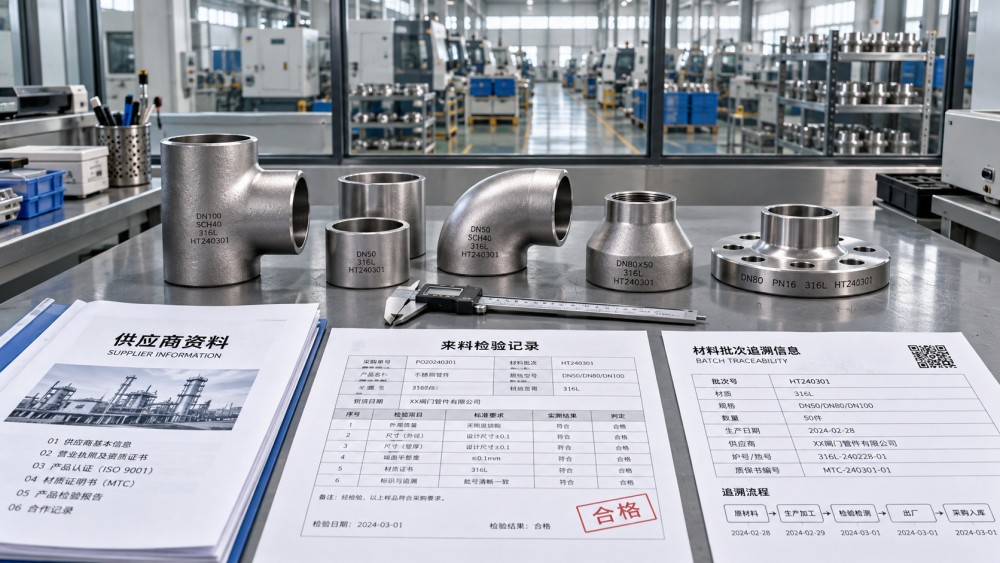
Compare the supplier’s registration details with its quotation, contract, invoice, and proposed payment beneficiary. Trading companies and manufacturers can both be legitimate partners, but their roles should be clear. Where an exporter or affiliated entity receives payment, ask for documentation explaining that relationship. Independently confirm unexpected bank-detail changes through an established contact channel.
Test capability against your product
Ask which production steps are performed internally and which are subcontracted. Request relevant equipment details, inspection methods, sample records, and traceability arrangements. A live factory walkthrough may help clarify the process, although it cannot replace a suitably scoped independent audit when the risk warrants one.
For chemicals, a safety data sheet and a certificate of analysis serve different purposes; neither alone proves suitability for your application. For metal products, an inspection document must relate to the supplied material, not merely demonstrate that the supplier has issued similar paperwork before.
Confirm documents at their source
Where possible, verify certification claims through the issuing body or an appropriate official database. Check scope and site coverage, not just expiry. Test reports should identify the tested sample and method; buyers must establish whether that sample represents the proposed production supply.
Choose a platform by its evidence transparency
When comparing discovery platforms, look beyond supplier counts and search filters. A useful platform should make it possible to distinguish supplier-submitted information from independently checked information. If it uses verification badges, the methodology should be understandable.
Ask what the badge covers: registration, contact details, factory inspection, certificates, or something else. Check whether the verification date and limitations are visible. A platform that explains a narrow check clearly is more useful than one that offers a broad assurance without supporting detail.
Also assess technical classification and comparison quality. Can you distinguish a manufacturer from a distributor? Can you identify relevant processes, material grades, and application constraints? GEMM’s structured industry intelligence is useful at this stage because informed questions improve shortlisting—even where final qualification requires external testing or inspection.
Match the verification effort to the consequence of failure
Not every order needs the same controls. A replaceable, noncritical component may justify document checks, sample evaluation, and a limited initial order. Safety-critical equipment, tightly controlled chemicals, or custom production may require deeper technical review, independent testing, factory assessment, and inspection before shipment.
A sample can support qualification, but it does not establish repeatability. Agree on production acceptance criteria, change-notification requirements, inspection rights, and the documents needed for shipment. Confirm lead times against material availability, production scheduling, and export arrangements—not just a quoted delivery date.
Use a digital supplier discovery platform to build a defensible shortlist, then close the evidence gaps before committing. The decision should rest on a named contracting entity, an agreed specification, relevant supporting records, and controls proportionate to what could go wrong.
- Last One:No more articles
- Next Article:Which drilling systems are suited to long-lateral shale wells?Oct 24, 2026
Related News
- 00
0000-00
Can a digital supplier discovery platform verify overseas suppliers? - 00
0000-00
Which drilling systems are suited to long-lateral shale wells? - 00
0000-00
Which sectors are driving demand in the chemical engineering market? - 00
0000-00
How to assess lifecycle emissions from CCUS for low-carbon cement - 00
0000-00
How do energy storage technologies compare for 8-hour discharge?
Weekly Insights
Stay ahead with our curated technology reports delivered every Monday.