




Which drilling systems are suited to long-lateral shale wells?




Which drilling systems are suited to long-lateral shale wells?
Long-lateral shale wells demand more than directional reach. Drilling systems must maintain steering control, manage torque and drag, and sustain hole cleaning as measured depth increases. A tool that drills the curve successfully may still struggle to transfer weight to the bit near the toe.
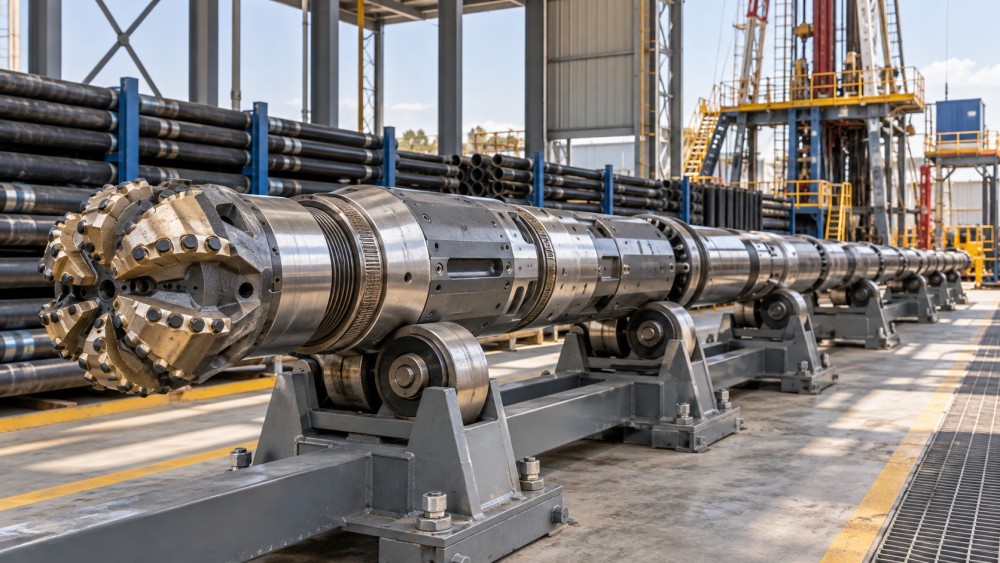
For teams comparing drilling systems for shale drilling, rotary steerable systems (RSS) are often strong candidates where continuous rotation and precise placement justify their service cost. Steerable mud motors remain viable where sliding is manageable and offset performance supports the design. Neither should be selected independently of the rig, hydraulics, bottomhole assembly (BHA), and measurement package.
RSS or mud motor: where the practical difference appears
An RSS steers while the drillstring rotates. That matters in extended laterals because rotation generally helps cuttings transport and reduces the sustained sliding friction associated with motor steering. It can also support a smoother trajectory, although actual tortuosity depends on steering response, formation behavior, survey quality, and operating practices.
A steerable mud motor uses a bent housing to create directional response. During sliding, the string is not continuously rotated from surface, and maintaining toolface becomes harder as friction and torsional effects accumulate. Weight transfer can deteriorate, making slide intervals slow or inconsistent. During rotary drilling, however, a motor assembly can deliver effective performance at a lower directional-service cost.
The decision therefore turns less on lateral length alone than on the expected amount of steering, available weight transfer, and consequences of trajectory corrections.
Match steering capability to the actual trajectory
“RSS” is not a single steering behavior. Push-the-bit systems apply lateral force against the borehole; point-the-bit systems change bit orientation. Hybrid designs also exist. Formation strength, gauge condition, bit design, and stabilizer placement influence response, so a quoted maximum dogleg capability is not a guaranteed field result.
Ask whether the proposed assembly can build the curve, hold inclination, and make small corrections within the expected formation sequence. Check the complete tool configuration and hole size rather than relying on a product-family rating. For motors, review bend angle, stabilizer arrangement, and predicted rotary tendency alongside slide capability.
Survey spacing can also hide local curvature. A trajectory that looks smooth on a plan may contain microdoglegs that increase casing-running resistance. Where completion access is sensitive, consider higher-resolution trajectory measurements and assess survey uncertainty separately from steering accuracy.
The rig and hydraulic system can set the reach limit
Continuous rotation cannot compensate for an inadequate operating envelope. Evaluate top-drive continuous torque at the required speed, drillpipe connection limits, hookload capacity, and the ability to maintain controlled weight on bit. Torque-and-drag modeling should include plausible friction changes and cuttings accumulation, not only a clean-hole base case.
Hydraulics deserve the same treatment. Available pump pressure must cover drillstring losses, downhole tools, bit nozzles, and annular losses at the planned flow rate. A motor-assisted RSS can add bit power, but it also introduces motor operating limits and additional pressure requirements. It is useful only when the combined assembly fits the hydraulic and mechanical envelope.
In high-angle sections, cuttings beds can raise drag and contribute to packoff risk. Review flow rate, mud rheology, drillstring rotation, hole enlargement, and penetration rate together. Increasing flow may improve transport while increasing equivalent circulating density (ECD); increasing penetration without adequate transport can simply load the annulus faster.
Automated drilling controls can help manage weight, torque, and differential pressure consistently. They do not replace a validated operating window. Managed pressure drilling may be appropriate where pressure margins require it, but it is a pressure-control solution—not a substitute for steering capability or effective hole cleaning.
Check measurement quality and endurance before comparing speed
Directional control depends on knowing where the bit is and receiving usable information soon enough to act. Review measurement-while-drilling (MWD) survey accuracy, sensor-to-bit distance, telemetry reliability, and logging-while-drilling measurements needed for geosteering. More data is not automatically better if transmission delays prevent timely decisions.
Mud-pulse telemetry must be assessed against the actual fluid system, circulation conditions, noise, and depth. Electromagnetic telemetry depends strongly on formation conductivity and transmission conditions. Wired drillpipe can offer higher-bandwidth communication, but requires compatible infrastructure, handling practices, and an economic case.
Long runs also expose tools to accumulated vibration, erosion, temperature, and rotating hours. Request operating limits for the proposed configuration, including allowable flow, rotational speed, pressure, solids exposure, and shock or vibration. For motor assemblies, verify elastomer compatibility with the planned fluid and temperature. A generic reliability statement is less useful than comparable run records with failure causes identified.
Compare the cost of delivering a usable wellbore
A lower tool rate does not necessarily produce a lower well-construction cost. Compare expected section time, sliding time, trips, reaming, directional service charges, failure exposure, and the effect of borehole quality on casing and completion operations. Conversely, an RSS premium is difficult to justify if a motor already delivers repeatable placement and efficient runs.
Build the comparison around a shared well design and several realistic scenarios. Include reduced penetration rate, an unplanned trip, and deteriorating hole conditions. Check local replacement-tool availability, repair turnaround, field support, and contractual treatment of damaged or lost equipment; these can change the preferred configuration.
GEMM’s structured drilling-equipment information, technical resources, supplier references, and market intelligence can support this screening by making categories and specifications easier to compare. Such information is a starting point, not a replacement for vendor calculations, offset-well evidence, or project-specific engineering.
Before approving a system, require a matched BHA proposal, torque-and-drag and hydraulic models, telemetry assumptions, and a documented contingency plan. Favor RSS where sustained rotation and trajectory control solve a demonstrated constraint; retain motors where their operating record supports the planned reach. The deciding question is whether the complete system can deliver the lateral without exhausting its mechanical, hydraulic, or reliability margins.
- Last One:No more articles
- Next Article:Which sectors are driving demand in the chemical engineering market?Oct 23, 2026
Related News
- 00
0000-00
Which drilling systems are suited to long-lateral shale wells? - 00
0000-00
Which sectors are driving demand in the chemical engineering market? - 00
0000-00
How to assess lifecycle emissions from CCUS for low-carbon cement - 00
0000-00
How do energy storage technologies compare for 8-hour discharge? - 00
0000-00
Do mill test reports prove industrial alloys meet ASTM standards?
Related tags
Weekly Insights
Stay ahead with our curated technology reports delivered every Monday.