




How to assess lifecycle emissions from CCUS for low-carbon cement




Assess lifecycle emissions from CCUS in cement by comparing two systems that deliver equivalent cement performance: a defined reference system and a system with carbon capture, utilization, or storage. Include residual plant emissions, capture energy, upstream supplies, CO₂ conditioning and transport, and the fate of captured carbon. The relevant result is the difference in greenhouse gas emissions per functional unit, expressed as CO₂ equivalent. A capture percentage alone cannot establish that difference.
A defensible assessment also separates measured operating data from design assumptions. Capture performance during steady operation, electricity emissions, and storage outcomes describe different parts of the calculation; combining optimistic values for all three can produce an unrealistic result.
Define the cement function before drawing the boundary
For a factory-gate comparison, a practical declared unit is one tonne of cement with a stated composition and performance specification. Results per tonne of clinker help explain kiln performance, but they cannot directly establish the footprint of cement with a different clinker content. Report both where clinker substitution materially affects the comparison.
Equal mass does not always mean equal function. If cement formulations require different dosages to deliver equivalent concrete strength, exposure resistance, or service life, extend the comparison to an appropriate concrete or construction function. Keep curing conditions and the age at which strength is assessed consistent. Otherwise, apparent improvements can reflect a changed performance requirement.
The system boundary should cover raw material extraction, fuel production, electricity supply, clinker and cement manufacture, capture consumables, and the complete CO₂ pathway. A factory-gate cement result that claims geological storage benefits still needs to account for the downstream transport and storage processes supporting that claim. State any exclusions and explain whether they could alter the comparison.
Translate capture performance into avoided emissions
Use a transparent calculation:
Net avoided emissions = reference lifecycle emissions − CCUS lifecycle emissions.
Net reduction fraction = net avoided emissions ÷ reference lifecycle emissions.
Both lifecycle totals must use the same functional unit, greenhouse gas characterization method, time horizon, and accounting conventions. Within the CCUS total, include residual releases and additional burdens, then apply captured-carbon accounting consistently with its origin and fate.
Capture rate requires its own denominator. A percentage measured across an absorber describes the treated gas stream. It does not establish how much of the plant’s total CO₂ is captured. Untreated stacks, bypass operation, startup, shutdown, and capture outages reduce annual plant-wide performance.
Additional fuel burned to provide capture heat can generate additional CO₂. If that gas enters the capture system, it increases both the available CO₂ and capture duty. Recalculate the integrated mass and energy balance instead of applying a nominal capture rate to the original kiln emissions. Keep captured tonnes and avoided tonnes as separate reported quantities.
Resolve the energy balance at the integration point
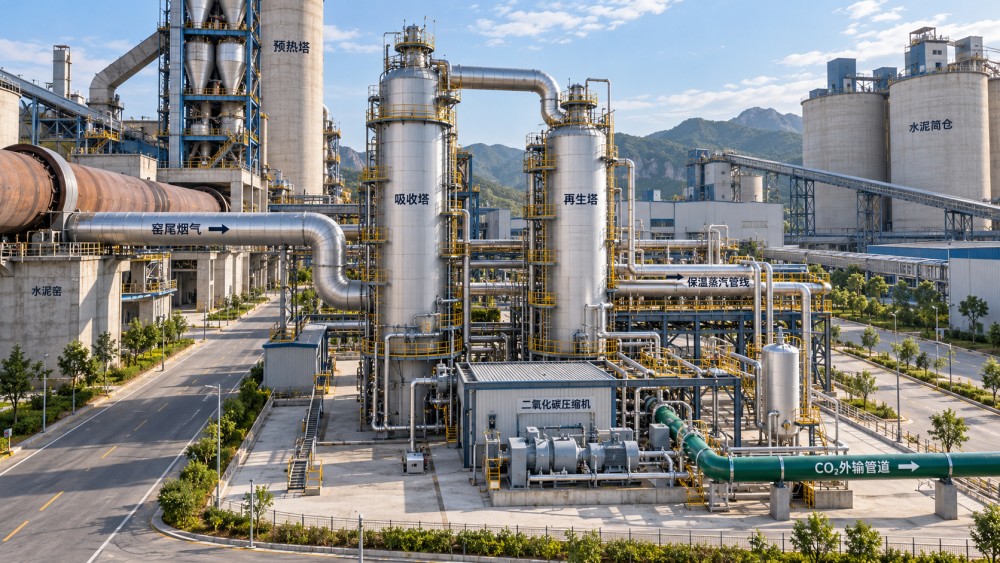
Cement emissions arise from carbonate decomposition and fuel combustion, so the assessment must represent both sources. Capture technology changes the energy balance: solvent regeneration requires heat, while gas separation, oxygen production where applicable, pumps, fans, and compression require electricity. Record these demands per functional unit and reconcile them against annual production.
Waste heat should only receive a low additional burden when its availability, temperature, and competing uses support that treatment. Heat already used for drying feed or generating electricity is not an unused resource. Diverting it requires replacement energy or reduces an existing output.
Electricity assumptions need similar care. Use supply data appropriate to the assessment’s location, period, and accounting method. If the question concerns the consequences of adding a large capture load, a separate scenario addressing changes in electricity generation is useful. Keep that scenario distinct from an attributional product footprint.
Follow captured CO₂ to its final fate
Transport calculations need the actual route and physical state of CO₂. Include conditioning at transfer points, intermediate storage, loading, unloading, and recompression where relevant. Route length alone is insufficient: pipeline transport and shipping require different infrastructure and operating inputs. Avoid counting compression twice when capture and transport inventories share an interface.
For geological storage, include injection energy, site operations, and estimated releases across the modeled chain. State the evidence supporting containment and the treatment of potential leakage. CO₂ delivered to an injection facility should not automatically be reported as an equal quantity permanently retained without accounting for operational losses and storage assumptions.
Utilization needs a product-specific carbon balance. CO₂ incorporated into a fuel is released when that fuel is used. It therefore does not provide the same retention outcome as geological storage. Any claimed benefit depends on the full production pathway and the product it replaces, including hydrogen and energy inputs where applicable.
Mineralization requires evidence of how much CO₂ becomes chemically bound and remains retained under the expected use and end-of-life conditions. Include feedstock preparation, grinding, curing, and transport. A material substitution credit also requires demonstrated equivalent function; carbon uptake alone does not prove that the resulting material displaces conventional cement.
Keep the reference scenario and credits consistent
A useful reference represents production without the proposed CCUS intervention under comparable conditions. Align capacity utilization, clinker ratio, fuel mix, electricity supply, and product performance unless a difference is explicitly part of the project. Comparing a future capture plant using cleaner electricity with a historical plant using more carbon-intensive power combines two effects. Separate them through additional scenarios.
Where useful products leave the system, disclose whether burdens are allocated between products or substitution is modeled. A credit for displaced production needs a defensible replacement ratio and a plausible displaced process. Do not combine allocation and substitution in ways that credit the same benefit twice.
Track carbon origin separately. Preventing release of fossil or limestone-derived CO₂ reduces emissions relative to a reference; it does not by itself remove atmospheric carbon. Biomass-derived CO₂ requires consistent treatment of biomass sourcing, upstream emissions, and carbon uptake before any removal claim is evaluated. Natural carbonation of cement products likewise needs equivalent treatment in both systems and a boundary that includes the relevant life stages.
Report the conditions under which the result holds
Build the central estimate from representative operation, including capture availability and annual cement output. Pilot measurements and vendor estimates can support an early assessment, but their scale, operating conditions, and uncertainty should remain visible. Reconcile kiln carbon inputs, stack releases, captured CO₂, and exported CO₂ through a mass balance.
Sensitivity analysis should focus on variables capable of changing the conclusion: heat source, electricity intensity, capture availability, clinker content, and utilization credits. Vary linked parameters together where necessary. Lower capture operation, for example, changes captured output and energy consumption; treating those changes as independent can create physically inconsistent scenarios.
Report reference and CCUS footprints alongside net avoided emissions, with contributions from residual plant emissions, energy, upstream materials, transport, and final CO₂ fate. If the result changes sign across credible operating scenarios, identify the limiting condition explicitly. A low-carbon cement claim is then tied to verifiable operating requirements rather than a capture-unit rating.
Related News
- 00
0000-00
Which sectors are driving demand in the chemical engineering market? - 00
0000-00
How to assess lifecycle emissions from CCUS for low-carbon cement - 00
0000-00
How do energy storage technologies compare for 8-hour discharge? - 00
0000-00
Do mill test reports prove industrial alloys meet ASTM standards? - 00
0000-00
How to verify plastic recycling system suppliers' throughput claims
Related tags
Weekly Insights
Stay ahead with our curated technology reports delivered every Monday.