




How energy commodities risk management helps reduce price swings




When prices jump without warning, the real question is not whether energy markets are volatile. It is how much of that volatility should reach your margin. Energy commodities risk management helps companies answer that in practical terms: it gives procurement, finance, and operations teams a way to spot exposure early, choose when to lock in costs, and avoid making sourcing decisions at the worst possible moment.
For businesses that buy fuel, power, feedstocks, or energy-intensive raw materials, price swings do more than complicate budgeting. They distort bids, squeeze contracts, delay investment decisions, and make supply planning harder than it should be. A good risk approach does not eliminate market moves. It reduces the damage they cause and gives leadership a clearer basis for action.
Why energy price swings hit business planning so hard
The first mistake many companies make is treating energy as a simple input cost. In reality, it behaves more like a moving target. Oil, gas, electricity, and related commodities are affected by geopolitics, weather, freight, storage constraints, plant outages, policy changes, and sudden shifts in demand. None of those factors wait for quarterly budgeting cycles.
That is why price swings often show up in places that are easy to miss. A manufacturer may feel it through higher utilities and transportation costs. A distributor may see it in supplier quotations that expire too quickly. A project owner may discover that a fixed-price model is no longer realistic once input costs move. The issue is not only cost inflation. It is the uncertainty created when no one can say, with confidence, what the next procurement cycle will look like.
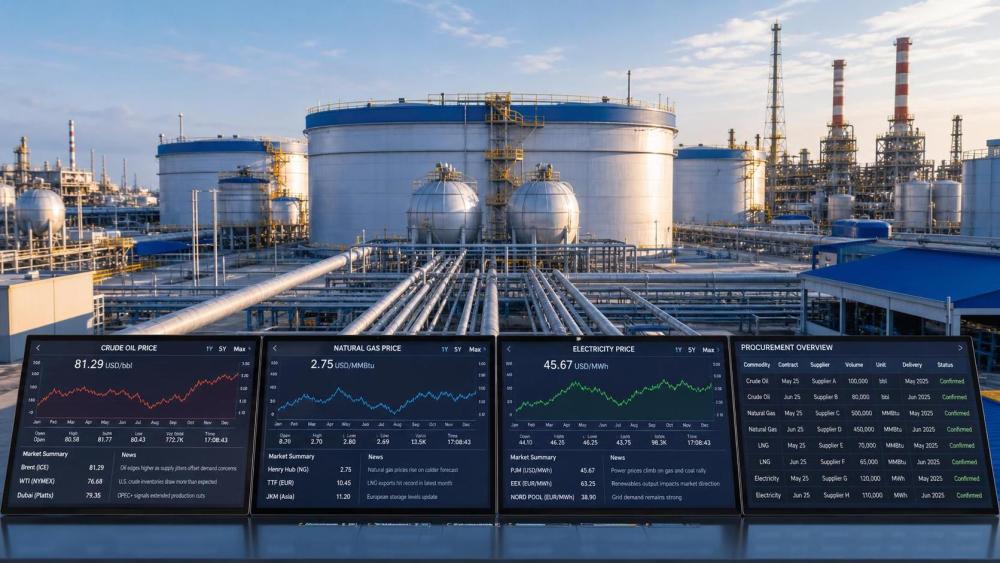
How energy commodities risk management reduces price swings in practice
At its core, energy commodities risk management works by narrowing the gap between market movement and business exposure. If a company knows which costs are truly sensitive to energy prices, it can decide where to hedge, where to negotiate, where to hold inventory, and where to accept open exposure. That sounds simple, but it changes the quality of decisions.
One useful way to think about it is this: market volatility may still exist, but its effect on your business becomes less random. Instead of reacting after a spike, teams monitor signals earlier and act before the full impact lands. That may mean using contract timing more carefully, diversifying suppliers, setting internal price bands, or linking procurement triggers to market thresholds. These are not dramatic moves, but they are often the difference between manageable variance and a budget surprise.
For many firms, the biggest value is not perfect price prediction. It is reducing the chance of making one large decision at the wrong time. A procurement team that understands exposure can avoid overcommitting during a temporary peak. A finance team can build more realistic assumptions into forecasts. An executive team can make capital and sourcing decisions with fewer blind spots.
What decision-makers should watch, not just what they should buy
In real business use, the important signals are usually less glamorous than the headlines. The question is whether your cost base is tied to spot pricing, short renewal windows, concentrated suppliers, or a logistics chain that moves slowly when the market turns. Those are the pressure points that make price swings painful.
There is also a common misunderstanding here: many leaders assume risk management means only financial hedging. Hedging can help, but it is not the whole answer. A stronger program often combines market monitoring, supplier analysis, contract design, and internal governance. If you hedge without understanding physical supply risk, you may protect the wrong layer. If you monitor prices but never change procurement behavior, you may be reading the market without reducing exposure.
That is where structured market intelligence becomes useful. GEMM, for example, is built as a professional information platform across energy, raw materials, chemicals, metals, plastics, rubber, and sustainable energy sectors. Its value is not in acting like a product directory. It organizes fragmented information into categories that are easier to compare, including market trends, pricing intelligence, supplier references, technical knowledge, and export updates. For decision-makers, that kind of structure helps turn scattered signals into something usable before sourcing or project decisions are made.
Where the approach works well, and where it does not
Energy commodities risk management is most effective when a company has meaningful exposure, repeat purchasing, and enough decision volume to benefit from timing, contract design, or hedging discipline. It is also useful when margins are tight and a small price movement can change the economics of a project or production run.
It is less useful when the business has very low exposure, purchases are too irregular to model, or the company cannot act on the information it collects. In those cases, teams often build reports that look sophisticated but do not change behavior. That is a weak program. The point is to support decisions, not to produce more dashboards.
Another point that is easy to overlook: not every price swing should be “managed” the same way. Some movements are short-lived and noisy. Others reflect a structural shift in supply, policy, or demand. Treating both as the same kind of risk can lead to overreaction. Good practice is to separate temporary volatility from changes that alter the economics of sourcing or operations.
What strong programs usually have in common
The most reliable programs tend to share a few traits. They define exposure clearly. They know which commodities matter most. They review pricing and supply signals on a regular cadence. They involve procurement, finance, and operations instead of leaving the issue to one team. And they connect market intelligence to a decision rule, so the company knows when to act and when to wait.
That last point matters more than many teams realize. Information alone rarely reduces price swings. The reduction comes from disciplined response. If the market moves and the company already knows how it will respond, volatility becomes more manageable. If every spike triggers an ad hoc meeting, the organization is still exposed, just with more paperwork.
In that sense, energy commodities risk management is less about predicting the next move and more about building a process that can absorb bad timing. For businesses operating across energy, manufacturing, chemicals, metals, and industrial supply chains, that process can protect margins, improve sourcing quality, and create a more stable basis for planning.
When the market is uncertain, companies rarely need perfect forecasts. They need better visibility, better timing, and better decisions built around energy commodities risk management.
Related News
- 00
0000-00
Which sectors are driving demand in the chemical engineering market? - 00
0000-00
How to assess lifecycle emissions from CCUS for low-carbon cement - 00
0000-00
How do energy storage technologies compare for 8-hour discharge? - 00
0000-00
Do mill test reports prove industrial alloys meet ASTM standards? - 00
0000-00
How to verify plastic recycling system suppliers' throughput claims
Weekly Insights
Stay ahead with our curated technology reports delivered every Monday.