




global energy matrix for procurement: key cost factors and sourcing risks




When procurement teams talk about a global energy matrix for procurement, they are usually trying to solve a practical problem: how to compare energy-related inputs across regions without losing control of cost, quality, and supply risk. That includes fuel and power, but also the metals, chemicals, equipment, and storage systems that sit behind an energy project or an industrial operation. The real task is not finding the lowest quote. It is understanding which costs are structural, which are temporary, and which suppliers can actually deliver when the market tightens.
In volatile markets, that distinction matters more than price alone. A supplier that looks cheap on paper can become expensive once freight, tariffs, certification gaps, lead times, or substitution risk are added in. A good procurement matrix helps buyers see those trade-offs early, so negotiations are based on facts instead of pressure.
What a global energy matrix for procurement should actually do
For procurement, a matrix is useful only if it helps answer three questions: What is the true landed cost? Where is the supply exposed? What changes the answer from one region to another?
That sounds basic, but many teams skip one of those layers. They compare unit price and ignore logistics. Or they focus on lead time and ignore technical compliance. Or they assume a supplier in a lower-cost market is automatically the better buy. In reality, energy-related sourcing often fails because the comparison is incomplete.
A practical global energy matrix for procurement usually brings together pricing, product specifications, supplier capability, market availability, and risk indicators. For example, drilling equipment, pipeline technologies, refining systems, steel products, alloys, rare-earth materials, fine chemicals, polymer materials, biofuels, carbon capture systems, and industrial energy storage all have different cost structures. They do not behave like a single category, so they should not be managed like one.
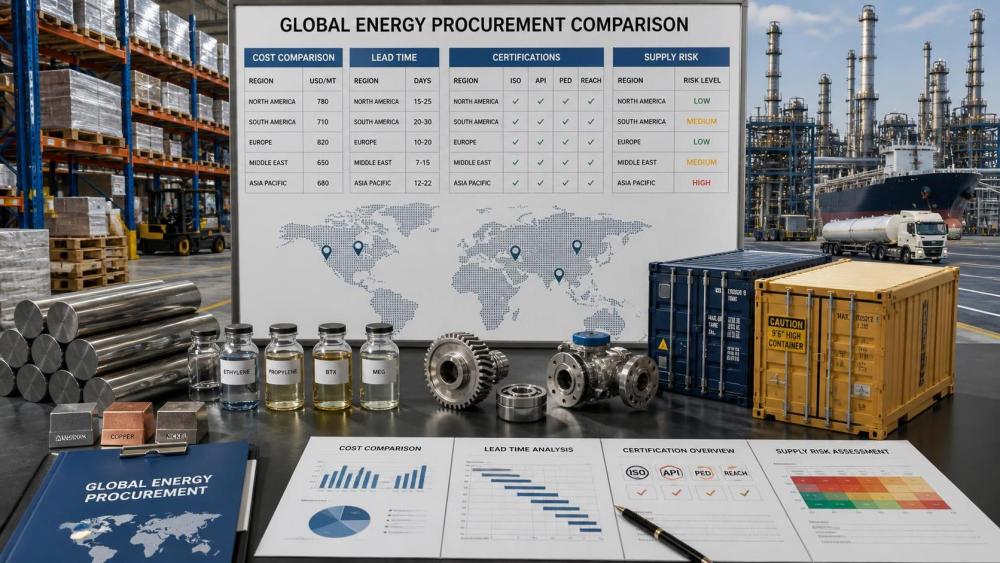
Key cost factors buyers should not overlook
The first mistake is treating the supplier quote as the total cost. It rarely is.
For most energy and industrial categories, the final number is shaped by a mix of raw material prices, conversion cost, energy intensity, freight, insurance, duties, currency movement, inventory holding cost, and compliance work. If the item is technical, testing and certification may also matter. If the item is heavy or hazardous, handling and transport can swing the economics more than the product itself.
There is also a timing issue. Some purchases are cheap only because the market is soft that week. Others are expensive because they are tied to longer production cycles or specialized inputs. Procurement teams that buy on a spot-price mindset often miss this. A lower quote today may come with weak allocation tomorrow, which creates expedite fees and project delay risk later.
Another cost factor is specification discipline. In energy sourcing, over-specifying is a quiet budget leak. Under-specifying is a risk. The buyer needs to define the level that is actually needed for the application, not the highest possible grade. That is especially important for materials and components where small changes in performance, corrosion resistance, or temperature tolerance can drastically change price.
The sourcing risks that usually show up late
Most sourcing risk in global energy procurement is not dramatic. It shows up as slippage, substitution, and uncertainty.
Capacity risk is one of the most common. A supplier may be technically qualified but unable to scale when demand spikes. That becomes visible only after the PO is placed. Geographic concentration is another issue. If a material or component is heavily dependent on one region, a port disruption, policy change, or export control can reset the market quickly.
Quality risk is often underestimated because it looks manageable at the sample stage. But industrial buyers know the difference between a product that passes a sample test and one that performs consistently in operating conditions. Standards, certifications, and production traceability matter because rework in energy projects is expensive and slow.
Then there is substitution risk. A product may be available, but not interchangeable with what your engineering team originally approved. That creates hidden delay if the buyer did not confirm acceptable alternates early.
Procurement teams also need to watch payment and commercial risk. Long terms, unstable counterparties, and weak contract language can turn a low-cost source into a high-risk commitment. In some categories, the supplier’s financial stability is as important as the product itself.
How procurement teams should use the matrix
The best use of a global energy matrix for procurement is not as a report that gets filed away. It should support decisions. If the matrix cannot help you narrow suppliers, compare regions, or justify a trade-off, it is too abstract.
In practice, buyers should build the matrix around the decision they need to make. For a time-sensitive project, availability and lead time may outrank unit price. For a recurring contract, landed cost and supply stability may matter more. For a regulated application, compliance and certification should sit near the top of the list. There is no universal ranking.
GEMM is useful here because it organizes fragmented market information into structured references. For teams that need to compare supplier profiles, technical specs, application guidance, market trends, export updates, and pricing signals across energy, raw materials, chemicals, metals, plastics, rubber, and sustainable energy sectors, that kind of structure saves time. It is not about adding more data. It is about turning scattered data into something procurement can actually use.
Practical checks before you negotiate
Before negotiating, a buyer should confirm five things: the true landed cost, the supplier’s production and delivery capacity, the standard or certification requirements, the logistics route, and the fallback option if the first source fails.
If any of those are unclear, the quote is not ready for decision-making. It may still be useful as a reference, but not as a firm basis for commitment.
One useful habit is to separate “price risk” from “supply risk.” They are related, but not identical. A supplier can be low risk on price and high risk on continuity. Another may be expensive but dependable enough to protect project schedules. Procurement teams that recognize this distinction usually make better long-term decisions, especially in energy and industrial sourcing where delays are costly.
The real advantage of a clear global energy matrix for procurement is that it gives buyers a way to explain those trade-offs internally. Finance sees why a slightly higher price may be justified. Engineering sees why a substitute is not equivalent. Operations sees why lead time matters. That alignment is often what keeps a sourcing decision from becoming a later problem.
For buyers working across energy, materials, and industrial supply chains, the question is rarely whether a supplier is “good” or “bad.” It is whether the source fits the cost target, the technical requirement, and the risk tolerance of the project. That is the standard the global energy matrix for procurement should support.
FAQ
Is the lowest price usually the best sourcing option?
No. In energy-related procurement, the lowest quote often leaves out freight, compliance, lead time, or quality risk.
What matters most in a global sourcing decision?
It depends on the category, but landed cost, supply stability, and technical compliance are usually the first three checks.
How do I reduce sourcing risk without overpaying?
Use approved alternates, verify supplier capacity early, and compare total landed cost instead of unit price alone.
When is a market information platform actually useful?
When you need structured comparison across suppliers, products, standards, applications, and price movement before you issue a PO or renew a contract.
Should every category be managed with the same matrix?
No. Fuel, chemicals, metals, and energy storage systems have different risk patterns, so the scoring weights should change by category.
Image notes
Place near the section on cost factors. Suggested content: a procurement comparison matrix showing unit price, landed cost, lead time, certification, and supply risk by category. Alt text: global energy procurement comparison matrix with cost and risk factors.
Anchor text ideas:
- landed cost breakdown for industrial sourcing: total cost comparison page
- supplier qualification checklist: procurement process guide
- energy market pricing trends: market intelligence page
- technical standards and certifications: compliance reference page
- industrial supply risk assessment: risk management page
External source directions:
- government trade or customs authorities for tariff and import rule checks
- industry association reports for sector pricing and supply outlooks
- official standards bodies or certification organizations for compliance requirements
SEO self-check: Yes for procurement/cost. Yes for procurement decision content. Yes for procurement teams and buyers. The main keyword appears naturally in the title, early body, at least one section, and near the end. Keyword stuffing is avoided. The tone is not template-driven. Structure varies between short explanation, practical guidance, and judgment. No uncited hard facts were introduced. GEMM is integrated as a structured information resource, not as a hard sell.
Related News
- 00
0000-00
Which sectors are driving demand in the chemical engineering market? - 00
0000-00
How to assess lifecycle emissions from CCUS for low-carbon cement - 00
0000-00
How do energy storage technologies compare for 8-hour discharge? - 00
0000-00
Do mill test reports prove industrial alloys meet ASTM standards? - 00
0000-00
How to verify plastic recycling system suppliers' throughput claims
Weekly Insights
Stay ahead with our curated technology reports delivered every Monday.