




What Trade Tariffs Will Affect Rare Earth Imports in 2026?




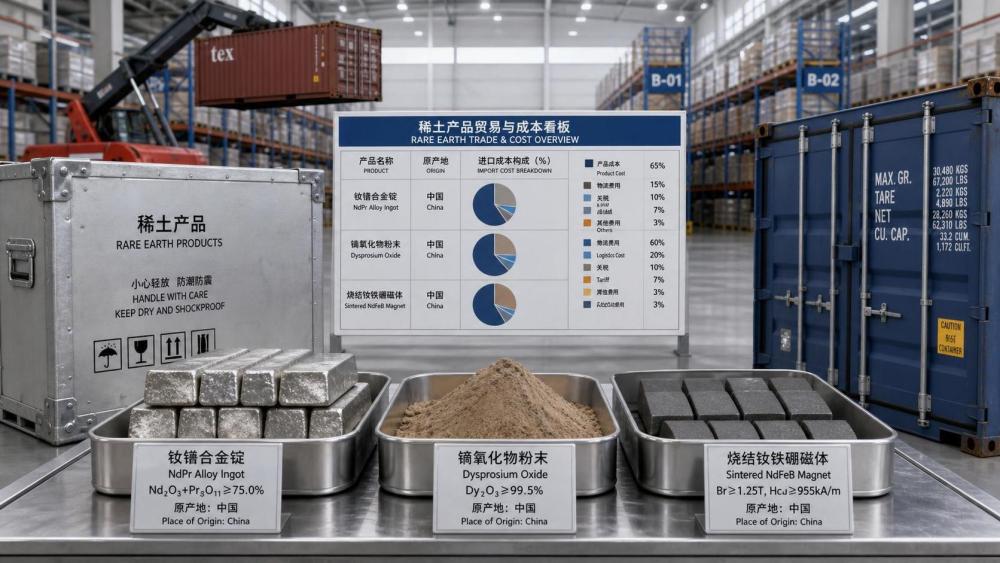
Rare earth import costs in 2026 will be shaped less by a single “rare earth tariff” than by the interaction of product classification, country of origin, processing stage, and destination-market policy. For a buyer importing neodymium-praseodymium alloy, dysprosium oxide, terbium metal, or permanent magnets, the tariff answer can differ even when the underlying rare earth element is the same.
The practical question is therefore not simply whether rare earth materials face tariffs. It is: which tariff measures apply to the specific HS code, declared origin, and form of material entering a particular market? Companies planning 2026 purchases should treat tariff exposure as a landed-cost and supply-continuity issue, rather than an item to review only when goods reach customs.
Start with the material form, not the element name
“Rare earth” is a commercial and technical category, not a customs classification. A shipment described internally as “neodymium material” may be imported as a mixed rare-earth carbonate, separated oxide, fluoride, metal, alloy, magnet powder, sintered magnet, or a finished component containing magnets. Those forms can sit under different tariff headings and can be subject to different trade measures.
This distinction matters because governments may apply tariffs selectively to upstream materials, semi-finished products, or downstream goods. A tariff schedule can also distinguish between unwrought metals and alloys, chemical compounds, machinery components, and finished electrical equipment. Importing an NdFeB magnet inside a motor or actuator can produce a different customs outcome from importing the same magnet as a standalone part.
Before pricing a 2026 contract, procurement and trade-compliance teams should establish a product record that includes:
- The material’s chemical composition and physical form.
- The proposed customs classification in the destination market.
- Whether it is a mixed concentrate, separated compound, metal, alloy, powder, magnet, component, or finished product.
- The country where the imported article acquired its customs origin.
- The country of export, which may differ from origin.
- The intended end use, where a tariff exclusion or special customs treatment depends on use.
A supplier invoice saying “rare earth metal” is rarely enough. Customs authorities assess the declared product, supporting technical evidence, and origin rules. Vague material descriptions make it harder to model duty exposure and raise the chance of inconsistent declarations between shipments.
Four tariff layers that can affect 2026 imports
For most buyers, the total duty burden is built from several possible layers. The base customs duty is only the starting point.
In the United States, importers should assess whether an item is covered by ordinary tariff treatment and whether any additional country-based tariff program applies to its tariff line and origin. Measures adopted under trade authorities such as Section 301 have historically required this type of line-by-line review for China-origin goods. The applicable treatment depends on the active tariff schedule, published exclusions, product scope, and effective dates at entry.
That does not mean every China-origin rare earth product will receive the same treatment. A separated oxide, a rare earth alloy, a permanent magnet, and an assembled industrial component may be treated differently. Nor should buyers assume that routing goods through a third country removes exposure. Customs origin is generally based on the relevant origin rules and degree of transformation, not simply the port from which a shipment departs.
Other importing markets have their own tariff schedules, free-trade arrangements, trade remedies, and origin requirements. A purchasing strategy that is workable for U.S. imports may be unsuitable for the European Union, the United Kingdom, Japan, India, South Korea, or another manufacturing destination. A global sourcing team should model duty by importing entity and destination rather than applying one blended tariff assumption to all facilities.
Trade policy is also broader than tariffs. Export licensing, export controls, customs inspections, sanctions rules, and restrictions on technology transfer can affect whether rare earth material is available, even if import duty itself is low. These measures may add delay, documentation requirements, or uncertainty without appearing in the duty-rate calculation.
Origin is often the commercial fault line
Rare earth supply chains frequently cross several borders. Ore may be mined in one jurisdiction, separated into oxides in another, reduced into metal or alloyed elsewhere, then converted into magnets or components in a fourth location. Each commercial step matters, but customs origin does not automatically follow the most recent shipment or invoice.
A distributor selling from a warehouse in Singapore, Germany, or Mexico may be supplying goods whose origin remains elsewhere. Likewise, simple repacking, sorting, relabeling, or minor processing may not create a new origin for tariff purposes. A buyer that assumes a non-origin-country shipping point solves a country-specific tariff issue may face an unexpected reassessment, penalties, or supply disruption.
The origin analysis becomes especially important for magnet supply. Moving magnet assembly or motor production to a different country can change the sourcing map, but whether the finished good qualifies as originating there depends on the applicable legal test. The answer may involve tariff-shift rules, regional value content, substantial-transformation analysis, or product-specific rules under a trade agreement.
For 2026 contracting, request origin documentation early rather than after a purchase order is issued. Useful evidence may include manufacturer declarations, bills of material, process-flow descriptions, production-site information, and records identifying the origin of material inputs. The appropriate evidence will depend on the importer’s jurisdiction and the treatment being claimed.
Do not confuse tariffs with rare earth export restrictions
One recurring error in rare earth planning is treating export restrictions and import tariffs as the same risk. They are connected commercially, but they operate differently.
An import tariff raises the landed cost of goods that can enter the destination market. An export control, licensing requirement, or foreign restriction can constrain the supplier’s ability to ship the material at all, delay shipment approval, restrict technical information, or alter the set of eligible buyers. A shipment may face no special import tariff and still be difficult to procure because its export path is constrained.
This is particularly relevant for heavy rare earths and specialized magnet inputs, where supply chains can be concentrated by processing capability rather than by mining alone. Buyers should create separate questions for their risk review:
- What duty applies when the goods enter the destination country?
- Can the exporter legally ship this product, quantity, and technical specification?
- Are there licensing, end-use, or end-user requirements?
- Can customs origin be supported with documents that match the declared treatment?
- What happens if a tariff change takes effect while goods are in transit or in bonded storage?
Combining all of these questions into one “China risk” or “tariff risk” label can obscure the action required. The trade-compliance owner may be able to calculate duty, while the sourcing team must solve for alternative processing capacity, lead time, and technical qualification.
How to calculate the exposure before placing orders
A useful tariff review should be performed at the stock-keeping-unit or material-specification level. High-level category labels are too broad for a defensible landed-cost estimate.
1. Lock down classification and specification
Obtain the technical data needed to classify the goods: chemical assay, alloy composition, particle size where relevant, whether the product is sintered or bonded, magnetization status if relevant to the tariff line, packaging form, and intended application. Classification should be aligned across supplier documents, customs entry data, purchase orders, and internal ERP records.
2. Confirm the origin path
Map where the material was mined, separated, processed, alloyed, fabricated, and shipped. The goal is not to build a marketing supply-chain map; it is to identify the production step that determines customs origin under the applicable rules. Where the classification or origin result is uncertain, a formal customs ruling or qualified local trade advice may be justified before a large or multi-year commitment.
3. Separate duty from total landed cost
Duty should be calculated on the relevant customs value, which may not equal a simple supplier unit price. Freight, insurance, assists, royalties, commissions, transfer-pricing arrangements, and Incoterms can affect the analysis depending on the jurisdiction and transaction structure. Add brokerage, testing, storage, demurrage exposure, financing costs, and potential tariff-related cash-flow effects to reach a usable procurement number.
4. Test contractual timing
Tariff changes are commonly tied to entry dates, not the date a purchase order was signed. A fixed-price contract can leave the buyer carrying the increase if tariff responsibility is not expressly allocated. Long-lead rare earth materials deserve clauses addressing changes in duty, export-control delays, documentary obligations, shipment timing, and alternatives when a named origin becomes commercially impractical.
5. Build a second scenario, not just a second supplier
A second supplier that uses the same separated oxide source, the same magnet producer, or the same origin country may not reduce trade exposure. A meaningful alternative should be tested for material qualification, origin, processing route, capacity, shipping lane, and its own tariff treatment. For high-performance magnets, a replacement source also needs to meet magnetic properties, dimensional tolerances, coating requirements, and reliability expectations; a lower-duty item that fails qualification is not a viable substitute.
Where buyers make the wrong assumptions
The first mistake is assuming raw material duty determines the cost of the finished system. In many applications, rare earth content enters through magnets embedded in motors, generators, sensors, medical devices, robotics, defense equipment, or consumer electronics. The import classification of the finished item can matter more to the delivered product cost than the duty on standalone oxide or alloy.
The second is using supplier nationality as a proxy for origin. A supplier headquartered outside a tariff-affected country may source, process, or manufacture there. Conversely, a producer operating in a third country may have a legitimate origin profile that differs from its parent company’s location. Documentation and manufacturing facts carry more weight than corporate branding.
The third is assuming a tariff exemption is permanent or broadly transferable. Exclusions, quotas, preferential rates, and special customs programs can have strict product descriptions, effective dates, usage conditions, and filing requirements. A rate applied successfully to one batch does not establish treatment for a slightly different product form or later import date.
Finally, tariff avoidance through artificial routing or paperwork changes is a serious compliance risk. Supply-chain redesign can be lawful when it reflects real production and satisfies origin rules. Cosmetic processing, inaccurate origin statements, and declarations that do not match the actual manufacturing sequence create a different kind of cost exposure: audits, retroactive duties, enforcement action, and disrupted customer deliveries.
What to monitor through 2026
Rare earth import planning should be reviewed whenever a policy notice changes the tariff schedule, an exclusion is added or expires, a trade-remedy investigation expands, or an export-control measure affects a material family. The most relevant watchpoints are the tariff lines attached to actual purchases, not general headlines about critical minerals.
For manufacturers with recurring demand, maintain a live register linking each material or component to its HS classification, origin evidence, applicable duty assumptions, supplier processing route, contract allocation of tariff risk, and qualification status. This makes it easier to see where a policy change affects a single low-volume input and where it threatens a production-critical magnet or alloy.
In 2026, the question of what trade tariffs affect rare earth metal imports will rarely have a one-line answer. Buyers that define the imported form precisely, verify origin before shipment, separate tariff analysis from export-control risk, and price multiple supply scenarios will be better positioned to make procurement decisions before policy changes become production problems.
Related News
- 00
0000-00
Which sectors are driving demand in the chemical engineering market? - 00
0000-00
How to assess lifecycle emissions from CCUS for low-carbon cement - 00
0000-00
How do energy storage technologies compare for 8-hour discharge? - 00
0000-00
Do mill test reports prove industrial alloys meet ASTM standards? - 00
0000-00
How to verify plastic recycling system suppliers' throughput claims
Related tags
Weekly Insights
Stay ahead with our curated technology reports delivered every Monday.