




Can Different Plastic Grades Be Mixed in the Recycling Process?




Different plastic grades can be mixed in recycling, but only when the materials are sufficiently compatible and the intended end use can tolerate the resulting property changes. Mixing plastics simply because they share a recycling stream is not the same as producing a reliable recycled resin. A blend may run through a grinder and extruder without obvious difficulty, yet still fail later through brittleness, poor surface finish, unstable melt flow, odor, discoloration, or inconsistent mechanical performance.
The practical question is therefore not merely, “can you mix different grades of plastic in the recycling process?” It is: which materials are being mixed, at what ratio, under what processing conditions, and for which product specification? The answer changes significantly between two polyethylene grades, between virgin and recycled polypropylene, and between chemically different resins such as polypropylene and polyethylene.
Start with polymer family, not the recycling code alone
The first separation point is the base polymer. Plastics with the same resin family often have a better chance of being blended than plastics from different families, although “same family” does not guarantee identical processing behavior or final performance.
For example, high-density polyethylene (HDPE) and low-density polyethylene (LDPE) are both polyethylene. They can be physically blended, and mixed PE streams are used in some applications. However, HDPE has a more crystalline structure and generally contributes stiffness, while LDPE contributes flexibility and different flow behavior. A mixed HDPE/LDPE recyclate may therefore be acceptable for products such as non-critical film, bins, crates, boards, or certain molded items, but may be unsuitable where a tightly controlled density, stiffness, environmental stress crack resistance, or film performance is required.
By contrast, polypropylene (PP) and polyethylene (PE) are usually problematic when mixed without a compatibility strategy. They are both common polyolefins and have relatively close processing temperatures, so a contaminated stream may still be extruded. Yet they do not naturally form a strong, uniform phase structure. The interface between PP and PE can become a weak point, reducing impact strength, elongation, and consistency. This is one reason mixed polyolefin recyclate is often directed to lower-specification applications unless sorting, compatibilization, and quality controls are strong.
More chemically distinct combinations raise the risk further. PVC contamination in a PET stream is particularly serious because PVC can degrade at PET processing temperatures and release acidic degradation products. Even small quantities may contribute to discoloration, gels, processing instability, or degradation of the PET. PET mixed with polyolefins also creates separation and quality issues because the materials differ in density, melting behavior, and polarity. These combinations should be separated rather than treated as routine blend components.
Recycling identification codes are useful for initial sorting, but they are not a full technical specification. Code 2 identifies HDPE and code 5 identifies PP, yet neither code reveals molecular weight, melt flow rate, filler loading, flame-retardant content, colorants, stabilizers, or prior service history. These differences can matter as much as the resin code.
“Different grades” can mean very different things
Within one polymer family, grades are formulated for different conversion methods and product requirements. Injection molding PP, fiber-grade PP, extrusion-grade PP, and impact-modified PP may all be classified as PP, but they are not automatically interchangeable. Their molecular weight distribution, additives, stiffness, flow, and impact balance can differ substantially.
A common example is mixing high-melt-flow PP regrind with a lower-flow PP stream. The blend can exhibit a melt flow rate between the inputs, but the result is not always predictable from a simple average. Thermal history, degradation during previous processing, filler content, and contamination affect viscosity. In injection molding, an uncontrolled blend may fill a mold more easily but produce weaker weld lines, higher shrinkage variation, or unstable cycle conditions. In extrusion, it may alter die pressure, drawdown, and dimensional control.
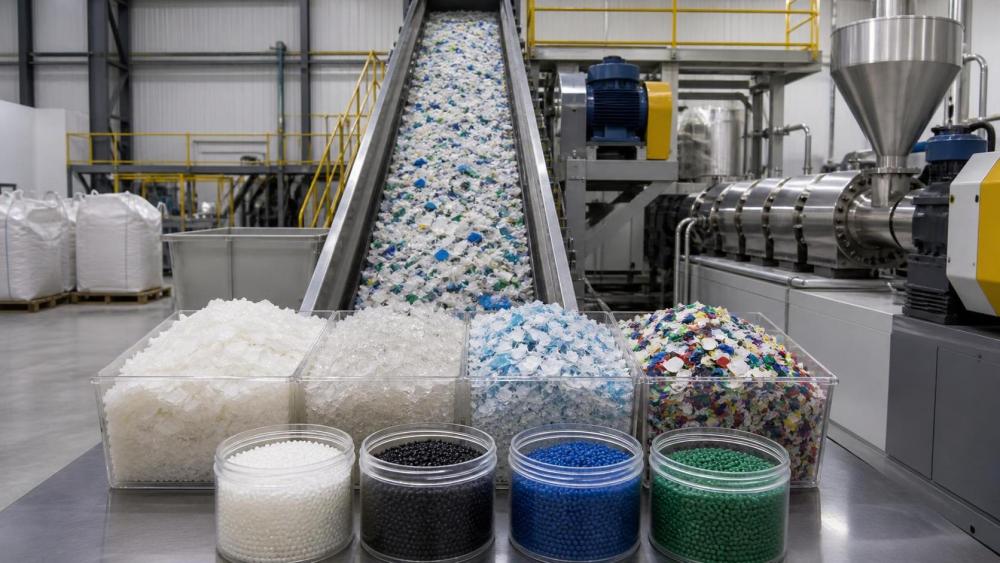
Color is another grade-level issue with commercial consequences. Clear, natural, white, and dark recyclates should not be assumed to have equal value or equal suitability. Once colored materials are mixed, the output commonly moves toward darker shades. This may be acceptable for black utility products but prevents use in transparent, light-colored, or appearance-sensitive applications. A processor that mixes natural HDPE with pigmented household containers may still make a usable resin, but it has permanently narrowed the downstream market.
Filled and reinforced grades require particular caution. Calcium carbonate, talc, glass fiber, wood flour, mineral fillers, or conductive additives can alter density, stiffness, moisture sensitivity, wear on equipment, and flow. A recycled PP stream containing unknown talc-filled components may look similar to unfilled PP but behave very differently in a molded part. If the buyer expects a density range or ash-content limit, visual inspection is inadequate.
Additives can be more disruptive than the base resin
Recycled material carries the additive history of its original product. This includes pigments, UV stabilizers, antioxidants, slip agents, flame retardants, plasticizers, impact modifiers, adhesives, inks, coatings, and residues from labels or product contents. Some additives are beneficial in the new blend; others interfere with processing or create compliance concerns.
Plasticized PVC is an obvious case: the polymer itself differs from rigid PVC, and the presence of plasticizers changes its behavior. Similarly, a packaging stream may contain barrier layers, tie layers, adhesives, metallized coatings, and paper residues that are difficult to identify after shredding. Multi-layer flexible packaging can contain polyethylene, polypropylene, polyamide, EVOH, and adhesive layers in one structure. Mechanical recycling may produce a blended material, but it will not reproduce the predictable performance of a single-resin grade.
Odor and volatile contamination also affect whether mixed material can be sold into a particular use. Recyclate derived from household, agricultural, automotive, electronic, industrial, or food-contact sources does not carry the same contamination profile. A mechanically acceptable compound may still be inappropriate for enclosed consumer products, light-colored articles, hygiene-related uses, or applications with stringent odor limits.
Sorting quality determines whether mixing is controlled or accidental
Intentional blending is a formulation decision. Accidental mixing is a sorting failure. The distinction matters because controlled blending begins with known inputs, defined ratios, representative testing, and a target specification. Uncontrolled mixed waste begins with uncertainty.
Manual sorting, near-infrared (NIR) identification, density separation, air classification, metal removal, washing, flake sorting, and melt filtration each address different contaminants. No single step eliminates every issue. NIR systems can identify many polymer surfaces, but black materials, labels, multi-layer structures, moisture, dirt, and particle size can reduce sorting effectiveness. Float-sink separation can distinguish certain materials by density, but it cannot fully resolve plastics with similar density or distinguish grades within the same resin type.
Sorting before size reduction is generally more valuable than trying to correct a heterogeneous stream after it has been ground into flakes. Once incompatible fragments are dispersed through a flake lot, the cost of obtaining a high-purity output rises sharply. For buyers, the relevant question is not whether a supplier has a sorting line, but what feedstock definition, sorting sequence, contamination controls, and batch-release criteria support the supplied grade.
Processing can hide incompatibility without solving it
Extrusion and pelletizing create a uniform-looking pellet, but a visually consistent pellet does not prove molecular compatibility. In an incompatible blend, one polymer can remain dispersed as droplets or domains within another. Under load, these boundaries may initiate cracks or reduce impact resistance. The defect may only become visible after molding, cold-temperature exposure, repeated loading, or environmental stress.
Compatibilizers can improve some blends. These are reactive or functional polymers designed to improve adhesion between otherwise incompatible phases. For example, grafted polyolefins may be used in certain PP/PE or polyamide/polyolefin systems. Their use requires formulation control: the correct compatibilizer type, dosage, dispersion, residence time, and temperature profile must be selected for the blend. Adding a compatibilizer is not a universal remedy for poorly sorted feedstock, nor does it remove contamination from PVC, metals, paper, silicone, or degraded material.
Heat exposure also compounds the problem. Each mechanical recycling cycle can cause some degree of chain scission, oxidation, crosslinking, or additive depletion, depending on polymer and conditions. PET is especially sensitive to moisture during melt processing and requires effective drying to prevent hydrolytic degradation. Polyolefins may undergo oxidation and molecular-weight changes when exposed to excessive heat and oxygen. A mixture of grades with different thermal histories can therefore have wider property variation than the same blend made from controlled virgin materials.
End-use requirements set the acceptable mixing limit
There is no universal rule that mixed recycled plastics are “good” or “bad.” The relevant standard is whether the resulting material meets the requirements of its next application.
For non-critical products with broad tolerances, a mixed stream may be commercially and technically workable. Examples can include some outdoor furniture, pallets, drainage-related products, protective elements, plastic lumber, traffic bases, or dark-colored utility articles. Even in these uses, consistency remains important because variable shrinkage, warpage, impact strength, and density can affect production yields and product reliability.
For tightly specified uses, mixing tolerance is far lower. Packaging, thin-wall injection molding, pressure-related components, electrical parts, medical applications, food-contact uses, and automotive components may require traceable feedstock, narrow property windows, and application-specific regulatory assessment. A resin that is suitable for a black molded crate cannot be assumed suitable for a clear food package or an electrical housing simply because both are made from plastic.
Food-contact status deserves particular restraint. Mechanical recycling alone does not automatically qualify a mixed plastic stream for food-contact use. Requirements depend on the jurisdiction, the input stream, the recycling process, the intended contact conditions, and applicable authorizations or compliance documentation. Claims in this area should be supported by specific, current regulatory evidence rather than a generic statement that the resin is “recycled” or “food safe.”
How to decide whether a proposed blend is acceptable
A useful assessment begins by defining the output requirement before combining material. If the final product needs a certain melt flow range, density, tensile behavior, impact performance, color, odor level, or regulatory status, those limits should guide feedstock selection.
- Confirm the primary polymer: use supplier documentation and, where necessary, analytical identification rather than relying only on labels or visual appearance.
- Map grade differences: compare melt flow, density, filler content, reinforcement, color, prior use, and known additive packages.
- Set a permitted blend ratio: a small, controlled proportion of a secondary grade may be acceptable where an uncontrolled proportion is not.
- Run representative processing trials: assess the material in the actual conversion process, not only as a laboratory pellet.
- Test against the product requirement: relevant tests may include melt flow rate, density, moisture, ash content, tensile properties, impact strength, color, odor, contamination level, and thermal behavior.
- Maintain lot traceability: when output properties shift, traceability makes it possible to identify whether feedstock, sorting, washing, extrusion, or formulation caused the change.
For recurring purchases, the most useful commercial document is a grade specification tied to measurable acceptance limits, rather than a broad description such as “mixed recycled PP” or “recycled HDPE.” The specification should state what the material is, what it is not allowed to contain, the expected test ranges, color condition, pellet or flake form, moisture expectations, packaging, and batch documentation. This reduces disputes caused by different assumptions about what “recycled grade” means.
The central distinction: blend design versus waste dilution
Mixing different plastic grades can be a valid recycling strategy when it is treated as blend design: compatible feedstocks, controlled ratios, suitable processing, measured properties, and an end use that accepts the output. It becomes a quality and value problem when mixing is used to dilute contamination or compensate for inadequate sorting.
Same-polymer grade blends can often be managed if their functional differences are understood. Blends across polymer families demand greater caution, and some combinations—particularly those involving PVC contamination in PET or unknown multi-material waste—should be separated rather than blended. The usable value of recycled plastic is created not at the moment materials are melted together, but when the composition is controlled well enough for the next manufacturer to process it with confidence.
Related News
- 00
0000-00
Which sectors are driving demand in the chemical engineering market? - 00
0000-00
How to assess lifecycle emissions from CCUS for low-carbon cement - 00
0000-00
How do energy storage technologies compare for 8-hour discharge? - 00
0000-00
Do mill test reports prove industrial alloys meet ASTM standards? - 00
0000-00
How to verify plastic recycling system suppliers' throughput claims
Related tags
Weekly Insights
Stay ahead with our curated technology reports delivered every Monday.