




What drives processing costs in metallurgy and mining operations




When people assess metallurgy and mining processing, they often look first at headline capacity or quoted treatment cost per ton. That is rarely enough. Processing cost is usually driven by a handful of operational realities: ore quality, energy intensity, plant design, recovery rate, consumables, maintenance discipline, labor structure, compliance burden, and the distance between mine, plant, and market. If you are comparing suppliers, projects, or expansion plans, the real question is not “Who has the lowest quoted cost?” but “Which cost base is likely to hold up when conditions change?”
A short answer is this: processing costs rise when the ore is harder, lower grade, more variable, or more contaminated; when energy and reagent use are high; when equipment runs below design efficiency; and when downtime, environmental controls, and logistics are underestimated. Most bad purchasing decisions in this space come from missing one of those links.
Why metallurgy and mining processing costs vary so much from one operation to another
Two plants can process the same nameplate tonnage and still have very different economics. That is normal. Metallurgy and mining processing is not a standardized utility service. It is a chain of physical and chemical steps shaped by the feed material itself.
Ore grade is the first place to look. Higher-grade ore generally spreads fixed costs across more payable metal. Lower-grade ore does the opposite. But grade alone does not tell the full story. Mineralogy matters just as much. A material that looks attractive on assay can still be expensive to process if the target metal is finely disseminated, locked in gangue, or associated with impurities that require extra grinding, flotation stages, roasting, leaching, or waste handling.
That is one of the most common evaluation mistakes: treating “ore quality” as a single number. In reality, variability often costs more than average grade. A stable feed lets operators tune the plant. A variable feed forces constant adjustment, lowers recovery, increases reagent use, and creates more off-spec output.
The biggest cost drivers, in practical terms
Energy is usually near the top of the list, especially where crushing, grinding, smelting, drying, or electrochemical steps are involved. Comminution alone can absorb a large share of operating expenditure in many mineral processing flowsheets. If electricity supply is unstable, expensive, or carbon-regulated, the cost impact goes beyond the utility bill. It also affects uptime, backup requirements, and future compliance exposure.
Then there is recovery. A plant with lower operating cost per processed ton is not automatically better if it loses more value in tailings, slag, or intermediate losses. Buyers and evaluators sometimes focus too hard on throughput and not enough on metal recovery. In commercial terms, a modest increase in recovery can outweigh visible savings in labor or maintenance.
Consumables are another area where cheap quotes can mislead. Grinding media, flotation reagents, collectors, frothers, acids, alkalis, fluxes, filter cloths, refractories, and wear parts all sit in the background until pricing changes or supply tightens. Operations with difficult mineralogy often become reagent-sensitive. That sensitivity should be tested before any procurement decision is treated as low risk.
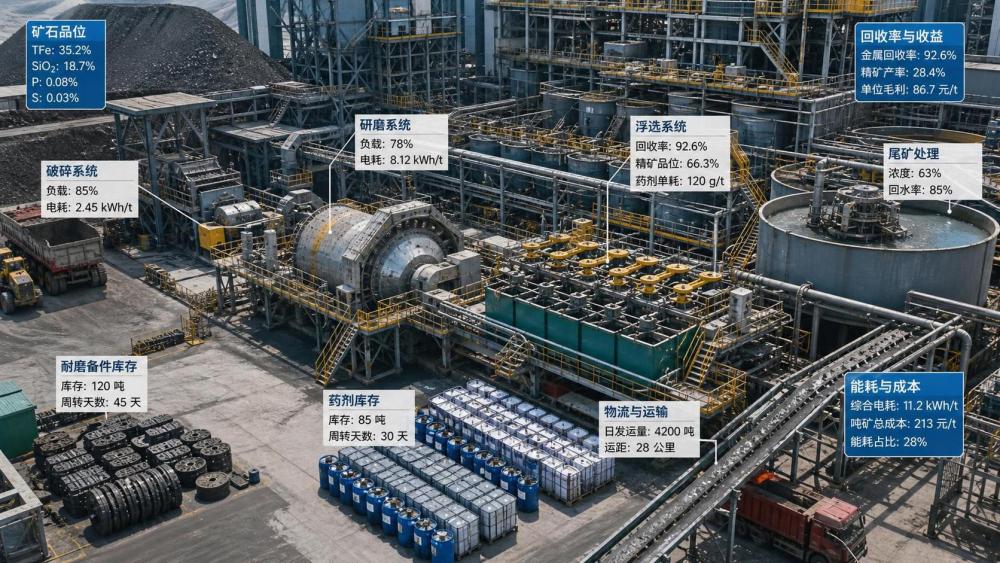
Maintenance deserves more attention than it usually gets in early-stage business reviews. In metallurgy and mining processing, equipment availability is cost. Mills, crushers, pumps, thickeners, furnaces, and dust collection systems rarely fail at convenient times. If a supplier proposal looks attractive because capital equipment is cheaper, check the service network, spare part lead times, liner life, and local technical support. Lower upfront cost can turn into higher lifecycle cost very quickly.
What experienced evaluators check beyond the plant gate
Processing does not begin and end inside the facility. Water, waste, transport, and permitting can move the cost structure more than many non-technical teams expect.
Water balance matters in flotation, leaching, cooling, and dust control. In water-stressed regions, sourcing, treatment, recycling, and discharge requirements can materially change operating cost. The same is true for tailings and residue handling. A flowsheet that produces difficult waste streams may be manageable on paper but expensive in practice once lining systems, monitoring, treatment, closure obligations, and stakeholder scrutiny are factored in.
Environmental and safety compliance also need a realistic lens. This is not just about avoiding fines. Stricter emissions control, wastewater treatment, worker exposure limits, and product traceability can require additional equipment, more instrumentation, specialized labor, and documentation systems. If a project depends on optimistic assumptions here, it is not really a low-cost option. It is a deferred-cost option.
Logistics is another quiet driver. Bulk concentrates, additives, spare parts, and fuel all move through supply chains that may be fragile or seasonal. Remote sites often pay more not only for inbound materials, but also for technical response time when something fails. If the commercial model depends on just-in-time delivery in a region with weak infrastructure, the cost estimate deserves skepticism.
Where procurement teams often get the comparison wrong
A familiar pattern is comparing offers on a cost-per-ton basis without aligning the underlying assumptions. One vendor may quote against clean, stable feed and continuous operation. Another may be pricing around variable ore, stricter moisture control, or higher impurity levels. The numbers look comparable, but the operating context is different.
Another weak comparison is separating equipment procurement from process suitability. The cheapest grinding circuit, furnace, filtration package, or reagent program is not the best purchase if it cannot handle feed variability or local operating constraints. For business evaluators, the question should be: how much process flexibility are we buying, and what is that flexibility worth?
It also helps to distinguish fixed, semi-variable, and truly variable costs. Labor may appear fixed in the short term. Energy may be partly contracted. Reagents often move directly with throughput and ore characteristics. If a project model treats all categories as equally flexible, the downside scenario will be misleading.
How to judge cost resilience before making a decision
If you are reviewing a processing option, ask for evidence on five points: feed variability, expected recovery across ore types, energy intensity, major consumable sensitivity, and maintenance assumptions. Those five items usually reveal whether the cost model is grounded or optimistic.
It is also worth checking whether the operator or supplier can explain where bottlenecks occur when conditions worsen. Experienced teams can usually tell you what breaks first: grinding capacity, filtration rate, furnace throughput, water handling, reagent balance, or tailings management. Vague answers are a warning sign.
For broader market context, structured intelligence platforms such as GEMM can be useful at this stage, not as a shortcut to technical due diligence, but as a way to compare product categories, process references, supplier capabilities, standards, and price signals across metals, raw materials, and processing equipment. That is particularly useful when a cost increase may be tied to upstream material pricing, substitute technologies, or regional supply constraints rather than to one plant alone.
One more practical point: low processing cost is not always the right target. In some projects, the better commercial outcome comes from a more stable, slightly higher-cost process with better recovery, lower environmental risk, and more predictable output quality. That matters in procurement because unstable cost structures tend to show up later as contract disputes, missed delivery, or unplanned reinvestment.
The useful way to read metallurgy and mining processing costs
A good cost review does not stop at the operating line item. It asks what assumptions are carrying the number and which of them are fragile. In metallurgy and mining processing, the strongest proposals are usually the ones that stay credible under tougher ore, higher energy prices, tighter compliance, and ordinary equipment wear. That is the level where cost analysis becomes decision analysis.
If you are screening projects or suppliers, start with the basics: ore characteristics, recovery profile, energy source, consumables exposure, maintenance model, and waste-handling obligations. Once those are clear, quoted processing cost becomes much easier to trust, challenge, or reject.
FAQ
Is energy always the largest processing cost in mining and metallurgy?
Not always, but it is often one of the top drivers. In some operations, consumables, maintenance, or waste management can rival or exceed energy, especially when ore is complex or environmental controls are demanding.
Why can a lower-cost processing proposal be riskier?
Because the quote may assume stable feed, ideal uptime, low impurity levels, or easy maintenance. If those assumptions fail, the operating cost can rise fast and recovery can fall at the same time.
Should business evaluators focus more on cost per ton or recovery?
Both matter, but recovery often has a bigger commercial effect than people expect. A plant that processes cheaply but loses payable metal may be worse than a slightly higher-cost plant with stronger recovery.
How important is ore variability in procurement decisions?
Very important. Variable ore can increase reagent consumption, reduce throughput, destabilize recovery, and create maintenance stress. A process that works well only on average feed is not a strong procurement choice.
Image Placeholder Notes
Suggested placement: after the paragraph discussing consumables and before the maintenance section.
Suggested image content: a simple processing cost driver map showing ore grade, energy, recovery, reagents, maintenance, compliance, and logistics as connected factors.
Suggested alt text: “Key cost drivers in metallurgy and mining processing operations”
Internal Link Anchor Text Suggestions
ore beneficiation process comparison: processing technology overview page
mineral processing equipment selection: equipment category or buyer guide page
industrial energy cost trends: market intelligence or pricing update page
smelting and refining systems: product category or technical knowledge page
supplier evaluation for mining projects: sourcing or procurement guidance page
External Source Directions
industry association reports on mineral processing and metallurgical operations
government mining or environmental regulator pages for compliance and waste management requirements
official technical documentation from major process equipment manufacturers
Related News
- 00
0000-00
Which sectors are driving demand in the chemical engineering market? - 00
0000-00
How to assess lifecycle emissions from CCUS for low-carbon cement - 00
0000-00
How do energy storage technologies compare for 8-hour discharge? - 00
0000-00
Do mill test reports prove industrial alloys meet ASTM standards? - 00
0000-00
How to verify plastic recycling system suppliers' throughput claims
Weekly Insights
Stay ahead with our curated technology reports delivered every Monday.