




Where polymer innovations in Southeast Asia are reshaping demand




Where polymer innovations in Southeast Asia are reshaping demand
From packaging and automotive components to electronics and sustainability-linked applications, polymer innovations Southeast Asia are no longer a side story in regional manufacturing. They are changing how buyers compare resin grades, how converters evaluate processability, and how suppliers position themselves in export-oriented value chains. What makes this shift worth watching is not just new material development. It is the way local manufacturing capacity, policy direction, feedstock access, and downstream demand are starting to move together.
For anyone tracking materials markets, Southeast Asia now sits in an interesting middle ground. It is not simply following China’s polymer model, and it is not replacing established hubs overnight. Instead, countries across the region are carving out specialized roles: some are stronger in packaging conversion, some in automotive parts, some in electronics assembly, and some in recycled or bio-based material adoption. That unevenness matters, because demand is being shaped less by broad “regional growth” narratives and more by application-specific decisions.
Why demand is shifting now
A practical way to read the market is to look at where polymer selection has become more conditional. A buyer choosing polypropylene for rigid packaging, engineering plastics for connectors, or recycled polyethylene for secondary packaging is often no longer asking only about price and availability. The questions are more layered: Can the grade run reliably on current equipment? Does the supplier understand export documentation and destination compliance? Is there consistency in melt flow, color, odor, or recycled content? Can lead times hold during freight disruption?
Southeast Asia is benefiting because many manufacturers want a wider sourcing base without compromising too much on technical support or production scale. At the same time, local converters are moving up from commodity output toward application-tuned materials, compounds, and blends. That creates a different kind of demand signal. Instead of one market absorbing large volumes of generic resin, multiple end-use segments are pulling for materials with narrower specifications.
This is especially visible in sectors where processing stability matters as much as nominal resin type. In injection molding, for example, a buyer may care less about whether a material is labeled “advanced” and more about cycle consistency, shrinkage behavior, warpage control, and the availability of technical documents that support qualification. In that sense, innovation is being judged on factory performance, not just chemistry.
The strongest pressure points: packaging, mobility, electronics, and circular materials
Packaging is still the fastest place to spot demand changes because it combines volume, regulation pressure, and brand scrutiny. Flexible packaging, food-contact applications, and transport packaging all face different constraints. Some producers are experimenting with downgauging, mono-material structures, or higher recycled content, but these choices are rarely straightforward. A structure that looks attractive on a sustainability slide may create sealing issues, barrier trade-offs, or sorting problems at end of life. Buyers who understand those trade-offs tend to compare not just resin families, but the whole converting context.
Automotive and mobility applications are moving differently. Here, polymer demand is often tied to weight reduction, thermal performance, interior compliance requirements, and part integration. Southeast Asia’s role is shaped by its manufacturing base for vehicles, two-wheelers, wire harnesses, under-hood parts, and molded interiors. Engineering polymers, elastomer-modified compounds, and specialty additives all become relevant, but qualification cycles are longer. That means demand does not always show up as sudden volume spikes; it often appears first in sourcing inquiries, pilot runs, and requests for alternative suppliers.
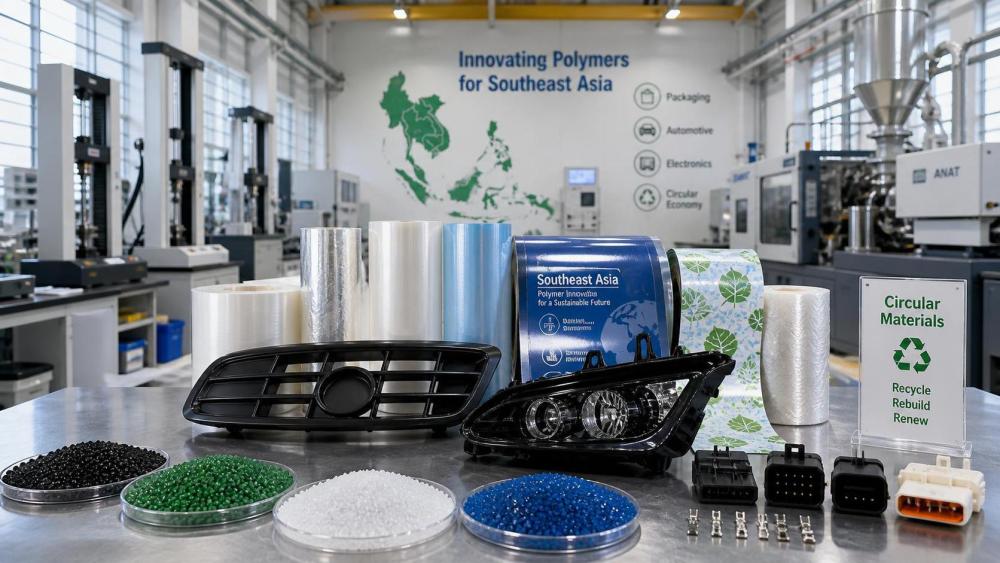
Electronics is another area where polymer innovations Southeast Asia are having a quiet but meaningful effect. Assemblers and component manufacturers need materials that can meet dimensional, thermal, flame-retardant, and cleanliness expectations, often under tighter export scrutiny. In these segments, documentation quality matters almost as much as the resin itself. Traceability, technical datasheets, processing guidance, and alignment with destination-market requirements can influence demand as much as base material cost.
Then there is the circular materials story. Recycled plastics and bio-based polymers attract attention, but the market is more selective than headlines suggest. In practice, buyers want to know whether recycled content is consistent enough for their process, whether odor or contamination risks are manageable, and whether claims can be substantiated. For bio-based options, compatibility with existing equipment and actual end-use performance remain the first filter. Interest is real, but purchasing decisions are still grounded in operational discipline.
What global buyers are actually comparing
One common mistake is to assume that demand is moving purely toward “higher-tech” polymers. In reality, buyers often compare three things at once: material performance, supply reliability, and information clarity. A supplier with a good resin but weak technical communication can lose out to a supplier offering slightly less ambitious material performance with better process support and export readiness.
This is where structured market intelligence becomes more useful than broad trend commentary. Platforms like GEMM matter because polymer markets rarely operate in isolation. A sourcing team evaluating a recycled PE grade may also need to understand injection molding equipment compatibility, downstream application guidance, price movement, and supplier references. An engineer considering an engineering plastic for an electrical housing may need technical knowledge, processing notes, standards context, and regional supply visibility in one place. That combination is often harder to find than the product itself.
The region’s demand signals are also fragmented by country. Some markets are more export-facing and therefore more sensitive to international buyer requirements. Others are driven by domestic packaging consumption, infrastructure buildout, or industrial substitution. Treating Southeast Asia as one uniform polymer market usually leads to weak conclusions.
What deserves closer scrutiny before calling something “innovation”
A useful rule of thumb: if a new material claim does not come with processing guidance, application limits, and some clarity on supply continuity, it is still more of a market signal than a procurement option. That does not mean the innovation is unimportant. It simply means buyers should separate early-stage interest from commercially stable demand.
There are a few recurring checkpoints worth keeping in mind:
- Whether the material fits existing production equipment or requires line adjustments
- Whether local and export-market standards need separate validation
- Whether the supplier can support repeatability, not just trial quantities
- Whether sustainability claims depend on certifications or project-specific documentation that still needs verification
- Whether pricing stability is realistic once feedstock, freight, and regional demand move
Those checkpoints sound basic, but they are where many sourcing decisions stall. In polymers, the gap between “interesting material” and “adoptable material” is usually filled by process data, qualification effort, and supply discipline.
How the next phase of demand may develop
The next wave is likely to be less about dramatic breakthroughs and more about better matching between application needs and regional capabilities. Expect demand to favor suppliers that can explain material behavior clearly, support downstream processing, and position products within broader industrial contexts such as chemicals, machinery, recycling, and export flows. That is particularly true in Southeast Asia, where polymer demand is increasingly tied to connected sectors rather than standalone resin sales.
For researchers and procurement teams, the practical question is not whether the region is innovating. It is where those innovations are mature enough to influence actual sourcing and project decisions. The best signals usually come from comparison work: tracking specifications, monitoring supplier capability, checking how applications are evolving, and watching where price, compliance, and processability start to align. When those pieces line up, demand does not just grow. It becomes more selective, and that is usually when a regional market starts to matter globally.
Related News
- 00
0000-00
Which sectors are driving demand in the chemical engineering market? - 00
0000-00
How to assess lifecycle emissions from CCUS for low-carbon cement - 00
0000-00
How do energy storage technologies compare for 8-hour discharge? - 00
0000-00
Do mill test reports prove industrial alloys meet ASTM standards? - 00
0000-00
How to verify plastic recycling system suppliers' throughput claims
Weekly Insights
Stay ahead with our curated technology reports delivered every Monday.