




What Environmental Limits Apply to Polymer Incineration?




There is no single environmental limit that applies to all polymer incineration. The allowable emissions depend on the jurisdiction, the type and capacity of the thermal treatment plant, the polymer feedstock, and the air-pollution-control system. A modern permitted waste-to-energy facility may be able to treat mixed plastic residues under tightly controlled conditions; an uncontrolled burner, poorly designed pyrolysis unit, or cement kiln without an appropriate permit may not.
The practical question is not simply whether a polymer can burn. Most polymers can. The relevant question is whether the combustion process can maintain stable destruction conditions and keep particulate matter, acid gases, metals, persistent organic pollutants, and greenhouse-gas emissions within permit limits. Feedstock composition matters as much as furnace temperature.
What pollutants set the environmental limits for polymer incineration?
Polymer waste can generate a broad emission profile because plastics are not chemically uniform. Polyethylene (PE) and polypropylene (PP) consist mainly of carbon and hydrogen, while polyvinyl chloride (PVC) contains chlorine, fluoropolymers contain fluorine, and engineering plastics may contain nitrogen, brominated flame retardants, fillers, pigments, stabilizers, or metal-containing additives.
Environmental permits therefore normally control several pollutant groups rather than applying one overall “plastic incineration” limit:
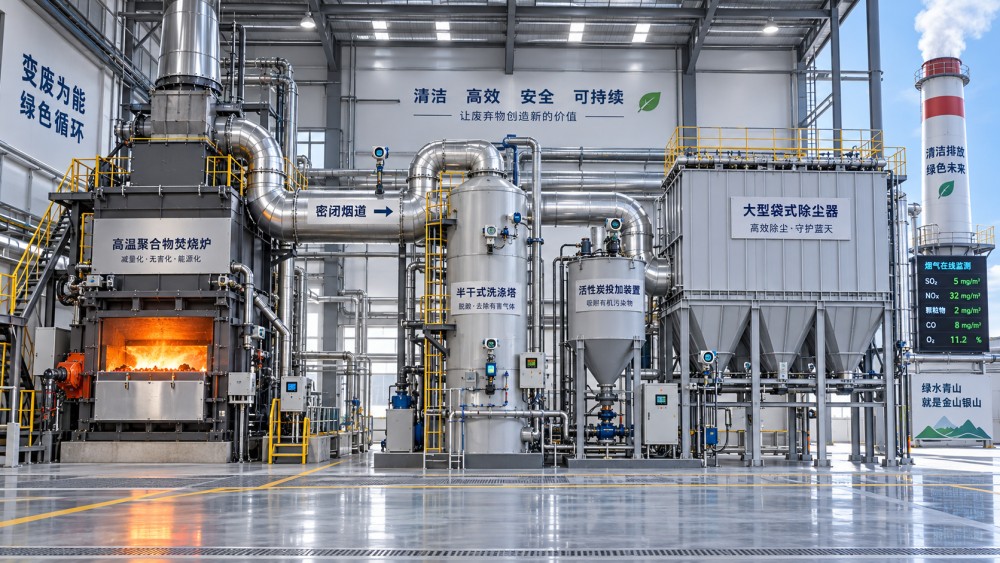
- Particulate matter: Fine ash, soot, condensed salts, and metal-bearing particles can leave the furnace with flue gas. Fabric filters, electrostatic precipitators, and dry or semi-dry scrubbers are commonly used to control these emissions.
- Acid gases: Hydrogen chloride (HCl) is the principal concern with PVC and other chlorinated feedstocks. Hydrogen fluoride (HF) may arise from fluorinated polymers. Sulfur dioxide (SO2) depends on sulfur-bearing materials and fuels. These gases require alkaline neutralization, usually with lime, sodium bicarbonate, or another suitable sorbent.
- Nitrogen oxides: NOx forms from combustion temperatures and nitrogen in the feed or auxiliary fuel. Control may involve staged combustion, selective non-catalytic reduction, or selective catalytic reduction.
- Carbon monoxide and total organic carbon: Elevated CO or organic carbon can indicate incomplete combustion, unstable feed conditions, poor oxygen distribution, or insufficient residence time.
- Metals: Mercury, cadmium, lead, chromium, antimony, copper, nickel, and other metals may be present in pigments, stabilizers, fillers, electronic-plastic fractions, or contaminated post-consumer feedstock. Some metals are captured in fly ash; mercury requires dedicated adsorption control, often activated carbon injection.
- Dioxins and furans: Polychlorinated dibenzo-p-dioxins and dibenzofurans are especially important where chlorine, organic material, oxygen, and metal catalysts coexist under unfavorable cooling conditions. Their formation is controlled through combustion quality, rapid flue-gas cooling, particulate capture, and activated-carbon treatment.
These categories explain why a facility designed for clean production scrap cannot automatically be assumed suitable for mixed municipal plastic waste, automotive shredder residue, e-waste plastics, or construction-and-demolition fractions. The latter streams can contain far more chlorine, metals, brominated flame retardants, moisture, and non-combustible contamination.
Are there universal emission limits for polymer materials?
No. Limits are defined by national, regional, and local permitting systems, and they must be read together with their measurement conditions. A figure stated without its averaging period, oxygen reference level, dry or wet basis, gas temperature and pressure convention, and plant category is not meaningful for compliance comparison.
In the European Union, waste-incineration requirements have historically been set through the Industrial Emissions Directive framework. For many waste-incineration installations, commonly cited daily average limits include 10 mg/Nm3 for total dust, 10 mg/Nm3 for HCl, 1 mg/Nm3 for HF, 50 mg/Nm3 for SO2, and 10 mg/Nm3 for total organic carbon. Dioxins and furans have commonly been subject to a limit of 0.1 ng I-TEQ/Nm3 over the prescribed sampling period.
Those values are not a universal operating specification. They are tied to defined regulatory conditions, including standardized flue-gas conditions and, for many incineration limits, correction to 11% oxygen on a dry-gas basis. Requirements for NOx, carbon monoxide, ammonia slip, metals, continuous monitoring, and averaging periods vary by installation class, permit history, fuel mix, and applicable best-available-technique conclusions. A local permit may be more restrictive than a general legal ceiling.
In the United States, the applicable framework can differ between municipal waste combustors, commercial and industrial solid-waste incineration units, hazardous-waste combustors, and other thermal treatment systems. Federal Clean Air Act rules, state implementation requirements, and site-specific permits may all apply. Other jurisdictions use their own waste, air-quality, hazardous-substance, and product-stewardship rules. For cross-border projects, the correct compliance baseline is always the permit regime at the actual treatment location, not the export country’s product standard.
Why polymer type changes the environmental assessment
Polyolefins such as PE and PP generally produce carbon dioxide and water when combustion is complete, but that does not make them environmentally neutral. Their carbon is usually fossil-derived, so incineration creates fossil CO2. If feedstock is contaminated with labels, inks, multilayer films, food residues, metal particles, or other waste, the actual emission profile differs materially from that of virgin resin.
PVC deserves separate attention because its chlorine content can be substantial. Burning PVC releases HCl unless the gas is effectively neutralized. PVC-rich loads also increase the chloride burden on scrubbers and may affect corrosion risk in boilers, ducts, and downstream equipment. The issue is not that PVC is impossible to incinerate; purpose-built waste-incineration systems do process chlorinated waste. The issue is that chlorine loading must remain within the design and permit envelope of the plant.
Fluoropolymers require comparable caution. Fluorine-containing feedstocks can generate HF and other fluorinated decomposition products under certain conditions. Facilities should not assume that controls selected for conventional mixed plastics are sufficient without feedstock-specific review.
Plastics containing brominated flame retardants, especially fractions originating from electrical and electronic equipment, require tighter sorting and characterization. Bromine can increase acid-gas treatment demand and complicate management of fly ash and air-pollution-control residues. Pigments and additives may also introduce lead, cadmium, antimony, chromium, or other metals. Concentrations in the incoming material, rather than the base polymer name alone, determine the compliance risk.
What combustion conditions are normally required?
Permitted incineration is a controlled thermal process, not merely exposure to flame. Regulations and permits commonly specify a minimum combustion temperature, residence time, oxygen conditions, and automatic waste-feed cutoff arrangements. In EU waste-incineration rules, flue gases are generally required to be raised, after the last injection of combustion air, to at least 850°C for at least two seconds. Where hazardous waste with more than 1% halogenated organic substances, expressed as chlorine, is incinerated, the required temperature may be 1,100°C.
These thresholds should not be treated as a simple recipe for compliance. A furnace can reach a nominal temperature while still experiencing poor mixing, short-circuiting gas flow, overloaded grates, variable moisture, or oxygen-starved zones. Stable combustion requires adequate turbulence, consistent feed preparation, sufficient excess air or controlled oxygen supply, and reliable control of furnace pressure and temperature.
Start-up, shutdown, upset conditions, and bypass events are equally important. A plant may meet routine stack averages but face substantial compliance exposure if waste is fed when the secondary combustion chamber is below the required temperature, if activated-carbon dosing fails, or if the baghouse operates outside its designed temperature range. Permit conditions normally require recorded operating data and defined actions when these conditions occur.
How are dioxins, acid gases, and metals kept below limits?
Dioxin control depends on the entire system rather than one piece of equipment. Complete combustion reduces unburned organic precursors. Rapid cooling through the temperature window associated with de novo synthesis limits re-formation on fly-ash surfaces. Activated carbon can adsorb dioxins and mercury, while fabric filters capture the carbon and fine particulates. The captured material then becomes an air-pollution-control residue that requires appropriate classification, transport, and disposal or treatment.
Acid-gas control is a reagent-and-residue balance. Dry sorbent injection and semi-dry scrubbers are widely used for HCl, HF, and SO2; wet scrubbers can achieve high removal efficiencies but create liquid effluent requiring treatment. A facility’s ability to handle PVC-rich or fluoropolymer-containing waste is therefore constrained by reagent storage, injection capacity, corrosion-resistant materials, residue handling, wastewater controls where applicable, and emission-monitoring performance.
Metal control begins upstream. Sorting out batteries, cables, electronic components, painted metal, and certain additives reduces the burden on the flue-gas system. Once metals enter the furnace, their behavior depends on volatility. Lead and cadmium may associate with fine fly ash, while mercury can remain in gaseous form unless captured by a dedicated sorbent system. Bottom ash and fly ash must be managed separately because their contaminant profiles and regulatory classifications may differ.
Do greenhouse-gas limits apply in the same way as stack-emission limits?
Usually not. Greenhouse-gas treatment is often governed through carbon accounting, emissions trading systems, reporting rules, fuel taxation, renewable-energy definitions, or corporate climate reporting rather than through a conventional stack concentration limit. Carbon dioxide from fossil-based plastics is generally counted as fossil CO2, even when the waste is used to generate electricity or heat.
This distinction matters when evaluating incineration against recycling, mechanical recovery, chemical recycling, landfill, or alternative fuels. A plant may comply with air-pollution limits and still have a significant climate impact because it converts fossil polymer carbon into CO2. Conversely, diversion of non-recyclable residues from landfill may have separate waste-management benefits. The environmental decision requires both air-emission compliance and life-cycle assessment; neither replaces the other.
What feedstock information should be available before thermal treatment?
“Mixed plastic waste” is not an adequate technical description for a treatment contract or compliance assessment. At minimum, the operator needs a defensible profile of polymer composition, chlorine and fluorine content, bromine where flame-retarded plastics are possible, moisture, ash, heating value, metal content, hazardous contaminants, particle size, and variability between loads.
Sampling plans should reflect the heterogeneity of the stream. A laboratory result from one small sample cannot reliably represent baled post-consumer films, imported scrap, shredder residue, or production rejects accumulated from multiple suppliers. Where material is traded across borders, documentation should also establish whether the shipment is classified as a product, recyclable secondary material, or waste under the receiving jurisdiction. That classification can determine transport controls, import restrictions, and which treatment route is legally available.
Contracts should identify unacceptable materials and define rejection rights. Problem items commonly include pressurized containers, batteries, medical waste, e-waste fractions, high-halogen plastics outside the plant’s acceptance criteria, liquids, and radioactive or explosive contamination. The environmental limit is often reached first through poor incoming-waste control, not through a failure of the final stack-control equipment.
Can a small-scale incinerator meet the same expectations as a large waste-to-energy plant?
Not automatically. Smaller units may have less sophisticated combustion control, fewer redundant pollution-control stages, limited continuous emission monitoring, and weaker capacity to manage variable waste. Their legal requirements differ by jurisdiction and scale, but lower capacity does not remove the need to control hazardous emissions.
Open burning, simple barrel burning, and improvised thermal units are particularly unsuitable for polymer waste. They cannot consistently maintain the temperature, residence time, mixing, gas treatment, and monitoring needed to control acid gases, particulates, metals, and dioxins. Claims that plastic is “fully burned” because no visible residue remains are not evidence of environmental performance.
What is the most reliable compliance test?
Compliance should be assessed against the treatment facility’s actual permit, its approved waste acceptance criteria, verified feedstock data, and measured emissions under prescribed test conditions. Design brochures, nominal furnace temperature, or a general statement that the plant has a scrubber are insufficient.
A credible review asks whether the proposed polymer stream falls within the permitted waste codes and chemical limits; whether chlorine, fluorine, metals, and calorific value are within the plant’s operating envelope; whether continuous monitoring covers the required parameters; how dioxins, mercury, and metals are periodically tested; and how bottom ash, fly ash, spent sorbent, and wastewater are managed. Polymer incineration is environmentally limited by the weakest part of that chain: feedstock control, combustion stability, flue-gas treatment, monitoring, or residue management.
Related News
- 00
0000-00
How to assess the reliability of offshore drilling safety systems - 00
0000-00
How to verify quality systems at oil and gas industry suppliers - 00
0000-00
Which carbon capture materials grades suit high-humidity flue gas? - 00
0000-00
How commodity intelligence analytics can improve price risk decisions - 00
0000-00
Terephthalic Acid CAS 100-21-0: The Technical Checks Behind Stable Polyester Supply
Weekly Insights
Stay ahead with our curated technology reports delivered every Monday.