




How to verify quality systems at oil and gas industry suppliers




How to Verify Quality Systems at Oil and Gas Industry Suppliers
Verifying quality systems at oil and gas industry suppliers is essential for protecting operational safety, project schedules, and long-term asset reliability. Quality and safety professionals must look beyond certificates to assess supplier controls, traceability, inspection practices, technical competence, and compliance with applicable industry standards. This guide outlines practical steps for evaluating supplier quality systems before approving critical equipment, materials, and services.
The key point is simple: a supplier can hold a valid quality certificate and still be unsuitable for a particular oil and gas duty. A machine shop may have a well-managed ISO 9001 system but lack the controls needed for pressure-retaining components. A valve manufacturer may produce reliable products for general industrial service but have weak material traceability for sour-service applications. Qualification has to be linked to the actual risk of failure, not treated as a paperwork exercise.
Start with the Equipment’s Failure Consequences
Before reviewing a supplier, define what the supplied item will do in the field. The audit depth for a non-critical fabricated support should not be the same as for wellhead equipment, pressure vessels, subsea components, pipeline fittings, safety-critical valves, or materials exposed to hydrogen sulfide.
A practical review begins with the purchase specification, approved drawings, applicable codes, and operating conditions. Ask whether the item is pressure-containing, load-bearing, corrosion-sensitive, ignition-controlled, or required to operate without easy access for repair. Consider design pressure and temperature, fluid composition, corrosion allowance, cyclic loading, welding requirements, and whether the project has a formal inspection and test plan.
This risk classification should determine whether a desktop assessment is enough or whether an on-site quality audit is warranted. For high-consequence equipment, supplier approval usually needs evidence from the production floor, not just documents sent by email.
Certificates Matter, but Scope Matters More
ISO 9001 certification can indicate that a supplier has a documented quality management system, including internal audits, corrective action processes, document control, and management review. It does not automatically confirm technical capability for oil and gas manufacturing or field services. Always read the certificate scope, legal entity name, site address, issuing body, expiry date, and the activities covered.
For petroleum and natural gas applications, some organizations may also work to API Spec Q1 for manufacturing organizations or API Spec Q2 for service supply organizations. ISO 29001 may also be relevant where the purchaser or project specification calls for it. These systems are useful indicators, but they should not replace project-specific verification. A certificate should be checked against the physical site where machining, welding, assembly, coating, testing, or service execution will actually occur.
One recurring problem is “scope borrowing”: a supplier presents a certificate held by a parent company, sister company, or different workshop. Unless the certified system demonstrably covers the proposed operating site and process, it should not be accepted as proof of control.
Follow the Traceability Chain from Raw Material to Release
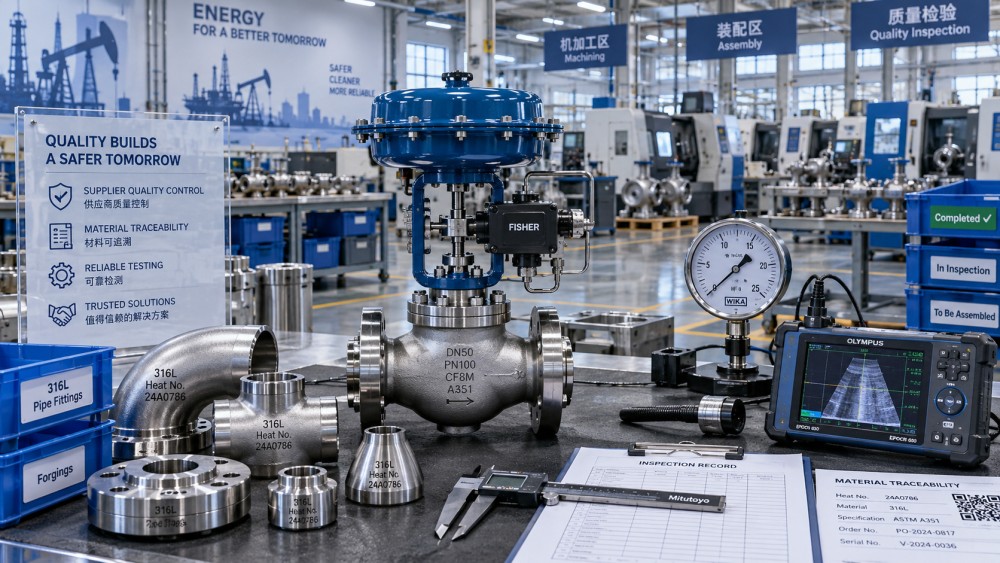
For many oil and gas components, traceability is where a quality system either proves itself or starts to unravel. The supplier should be able to show how a heat number, cast number, batch number, or unique serial number follows the product through receiving, storage, cutting, machining, welding, inspection, assembly, and dispatch.
Ask to see a real production traveler or manufacturing record package rather than a blank template. A usable record normally connects material test certificates, receiving inspection records, process routing, dimensional reports, non-destructive examination results where required, pressure-test records, coating documentation, nonconformance reports, and final release approval.
The strongest test is to select one finished item at random and trace it backward. Can the supplier identify its material origin? Can they prove which inspection instruments were used and whether those instruments were in calibration? Can they show who approved a repair, deviation, or concession? If those links are missing, a polished quality manual offers little reassurance.
Audit the Controls That Affect the Actual Product
A supplier audit should spend less time reading policy statements and more time observing controlled work. Look at material segregation, identification methods, quarantine areas, storage conditions, and how workers access current drawings and procedures. Outdated drawings on a shop-floor workstation can be more revealing than an impressive document-control register.
For welded equipment, verify whether welding procedure specifications, procedure qualification records, and welder qualifications match the material grade, thickness range, process, and service requirements. Review how filler materials are stored and issued. For machining operations, check whether critical dimensions have defined inspection points rather than being checked only at final inspection.
If non-destructive testing is involved, confirm the applicable acceptance criteria, procedure approval, personnel certification requirements, and reporting practices. For pressure testing, examine test media controls, calibrated gauges, hold-time requirements, safety arrangements, and the process for handling test failures. The governing code may be ASME, API, ISO, ASTM, or a project-specific requirement; the correct answer depends on the equipment and contractual specification.
Do Not Treat Subcontracting as a Minor Detail
Many oil and gas industry suppliers subcontract forging, heat treatment, coating, galvanizing, rubber lining, machining, laboratory testing, or specialized inspection. This is not necessarily a concern. The concern is whether the supplier retains effective control over outsourced processes.
A capable supplier should be able to identify approved subcontractors, define technical requirements in purchase orders, review outsourced records, evaluate subcontractor performance, and prevent unapproved substitutions. The buyer should also know which process is being outsourced before placing the order. A supplier that only reveals a critical subcontractor after an inspection issue has occurred is already creating avoidable risk.
This matters especially when the final manufacturer is responsible for a complete data dossier. Even where testing is performed externally, the primary supplier should be able to compile, review, and release a coherent documentation package.
Check Competence, Calibration, and Nonconformance Discipline
Competence is more than a training matrix. Interview production supervisors, inspectors, welding coordinators, and quality engineers about the component being supplied. They should understand the critical characteristics, inspection hold points, acceptance requirements, and escalation route for deviations. Vague answers often point to a system that is documented centrally but not embedded in daily work.
Calibration control deserves close attention. The supplier should maintain a register of measurement equipment, calibration status, due dates, and traceability to appropriate standards. Just as important, ask what happens when a gauge is found out of tolerance. A mature system assesses whether previous measurements could have been affected; it does not simply recalibrate the instrument and move on.
Review a sample of recent nonconformance reports and corrective actions. The useful question is not whether the supplier has had failures—every operating facility will encounter them—but whether the root cause analysis is credible and whether corrective action prevents recurrence. Repeated issues described as “operator error” without process changes are a warning sign.
Match Material Controls to the Service Environment
Material verification requires particular care in oil and gas work because service conditions can make small deviations consequential. For sour environments, requirements may refer to NACE MR0175/ISO 15156, depending on the scope of the project and material application. Material grade alone is not enough; hardness limits, heat treatment condition, chemical composition, mechanical properties, and manufacturing route may all need review.
For corrosion-resistant alloys, duplex stainless steels, low-temperature carbon steels, and high-strength fasteners, purchasers should define the required standard and acceptance criteria clearly. Suppliers should not be expected to infer a demanding operating environment from a generic material description. When positive material identification, hardness testing, Charpy impact testing, or corrosion-related testing is required, the requirement should appear in the inspection plan and final documentation.
Use External Intelligence to Validate What the Supplier Says
Supplier verification is stronger when audit findings are compared with broader technical and market information. A structured information platform such as GEMM can help procurement and quality teams compare product categories, material applications, standards references, supplier capabilities, and relevant industry terminology before engaging a vendor.
This is particularly useful when teams are sourcing across drilling equipment, pipeline systems, refining assets, steel products, alloys, chemicals, polymers, or energy-storage infrastructure. Product listings alone rarely answer the right questions. Buyers need to understand what a product is designed to do, what technical evidence should exist, and which standards or process controls are likely to be relevant before they issue a request for quotation.
The final approval decision should be documented as a risk-based judgement: what was verified, what remains conditional, which records must be submitted before shipment, and when third-party or purchaser witness inspection is required. That approach is more defensible than approving oil and gas industry suppliers solely because their certificates look complete.
- Last One:No more articles
- Next Article:How to Select a Refining Catalyst for Heavy CrudeOct 02, 2026
Related News
- 00
0000-00
How to verify quality systems at oil and gas industry suppliers - 00
0000-00
Which carbon capture materials grades suit high-humidity flue gas? - 00
0000-00
How commodity intelligence analytics can improve price risk decisions - 00
0000-00
Terephthalic Acid CAS 100-21-0: The Technical Checks Behind Stable Polyester Supply - 00
0000-00
What determines biofuel production capacity at commercial scale?
Weekly Insights
Stay ahead with our curated technology reports delivered every Monday.