




Which carbon capture materials grades suit high-humidity flue gas?




High-humidity flue gas changes the grade-selection logic
For wet flue gas, the most suitable carbon capture materials grades are usually moisture-tolerant amine-functionalized solid sorbents or liquid amine solvent grades designed for contaminated industrial gas service. Conventional physisorbents, especially standard zeolite grades, can still be useful in carefully conditioned systems, but they are rarely the first choice when the gas enters the capture unit near saturation or with large humidity swings.
The reason is practical. A material may show an attractive CO2 capacity under dry laboratory conditions and still perform poorly on a wet stack stream. Water can occupy adsorption sites, alter gas diffusion, increase regeneration duty, accelerate chemical degradation, or create handling problems across repeated cycles. Technical evaluation should therefore begin with the incoming gas condition, not with the supplier's headline CO2 uptake figure.
For most post-combustion applications, the relevant question is: can the selected grade maintain usable working capacity and stable cyclic performance at the actual moisture level, temperature, pressure, and impurity profile of the flue gas?
Start by separating wet-service materials from dry-gas materials
Carbon capture materials grades are often compared as if they belong on a single capacity scale. For high-humidity flue gas, they should first be sorted by how water interacts with the capture mechanism.
Amine solvent grades
Aqueous amine systems are inherently compatible with water-rich gas streams because absorption occurs in a liquid phase. They remain a practical benchmark where the flue gas can be cooled, cleaned, and routed through an absorber-regenerator loop. Selection within this family is less about whether water is present and more about solvent formulation, degradation control, corrosion management, reclaiming requirements, and energy demand during regeneration.
For a technical evaluator, a generic “amine-based” designation is insufficient. The proposed grade should be assessed for its intended CO2 loading range, resistance to oxygen and heat, tolerance to sulfur and nitrogen oxides after upstream cleanup, foaming tendency, and compatibility with the planned metallurgy. A solvent suitable for a relatively clean gas stream may require a very different pretreatment arrangement when used downstream of a boiler, kiln, refinery heater, or waste-to-energy unit.
Amine-functionalized solid sorbent grades
Supported amines, amine-grafted porous materials, and polymeric amine sorbents are often better candidates than conventional dry adsorbents when water vapor is unavoidable. In many formulations, moderate humidity can support CO2 capture chemistry rather than simply competing for pore volume. Their appeal is strongest where a process seeks lower-temperature regeneration, modular contactor designs, or reduced bulk liquid circulation.
That does not make all amine-functionalized grades interchangeable. The support structure, amine type, amine loading, pore accessibility, pellet or monolith form, and binding method all affect performance under humid cycling. A high amine loading can improve initial uptake but may also create diffusion limits, sticky surfaces, pore blockage, or faster loss of active functionality. Grades should be judged on working capacity after repeated wet adsorption and regeneration, rather than on fresh-material capacity alone.
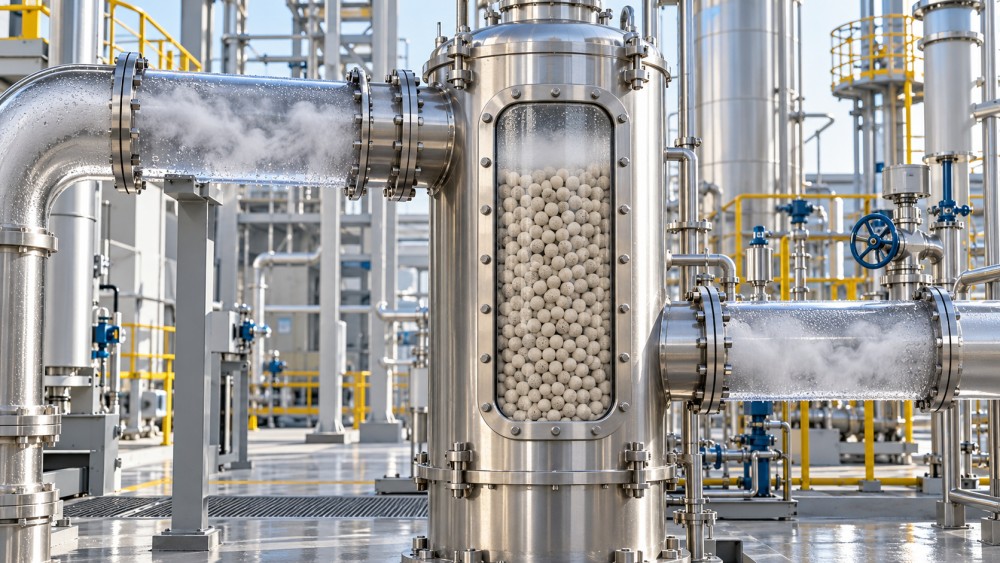
Zeolite and molecular sieve grades
Zeolites can offer strong CO2 affinity and well-defined pore structures, but standard grades are highly sensitive to water. In a wet flue gas stream, water adsorption may dominate the available sites and sharply reduce CO2 working capacity. Regenerating the accumulated water can also raise energy use and extend cycle time.
They remain relevant when the process includes robust dehydration ahead of the adsorption bed, when humidity is low and controlled, or when a specialized hydrophobic or modified grade has demonstrated its behavior under the intended conditions. Those cases require evidence from humid mixed-gas testing. Treating a dry-gas zeolite data sheet as a proxy for wet-flue-gas operation is a common selection error.
Activated carbon and other physical adsorbent grades
Activated carbon grades may have a role in impurity control, hydrocarbon removal, or selected separation duties, but their CO2 capture value in saturated flue gas must be examined carefully. Water can displace adsorbed species and change surface behavior. Carbon materials also vary widely in ash content, pore-size distribution, mechanical strength, ignition behavior, and resistance to contaminants.
In some designs, activated carbon is more valuable as a guard-bed material than as the main CO2 capture medium. That distinction matters when comparing material cost: a low-cost adsorbent may appear attractive until the wider process needs separate moisture control, frequent replacement, or downstream polishing.
Humidity is only one part of the gas specification
High humidity often arrives with other conditions that determine whether a grade will survive. Flue gas temperature, CO2 concentration, oxygen content, particulate carryover, sulfur oxides, nitrogen oxides, chlorides, trace metals, and condensable organics can all alter material life. The capture material should be evaluated against the combined gas envelope, including excursions during startup, shutdown, fuel changes, and upset conditions.
Sulfur oxides deserve particular attention. Many amine-containing materials, liquid or solid, can lose useful capacity when exposed to acid gases or irreversible reaction products. Dust and aerosols can foul contactors or beds. Oxygen and elevated regeneration temperatures can degrade certain active sites over time. A grade that tolerates moisture may still be unsuitable unless particulate and acid-gas control are adequate upstream.
Ask for performance evidence using a gas composition close to the intended stream. Single-component CO2 isotherms, dry breakthrough curves, and a short number of cycles cannot answer the wet-service question on their own.
Evaluate working capacity, not maximum capacity
The capacity relevant to equipment sizing is the difference between the loaded and regenerated states under the actual cycle. This working capacity can be materially lower than an advertised equilibrium number. It also affects bed size, solvent circulation rate, valve and blower duty, regeneration equipment, and reserve capacity during changing operation.
- Humidity range: Define normal, high, and near-condensing moisture conditions rather than using a single average value.
- Temperature profile: Record gas temperature at the capture inlet and the expected temperature rise through adsorption or absorption.
- CO2 partial pressure: Compare materials at the real concentration and operating pressure, not at a favorable test condition.
- Cycle stability: Review retained working capacity after extended humid adsorption-regeneration cycling.
- Regeneration window: Assess temperature, vacuum, steam, purge gas, or electrical requirements alongside achievable desorption.
- Mechanical form: Confirm attrition resistance, pressure-drop behavior, dust generation, and suitability for fixed beds, fluidized systems, rotating contactors, or structured modules.
Regeneration is where a superficially promising grade can lose its economic advantage. Stronger CO2 binding may support capture at low partial pressure but demand more heat or deeper vacuum to restore capacity. Water retained by the material can further increase the energy burden. Conversely, a lower-capacity grade with rapid and mild regeneration may produce better throughput for a particular contactor design.
Do not treat moisture tolerance as immunity to condensation
A material described as humidity tolerant is not automatically suited to liquid-water exposure. Saturated gas, aerosol carryover, and condensation inside a bed or module are different conditions. Condensation can cause channeling, agglomeration, swelling, corrosion, pressure-drop increases, and uneven thermal behavior. For supported amines, persistent liquid water may leach or redistribute active components depending on the formulation.
The process design should therefore control temperature margins relative to the dew point, especially at inlet ducts, cool zones, valves, and during intermittent operation. Grade selection and equipment design are inseparable here: a robust sorbent cannot compensate for poor condensate management, while an overly dry feed specification may impose unnecessary conditioning cost.
A practical shortlist for technical evaluation
For a typical high-humidity, post-combustion flue gas application, begin with formulated aqueous amine grades when a mature absorber-regenerator configuration and upstream gas cleanup are feasible. Consider moisture-tolerant amine-functionalized solid grades when lower-temperature regeneration, compact modular equipment, or limited water handling are material project drivers. Keep standard zeolite or molecular-sieve grades on the shortlist only when dehydration is credible or humid mixed-gas results demonstrate stable working performance.
Before selecting a grade, require a defined test protocol that includes the expected water content, contaminants, temperature range, regeneration conditions, and meaningful cycling duration. The useful comparison is not which material captures the most CO2 in isolation. It is which grade retains predictable capture performance, can be regenerated within the site energy constraints, and remains manageable after the flue gas behaves less neatly than its design-basis average.
Related News
- 00
0000-00
How to verify quality systems at oil and gas industry suppliers - 00
0000-00
Which carbon capture materials grades suit high-humidity flue gas? - 00
0000-00
How commodity intelligence analytics can improve price risk decisions - 00
0000-00
Terephthalic Acid CAS 100-21-0: The Technical Checks Behind Stable Polyester Supply - 00
0000-00
What determines biofuel production capacity at commercial scale?
Weekly Insights
Stay ahead with our curated technology reports delivered every Monday.