




Terephthalic Acid CAS 100-21-0: The Technical Checks Behind Stable Polyester Supply




Terephthalic acid is often treated as a familiar feedstock, but dependable polyester production depends on more than a product name. The buyer must translate chemical identity, acceptance criteria, handling conditions, documentation, and logistics into a specification that production and quality teams can use. The product reference appears once as Terephthalic Acid CAS 100-21-0, which points to the selected product landing page while keeping the article readable for buyers and portal editors.
This is a technical analysis for procurement managers, importers, distributors, engineers, project planners, quality teams, warehouse staff, and operations personnel. Its focus is chemical identity, quality evidence, handling discipline, and technical alignment between the purchase order and polyester processing.
Start With Chemical Identity and the Processing Question
A useful inquiry identifies terephthalic acid CAS 100-21-0, the intended downstream route, the expected grade or purity basis, quantity, package, destination, and required documents. Those elements allow technical and purchasing teams to compare offers on the same scope.
The product name alone does not explain how a material will be received, stored, charged, sampled, or released into a polyester process. Buyers should state the parts of the specification that are critical to their operation, then ask suppliers to confirm which requirements are standard and which require written agreement.
Particle Handling Is Part of Technical Fit
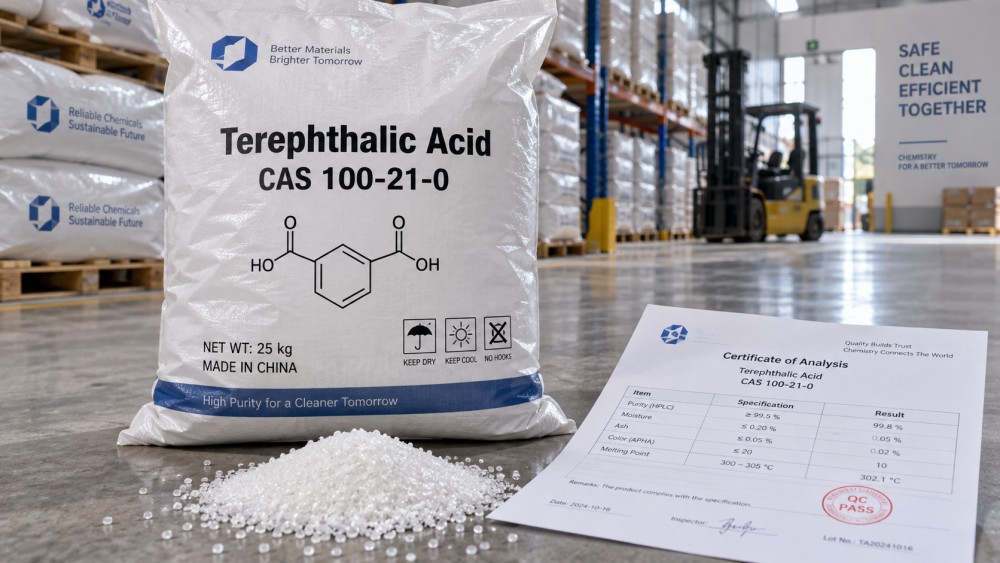
Powder and granular chemical handling can be affected by packaging condition, transfer equipment, dust control, warehouse exposure, and the receiving system. A material that is suitable on paper still needs a practical handling plan at the destination.
Before an order is released, review the unloading method, storage location, bag or bulk protection, sampling rule, and identification process. The aim is not to invent a universal handling procedure, but to make sure the supply arrangement fits the actual plant and warehouse workflow.
Certificates Must Match the Accepted Lot
A certificate of analysis, safety data sheet, packing list, and lot marking give the buyer a traceable record of the delivered material. The exact format and test scope should be agreed in advance, especially where several teams must approve the receipt.
Document review is most useful when it is connected to physical checks. Receiving staff can compare package labels, lot identity, quantity, visible condition, and storage instructions with the files supplied for that shipment. This closes the gap between a sales document and the actual delivery.
Storage Protects the Purchase Decision
Chemical storage should account for moisture, contamination, damaged packaging, warehouse rotation, and the time between receipt and use. The appropriate conditions depend on the supplier guidance, local site controls, and the buyer's downstream process.
A concise receiving record creates value on the next order. It shows how the material arrived, how it was identified, any issue observed, and whether the package and documents matched the approved scope. That record helps both sides resolve questions without relying on memory.
Technical Consistency Supports Repeat Polyester Supply
Repeat supply works best when the buyer keeps a controlled file for the approved specification, packaging, document format, shipping route, and accepted lot criteria. A later order can then be compared with the original instead of treated as a completely new purchase.
The point is practical continuity, not unnecessary paperwork. Polyester and resin operations depend on predictable inputs, so a small amount of disciplined product control can prevent larger disruptions caused by an unclear quality basis or a shipment that reaches the site without the expected evidence.
Supplier Evaluation Table
Risk Review Before Order Confirmation
The principal risks include unclear purity basis, inconsistent particle handling, damaged packaging, moisture exposure, incomplete certificates, lot-mixing, and uncertain repeat-supply scheduling. These issues may become visible during production, shipment, receiving, installation, use, or a later reorder. A buyer who waits until the final handover usually has fewer options and less time to collect evidence.
Early review should be concrete. Confirm product identity, application, quantity, configuration or package, documents, storage, shipping method, receiving procedure, and acceptance responsibilities. Where technical integration is involved, define the interfaces and the owner for each pre-approval check.
A written comparison file gives purchasing, engineering, quality, warehouse, and operating teams one source of truth. It should retain the selected core keyword, landing page, supplier scope, requested evidence, decision notes, and open points. That is more useful than an informal list of quotations when the order needs to be repeated later.
Pre-Approval Workflow for a Cleaner Purchase
First, define the real use case and separate mandatory requirements from preferences. Second, ask the supplier to confirm whether the selected item is standard, custom, stocked, or dependent on production scheduling. Third, review relevant data sheets, drawings, labels, test information, samples, photos, and packing details before release. Fourth, plan logistics, storage, installation, or production handover with the teams that will receive the item.
Finally, retain the accepted scope for future orders. Many disputes are caused by silent assumptions about a material identity, component suffix, package, certificate, accessory, or interface. A practical approval record makes those assumptions visible without creating unsupported claims.
Before the first delivery is closed, assign one owner for the purchase record and one owner for technical acceptance. That simple handoff keeps later questions about product identity, documents, packaging, configuration, or delivery condition connected to the same approved source.
Portal Match and Category Rationale
The recommended portal is zdsmetal.com, and the final category is Chemical Raw|Fine Chemicals. This is one primary|secondary path taken from the latest directory. It does not combine several secondary categories into a single publishing recommendation.
The category fits the article's industry, Chemical Raw Materials and Polyester Intermediates. The same alignment is maintained across the title, target product, landing page, article angle, and reader intent so the article can be routed by a portal editor without an unrelated category compromise.
Procurement Checklist
- Confirm the core product keyword: Terephthalic Acid CAS 100-21-0.
- Confirm the exact landing page URL shown in the metadata.
- Use only the selected final category: Chemical Raw|Fine Chemicals.
- Define application, quantity, destination, evidence, handling, and acceptance needs before comparing offers.
- Ask suppliers to state the assumptions behind their quotation.
- Review available labels, documents, drawings, test records, photos, and packing information.
- Check delivery, storage, installation, commissioning, or production handover before release.
- Keep approved records for repeat purchases and change review.
FAQ
Why does the article use one core product keyword?
One keyword keeps the title, TDK block, metadata, anchor text, landing page, and category route aligned. Related language can appear naturally, but the publication record remains simple to audit.
Why is there only one external link?
One contextual product link gives readers a precise verification point without turning the article into a promotional link list.
What should a buyer compare before the first order?
Compare application fit, specification scope, quality evidence, document availability, packaging or configuration, handling, logistics, supplier communication, and repeat-order discipline.
What must be checked before publication?
The publisher should verify the title, core keyword, URL, portal, single final category path, visible TDK, and destination portal formatting. Any price, performance, certification, or market statement requires separate current evidence.
Related News
- 00
0000-00
Terephthalic Acid CAS 100-21-0: The Technical Checks Behind Stable Polyester Supply - 00
0000-00
What determines biofuel production capacity at commercial scale? - 00
0000-00
How to select industrial chemicals for pulp processing by furnish type - 00
0000-00
What Factors Affect Bioprocessing Yield in Small-Scale Plants? - 00
0000-00
Do Metal Physical Properties Change After Welding?
Related tags
Weekly Insights
Stay ahead with our curated technology reports delivered every Monday.