




Can biofuels for industrial boilers reduce fuel costs at high load?




Biofuels can reduce fuel costs for industrial boilers operating at high load, but only when the delivered energy cost remains below the incumbent fuel after efficiency losses, handling costs, maintenance, and supply risk are included. A lower price per tonne or per litre is not enough. For a finance team, the useful comparison is cost per unit of usable steam over the boiler's high-demand operating period.
High load changes the calculation. At partial load, a boiler may absorb some variation in fuel moisture, heating value, or combustion response without materially affecting production. At sustained high load, those differences can show up as higher fuel consumption, unstable steam conditions, more frequent cleaning, or a need to retain an expensive backup fuel. Biofuels for industrial boilers are therefore most compelling where a facility can secure a consistent fuel specification, has adequate fuel handling capacity, and can use the boiler efficiently through peak demand.
Start with delivered energy cost, not fuel purchase price
Finance approvals often begin with a simple comparison: the quoted price of biomass, biogas, renewable liquid fuel, coal, fuel oil, or natural gas. That is a useful starting point, but it can produce the wrong answer when fuels have different calorific values and different logistics requirements.
A more defensible measure is the delivered cost per unit of useful heat or steam. The calculation should include the supplier's fuel price, transport, unloading, storage losses, preparation, internal movement, ash disposal where applicable, and the boiler efficiency achieved with that fuel. It should also include the cost of fuel consumed during start-up and the cost of maintaining an alternative fuel source if continuous production is essential.
For example, a low-cost solid biofuel with high moisture content may require significantly more mass to produce the same heat as a drier fuel. It may also take up more storage space and increase handling equipment use. Conversely, a higher-priced pellet, briquette, renewable liquid fuel, or pipeline-grade biogas may deliver more predictable energy performance and reduce operating disruption. The lower-cost option is the one with the lower fully loaded cost of producing usable steam, not necessarily the lower invoice price.
High-load suitability depends on fuel consistency
The economic case weakens quickly when fuel quality changes from delivery to delivery. Industrial boilers are designed around combustion conditions: particle size, moisture, ash content, ash behaviour, contaminants, and fuel flow all affect performance. High-load operation leaves less margin for variation because the plant is already close to its intended heat output.
Solid biomass fuels illustrate the issue clearly. Wet or inconsistent material can reduce flame stability and increase fuel feed rates. Ash with an unfavourable composition can create slagging, fouling, or corrosion risks in parts of the boiler and flue-gas path. Recycled or residual feedstocks may also introduce contaminants that complicate combustion control or ash disposal. A low purchase price may therefore reflect a fuel quality risk that becomes expensive when the boiler is running hard.
Liquid biofuels and gaseous biofuels can offer more uniform combustion characteristics, but they bring different questions. A liquid fuel conversion may require assessment of viscosity, storage compatibility, burner settings, emissions controls, and cold-weather handling. Biogas economics depend on gas quality, available volume, cleanup requirements, compression or pipeline arrangements, and whether gas production matches the boiler's demand profile. None of these fuels should be treated as interchangeable merely because they are described as renewable.
For financial approval, fuel specifications should be written into procurement terms rather than treated as technical preferences. Contracts can define acceptable ranges for moisture, heating value, particle size, contamination, ash, and delivery condition. They should also set out sampling, testing, rejection, price adjustment, and responsibility for off-spec material. This turns a variable operating risk into a measurable commercial condition.
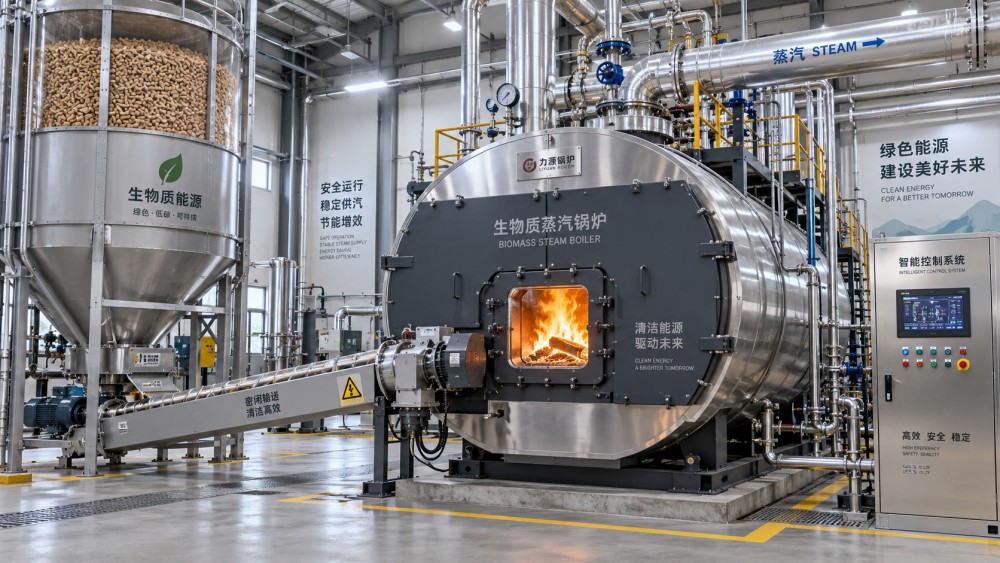
Conversion costs can erase early savings
A biofuel project should be evaluated as an operating-system change, even if the existing boiler can technically burn the proposed fuel. The visible capital items may include a new burner, feed system, storage silo, conveying equipment, gas cleanup, tank modifications, fire protection, controls, and emissions equipment. Less visible costs may include civil works, permitting, insurance changes, training, commissioning time, and production interruption during installation.
At high load, capacity is particularly important. A conversion that lowers the boiler's reliable steam output may force the site to run a second boiler, purchase supplemental fuel, or curtail production at the very time demand is highest. The projected fuel saving should therefore be tested against a conservative output assumption. A project that works only when every delivery is on specification and every component performs at design conditions may not support a robust budget case.
Maintenance also needs a separate line in the financial model. Some biofuel applications increase cleaning frequency, wear on fuel handling equipment, ash removal needs, or inspection requirements. These costs may be manageable, but they should be forecast as recurring operating expenses rather than absorbed into a generic contingency. The question is not whether maintenance will increase in every case; it is whether the expected maintenance profile has been priced into the comparison.
Supply reliability has a monetary value
A boiler at high load consumes fuel rapidly. This makes local supply depth, transport routes, storage capacity, and supplier concentration central to cost control. A facility may obtain attractive fuel pricing from one source, then face costly spot purchases or production risk when weather, feedstock availability, processing capacity, or freight disruption affects that supplier.
Approval should therefore consider the cost of resilience alongside average fuel cost. Practical measures include qualifying more than one supplier, maintaining sufficient on-site inventory, confirming alternate transport options, and defining how pricing changes when the primary grade is unavailable. The appropriate inventory level depends on consumption rate, delivery lead time, storage constraints, and the consequence of a steam interruption.
Longer-term contracts can improve budget visibility, but fixed pricing is not automatically preferable. Some feedstocks are exposed to seasonal availability, competing industrial demand, or transport costs. A contract with a transparent index or a defined adjustment mechanism may be easier to manage than a low initial price with broad discretionary surcharges. Finance teams should compare the downside exposure of each arrangement, not just its expected annual average.
Carbon value may improve the case, but should not carry it alone
Biofuels may reduce exposure to carbon-related costs or support internal emissions targets, depending on the fuel pathway, local rules, and the accounting method used by the organization. These benefits can be commercially meaningful, particularly for energy-intensive operations selling into markets with customer or regulatory emissions expectations.
They should nevertheless be separated from direct fuel savings in the investment case. The base case should show whether the project can withstand less favourable fuel spreads, lower utilisation, or reduced policy support. Carbon-related benefits can then be assessed as an additional value stream, with clear assumptions about eligibility, documentation, traceability, and any sustainability requirements imposed on the fuel supply chain.
Claims also need to match the actual fuel source. Waste-derived residues, purpose-grown feedstocks, renewable gases, and processed liquid fuels can have very different documentation needs and carbon profiles. A financial model that assumes a uniform carbon benefit across all biofuels can overstate value and create compliance risk later.
A practical approval test
The strongest proposal for biofuels for industrial boilers does not rely on a single optimistic fuel-price forecast. It compares at least three operating cases: the expected case, a stressed fuel-quality or supply case, and a peak-demand case that tests whether steam capacity remains intact. Each case should include fuel consumption, useful heat output, conversion capital, maintenance, logistics, backup fuel, and any carbon-related value separately.
- Use contracted or supportable delivered prices rather than a single supplier quotation where possible.
- Model fuel consumption using realistic heating value and boiler efficiency assumptions.
- Verify that the boiler can sustain required steam output with the proposed fuel and equipment configuration.
- Price storage, handling, cleaning, ash, downtime, and backup arrangements explicitly.
- Set commercial fuel-quality limits and remedies before relying on projected savings.
- Evaluate savings under adverse fuel spread and supply scenarios, not only the base case.
Biofuel conversion can be economically attractive at high load when it replaces an expensive conventional fuel with a reliable, specification-controlled alternative and preserves boiler output. It becomes difficult to justify when apparent savings depend on cheap but inconsistent feedstock, unpriced conversion work, or a supply chain that cannot support peak consumption. The approval decision should rest on usable steam cost and operational resilience, because those are the factors that determine whether lower fuel expenditure survives real operating conditions.
- Last One:No more articles
- Next Article:How Often Should Pipeline Transportation Systems Be Inspected?Oct 04, 2026
Related News
- 00
0000-00
Can biofuels for industrial boilers reduce fuel costs at high load? - 00
0000-00
How to assess the reliability of offshore drilling safety systems - 00
0000-00
How to verify quality systems at oil and gas industry suppliers - 00
0000-00
Which carbon capture materials grades suit high-humidity flue gas? - 00
0000-00
How commodity intelligence analytics can improve price risk decisions
Related tags
Weekly Insights
Stay ahead with our curated technology reports delivered every Monday.