




Are sodium-ion batteries suitable for cold-climate energy storage?




Sodium-ion batteries can be suitable for cold-climate energy storage, but only when the specific cell and complete system meet the required charging, discharge, and standby conditions. Some formulations offer promising low-temperature performance. That does not establish a universal advantage over lithium-ion batteries, nor does it mean a sodium-ion installation can operate through winter without heating.
The decisive distinction is between delivering energy while cold and accepting charge while cold. A battery may discharge below freezing yet require warming before recharge. Selection should therefore depend on verified usable energy, charge acceptance, power, efficiency, and degradation across the site’s operating temperatures—not a single minimum-temperature rating.
Cold-weather capability belongs to a cell design, not a chemistry label
Sodium-ion batteries include different combinations of cathodes, anodes, electrolytes, and electrode structures. Cathode families include layered oxides, polyanionic compounds, and Prussian blue analogues; many designs use hard-carbon anodes. These combinations do not share one low-temperature performance curve.
As temperature falls, electrolyte conductivity and ion transport decline, while interfacial reactions become slower. Internal resistance rises, increasing voltage losses under load. During discharge, the cell can reach its lower voltage limit before delivering all the energy available at a warmer temperature. During charging, increased polarization can force current restrictions or cause the upper voltage limit to be reached earlier.
Electrolyte formulation, electrode thickness, porosity, and interfacial behavior all influence these effects. A design optimized for high energy density may behave differently from one optimized for cold-weather power. Sodium’s greater abundance does not explain cold performance, and its larger ion size alone cannot predict it.
A supplier’s low-temperature claim is meaningful only when accompanied by the cell model, test temperature, current, voltage limits, conditioning procedure, and measured result. Performance from a laboratory cell or a different product generation should not be transferred to the proposed storage system.
Discharging below freezing is not the same as recharging safely
Low-temperature discharge demonstrations can obscure the more restrictive part of the duty cycle. In sodium-ion cells with hard-carbon anodes, charging under unfavorable temperature, current, and state-of-charge conditions can create a risk of metallic sodium deposition. The safe operating boundary depends on the cell design and requires validation.
A battery management system should enforce temperature-dependent charging limits rather than rely on a broad ambient-temperature rating. Relevant controls include maximum charge current, allowable state-of-charge range, heating permissions, and the conditions for restarting charge after a cold shutdown.
This matters particularly for solar storage. An outdoor battery may cold-soak overnight and then receive its first charging opportunity while its cells remain below their permitted charging temperature. If warming consumes much of the available morning generation, good cold-discharge performance does not necessarily produce useful winter energy capture.
Backup storage presents a different problem: the battery may need to deliver full power immediately after extended standby. The key requirement is then demonstrated cold-start output at the expected state of charge, including whether heaters and control electronics remain available during a grid outage.
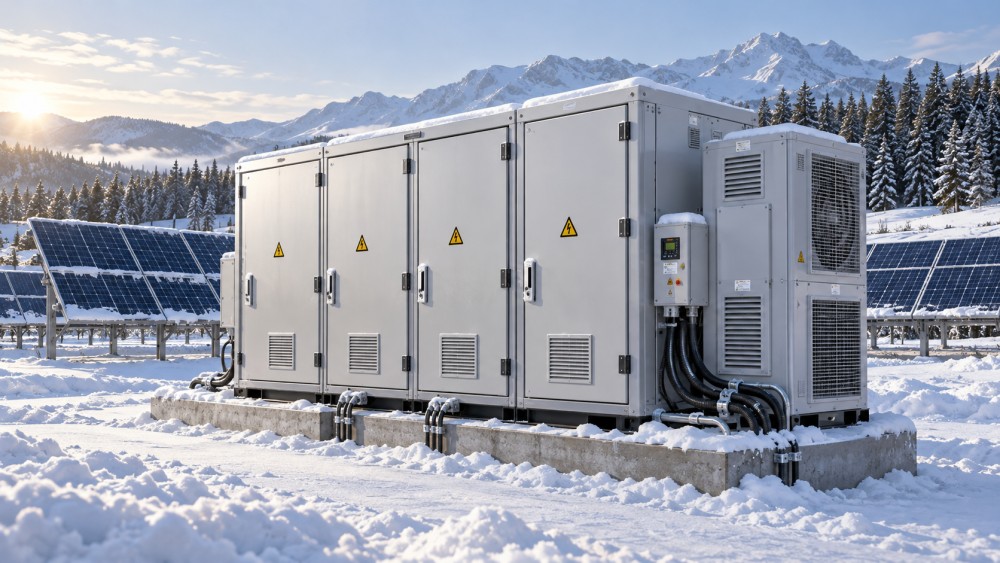
Translate the site’s winter conditions into a testable duty cycle
Outdoor air temperature is not cell temperature. Insulation, enclosure geometry, wind exposure, internal heat generation, and heater controls determine how quickly the battery cools and warms. A short exposure to cold air is not equivalent to several days without operation or auxiliary power.
The operating specification should define minimum ambient temperature, expected cold-soak duration, required discharge power and duration, recharge window, standby time, and the availability of external heating power. It should also distinguish routine winter operation from an exceptional minimum-temperature event.
A system used for daily energy shifting may stay partly warm through regular cycling. A remote emergency installation can approach ambient temperature during prolonged inactivity. Identical cells can therefore require substantially different thermal-management strategies.
Measure usable energy, not just retained capacity
Capacity-retention percentages can mislead when their test conditions differ. A result obtained at a low discharge current does not prove performance at the project’s required power. Likewise, a cell charged while warm and then cooled demonstrates cold discharge—not a complete cold-temperature operating cycle.
Request both ampere-hour capacity and delivered watt-hours. Increased voltage losses can reduce energy delivery even when capacity retention appears favorable. Voltage sag also matters at system level: the battery may contain remaining energy but be unable to maintain the inverter’s required DC operating range under load.
The measurement boundary for efficiency must be explicit. Cell-level DC efficiency excludes inverter losses, heaters, cooling equipment, and controls. For a winter installation, the more relevant measure is AC energy returned relative to AC energy supplied over a representative operating period, including thermal-management and standby consumption.
Heater energy is especially consequential for lightly cycled backup systems. Maintaining readiness can consume substantial energy relative to the small amount discharged. Conversely, a frequently cycled installation may use internally generated heat to reduce heating demand. Neither outcome can be inferred from a cell datasheet alone.
Compare against a winterized alternative, not an unheated cell
A useful comparison is between complete systems meeting the same duty: for example, a sodium-ion system and an LFP system, each with its proposed enclosure, insulation, heating, controls, and inverter. Comparing an optimized sodium-ion cell with an unheated LFP cell does not establish which installation performs better.
Sodium-ion becomes attractive where its verified operating envelope reduces preheating delays, heater consumption, or the extra battery capacity needed to meet winter output. Those benefits must outweigh any project-specific disadvantages in energy density, enclosure size, integration effort, or warranty coverage.
Where space or structural loading is constrained, compare installed mass and footprint per usable winter kilowatt-hour, not nominal cell energy density alone. Where an existing inverter is specified, confirm the battery’s full voltage range, current capability, communications, and cold-condition protection behavior.
A heated LFP installation may remain the stronger choice if it already satisfies the winter duty with well-characterized thermal consumption and support arrangements. Sodium-ion should earn selection through measurable system performance, not simply because the site experiences freezing temperatures.
Require evidence that survives repeated winter operation
Acceptance testing should use production-representative cells and, where practical, the proposed module or rack configuration. Cold-soak conditions should be defined by stabilized cell temperatures rather than chamber air temperature alone. Instrumentation should capture temperature differences within the assembly because the coldest cells can determine allowable charging current.
The test sequence should reproduce the intended operation: standby, cold start, discharge, recharge, and recovery after loss of heating power. Record delivered energy, voltage limits, current restrictions, auxiliary consumption, and elapsed time before full operation becomes available.
A single successful cold cycle is insufficient evidence for long-term service. Request degradation data under relevant low-temperature cycling, including capacity loss and resistance growth. Separate reversible cold-related performance loss from permanent damage by checking performance again at a defined reference temperature.
Warranty terms should match those operating conditions. Check whether low-temperature charging, heater downtime, state-of-charge limits, and restricted-power operation affect coverage. General claims of safety or low-temperature capability do not replace system-level protection validation and applicable installation requirements.
Sodium-ion is a credible cold-climate option when the proposed system can meet the complete winter duty cycle with documented limits and acceptable auxiliary consumption. If the evidence covers only cold discharge after warm charging, it supports a narrower conclusion. Until recharge behavior, cold-start recovery, and repeated-cycle durability are established, the installation should be treated as a temperature-managed battery system—not an inherently cold-proof one.
- Last One:No more articles
- Next Article:How to use an application compatibility guide before an OS upgradeOct 28, 2026
Related News
- 00
0000-00
Are sodium-ion batteries suitable for cold-climate energy storage? - 00
0000-00
How to use an application compatibility guide before an OS upgrade - 00
0000-00
How overcapacity shapes the ferrous metallurgy market outlook - 00
0000-00
How do EU allowances differ from other carbon assets in Europe? - 00
0000-00
Can a digital supplier discovery platform verify overseas suppliers?
Related tags
Weekly Insights
Stay ahead with our curated technology reports delivered every Monday.