




How to verify chemical manufacturing environmental standards compliance




Environmental compliance in a chemical plant cannot be confirmed by finding a current permit or a written policy. Those documents establish obligations, but compliance is demonstrated by consistent operating evidence: what is emitted, where waste goes, how materials are stored, whether controls are maintained, and whether records match actual plant conditions.
For chemical manufacturing environmental standards, the most reliable approach is to verify the full chain from legal requirement to shop-floor practice. A site may have an approved wastewater system, for example, while production changes, poor segregation, or incomplete sampling records create a compliance gap. The same principle applies to air emissions, hazardous waste, spill prevention, and supplier-managed materials.
Start with an obligations register, not a generic checklist
Build a register that connects each environmental obligation to a specific process, control measure, owner, and record. This is more useful than a broad audit checklist because chemical operations have different risks depending on raw materials, reactions, solvents, batch size, utilities, packaging, and waste streams.
Include permits, discharge limits, storage conditions, reporting duties, waste classification rules, transport requirements, and site commitments under any environmental management system. Separate legal requirements from voluntary customer or corporate standards. Both can matter during an audit, but they should not be treated as interchangeable.
The register should also identify trigger events. A new solvent, revised formulation, additional production line, different waste contractor, or increased throughput can change the compliance position even when no one has intentionally changed the environmental program.
Verify the actual process flow
Documents can look complete while the process they describe is outdated. Walk the production route from receiving through storage, processing, cleaning, packaging, and dispatch. Trace every route by which a chemical can leave the intended process: stack, vent, drain, floor, waste container, loading area, or off-site shipment.
This inspection should focus on interfaces. Environmental failures often occur between departments: production generates a residue that is not clearly classified; maintenance replaces a component without updating an emissions-control procedure; a cleaning operation sends wash water to a drain not covered by the assumed treatment route.
Compare plant observations with process flow diagrams, equipment lists, chemical inventories, and environmental aspects registers. Differences do not automatically mean noncompliance, but every difference needs a clear explanation and, where needed, a controlled update.
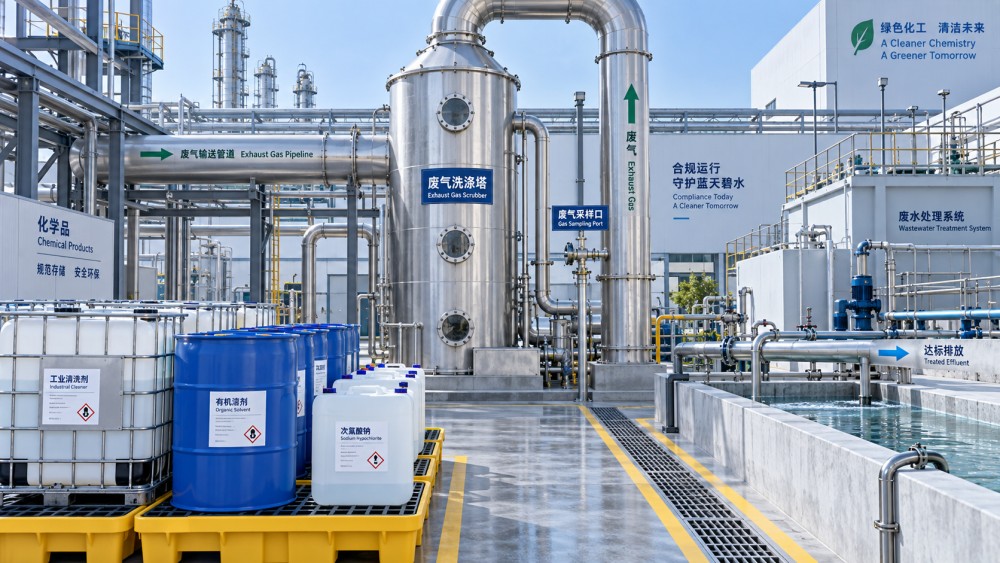
Test whether emission and waste controls work under normal conditions
A control device should not be accepted simply because it is installed. Verification needs to examine whether it is operated within its intended conditions, inspected at an appropriate frequency, and supported by usable maintenance records. For example, a ventilation system may be running, but damaged ducting, poor capture at a charging point, or an unrecorded bypass can undermine its purpose.
For wastewater, confirm that the sampling point represents the discharge being assessed. Check whether high-strength streams, cleaning water, laboratory residues, and stormwater are separated as required. Sampling results are meaningful only when linked to production conditions, treatment performance, and any unusual event during the period.
Waste management deserves the same level of scrutiny. Review whether each waste stream has been identified based on its actual composition rather than a convenient generic label. Mixed wastes, expired reagents, contaminated packaging, spent catalysts, filters, and cleanup materials are frequent sources of classification errors. The container label, storage location, waste profile, and transfer documentation should describe the same material.
Look for record integrity, not just record existence
Environmental records should tell a coherent story. A monthly inspection form with identical entries, a calibration record disconnected from the instrument in use, or a waste manifest that cannot be matched to the accumulation area is weak evidence even when the paperwork is technically present.
Use sample-based traceability checks. Select a recent waste shipment and trace it back to the process that generated it. Select an emission-monitoring result and trace it to the relevant equipment, operating conditions, and corrective actions. Select a chemical from the warehouse and verify its storage controls, current safety documentation, inventory status, and potential waste route.
This method is efficient because it tests whether different functions are working from the same facts. It also exposes a common mistake: treating environmental compliance as the responsibility of one coordinator instead of an operational control shared by production, maintenance, laboratory, warehouse, and procurement teams.
Assess changes before they become audit findings
Many environmental problems begin with an apparently small operational change. A higher-boiling solvent may alter air-control performance. A new raw material may produce a different wastewater load. Increased production can exceed the practical capacity of storage or treatment equipment. Changes in packaging can generate waste that the current contractor is not prepared to accept.
A practical management-of-change review should ask four questions:
- Does the change introduce a new emission, effluent, waste stream, or storage hazard?
- Does it alter the quantity, concentration, temperature, pressure, or composition of an existing stream?
- Do monitoring methods, waste profiles, operating instructions, or employee training need revision?
- Has the change been reflected in permits, reports, contractor arrangements, and emergency controls where relevant?
Do not limit this review to capital projects. Temporary production campaigns, trial batches, maintenance shutdowns, and supplier substitutions can have the same environmental effect as a permanent modification.
Use external standards carefully
International management frameworks can improve structure, accountability, internal auditing, and corrective action, but they do not replace site-specific environmental obligations. Certification may show that a management system exists; it does not prove that every emission point, waste stream, or storage area meets the applicable operational requirement.
When sourcing chemicals, equipment, treatment services, or recycling partners, evaluate claims against relevant technical documentation. Confirm material specifications, safety data, waste acceptance criteria, process capability, and traceability rather than relying on a certificate name alone. Platforms such as GEMM can help teams compare product categories, process information, supplier references, and standards-related documentation before procurement or project decisions. That research is most useful when it is tied to a defined site requirement, not used as a substitute for plant-level verification.
Close gaps with evidence and ownership
Classify findings by environmental consequence and likelihood, then assign one accountable owner, a completion date, and a verification method. “Retrain staff” is rarely enough on its own. A stronger action might include relabelling containers, revising a waste profile, repairing containment, updating an operating instruction, and confirming through a follow-up inspection that the new control is being used.
The final question is simple: can the site demonstrate that its environmental controls reflect current operations and work consistently? When the answer is supported by observed conditions, traceable records, maintained equipment, and controlled changes, compliance becomes defensible rather than paper-based.
- Last One:No more articles
- Next Article:What Hidden Costs Affect Sustainable Energy Infrastructure Projects?Oct 07, 2026
Related News
- 00
0000-00
How to verify chemical manufacturing environmental standards compliance - 00
0000-00
How to evaluate data quality in a recycled plastics database - 00
0000-00
How to assess contamination risk in plastic recycling pellets - 00
0000-00
Can biofuels for industrial boilers reduce fuel costs at high load? - 00
0000-00
How to assess the reliability of offshore drilling safety systems
Weekly Insights
Stay ahead with our curated technology reports delivered every Monday.