




How to evaluate data quality in a recycled plastics database




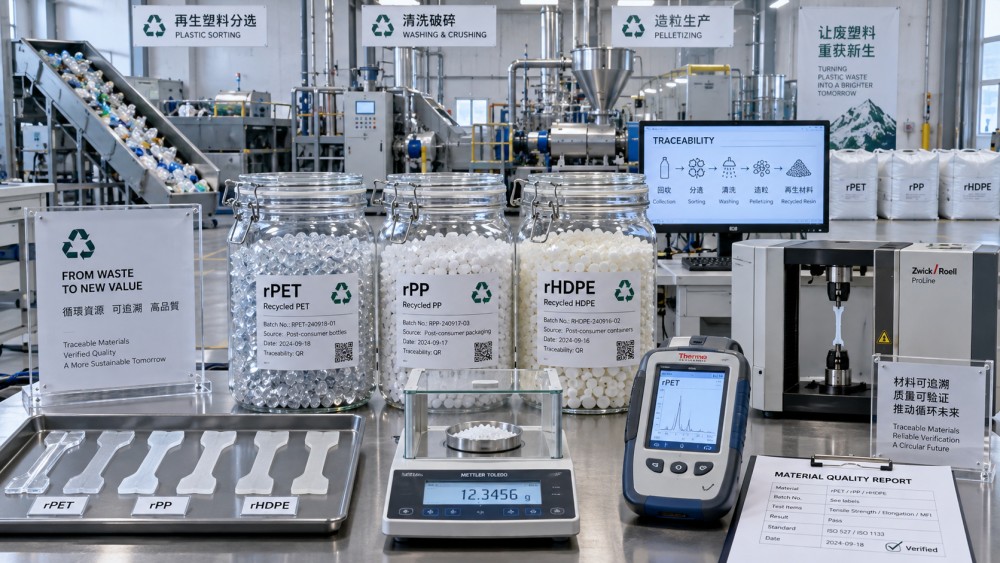
A recycled plastics database should not be judged by the number of grades it lists. Its value lies in whether a material record can support a defensible engineering decision: can you identify the feedstock, understand how the material was processed, compare properties tested under equivalent conditions, and see what evidence supports recycled-content or certification claims?
For technical assessment, incomplete data is not merely inconvenient. It can lead to an unsuitable resin choice, unstable processing, avoidable qualification work, or an unsupported compliance claim. The most reliable approach is to assess both the individual material record and the database rules that produced it.
Start with traceability, not the headline property
A record stating “recycled polypropylene” or “recycled PET” is not sufficiently specific for material selection. Recycled polymers can differ substantially because of collection source, sorting quality, prior use, decontamination, compounding, and the number of thermal processing cycles. Two materials with similar melt flow or density may behave differently in molding, extrusion, impact loading, appearance-sensitive parts, or long-term service.
A credible entry should make the material’s origin understandable. Useful fields include the polymer family, post-consumer or post-industrial origin, feedstock stream, sorting approach where relevant, reprocessing route, additives, fillers, and whether virgin resin or another polymer has been blended in. The purpose is not to demand every commercial detail. It is to determine whether the material identity is sufficiently defined for the intended application.
Be cautious with broad labels such as “mixed recycled polyolefin” when the proposed use needs predictable mechanical or thermal behavior. Such a designation may be appropriate for some robust, non-critical products, but it does not provide the same decision basis as a controlled, grade-specific compound.
Check whether test data is comparable
Property values only become useful when the test conditions are visible. A tensile strength figure without a stated method, specimen condition, direction, or test environment cannot be confidently compared with another supplier’s figure. The same applies to impact performance, melt flow, density, ash content, moisture, odor, color, and volatile content.
When reviewing a recycled plastics database, look for a clear connection between each property and its test method. The record should distinguish measured values from estimates, typical values from specification limits, and supplier-declared information from independently documented data.
Do not assume that a value presented with several decimal places is precise. Precision in formatting is not evidence of repeatability. For recycled material, a practical database also needs to show the expected variability or at least identify which properties are controlled in routine production.
Separate a material profile from a qualified grade
Many databases combine information with different levels of evidence. A general profile may describe typical characteristics of recycled HDPE from a particular waste stream. A qualified grade, by contrast, should identify a defined commercial material, its supplier, relevant specifications, and supporting documents.
Both have a place. General profiles are useful early in concept development, when comparing polymer families or considering feasible recycled-content strategies. They are not enough to release a material for a critical component, a regulated use, or a process with narrow operating margins.
For a specific grade, inspect whether the record answers these questions:
- Is the grade name or identifier stable enough to request samples and technical documents?
- Does the record state the intended processing route, such as injection molding, extrusion, blow molding, film, or fiber production?
- Are critical limitations disclosed, including color restrictions, odor sensitivity, food-contact status where applicable, or suitability for outdoor exposure?
- Is there a distinction between a marketing description and a documented specification?
- Can the record be tied to a supplier contact, technical data sheet, declaration, or certification record?
A database that blends these evidence levels without labeling them creates a misleading sense of certainty. Classification is a data-quality feature, not a cosmetic one.
Evaluate recycled-content claims in context
“Recycled content” can describe different things: the share of recycled input in a formulation, the share attributed through a chain-of-custody model, or the recycled fraction in a finished article. A strong database makes the claim basis clear and avoids implying that all percentages are interchangeable.
Technical evaluators should also check whether the stated recycled content applies to the exact grade, color, additive package, and production location being assessed. A supplier may offer related grades with different formulations. Treating the highest reported figure in a product family as the figure for every grade is a common documentation error.
Certification information is useful when it is linked to the claim it supports. A certificate name alone does not establish the usable properties of a resin, nor does a material data sheet prove recycled-content traceability. These are separate evidence streams and should be reviewed together when the project requires both performance and substantiation.
Look for the data gaps that cause failures later
The most consequential omissions are often outside the basic property table. A recycled resin may meet initial tensile and flow requirements yet create problems because of moisture sensitivity, volatile residues, odor, color variation, incompatible polymer traces, or degradation during repeated processing.
The importance of each gap depends on the application. A hidden structural component may tolerate color variation but require strong impact retention. Packaging may prioritize odor, appearance, and consistency. A part exposed to heat, chemicals, sunlight, or repeated loading needs evidence related to those service conditions, rather than a generic “suitable for industrial use” statement.
Use the end-use failure mode to decide which missing data matters. If a database cannot show the information required to assess that failure mode, the entry can still be a sourcing lead, but it should not be treated as a final material qualification.
A practical review sequence
- Define the application limits before searching: process, critical properties, visual requirements, environmental exposure, and documentation needs.
- Filter records by polymer family and intended process, then remove entries that lack traceable source or grade identification.
- Compare only values produced under compatible methods and conditions. Mark any comparison that relies on missing method details.
- Review recycled-content evidence separately from performance data.
- Identify the application-specific gaps that require supplier documentation, sample testing, or production trials.
- Record the version and source of the chosen data so the final decision can be revisited when a formulation or supply route changes.
This sequence prevents an early search result from becoming an unexamined engineering assumption.
What a well-structured platform contributes
For evaluators working across multiple suppliers and material categories, the main advantage of a structured information platform is comparability. GEMM organizes product information, technical knowledge, supplier references, application guidance, standards-related documentation, and market intelligence across plastics and other industrial sectors. In recycled materials research, that structure can help users move from a broad material category to questions that actually determine suitability: grade identity, processing route, technical documentation, supply capability, and application fit.
It should still be treated as a research and comparison layer, not a substitute for qualification evidence. The final selection of a recycled polymer should rest on the documented grade, the conditions of its manufacture and use, and testing that reflects the finished part or product.
The most dependable database record is therefore not the one with the longest list of properties. It is the one that allows a reviewer to understand what the material is, how the values were obtained, what the values do not prove, and which next document or test will close the remaining decision gap.
Related News
- 00
0000-00
How to evaluate data quality in a recycled plastics database - 00
0000-00
How to assess contamination risk in plastic recycling pellets - 00
0000-00
Can biofuels for industrial boilers reduce fuel costs at high load? - 00
0000-00
How to assess the reliability of offshore drilling safety systems - 00
0000-00
How to verify quality systems at oil and gas industry suppliers
Related tags
Weekly Insights
Stay ahead with our curated technology reports delivered every Monday.