




What Hidden Costs Affect Sustainable Energy Infrastructure Projects?




Hidden costs in sustainable energy infrastructure are the expenses that emerge between an approved concept and a reliably operating asset. Equipment quotations and civil works budgets often capture only the visible portion. The less visible portion includes the time and studies needed to connect to the grid, site-specific ground and drainage work, permitting revisions, logistics constraints, commissioning failures, spare-parts strategy, data-system integration, and the effort required to preserve performance over the asset's life.
These costs are difficult because they are rarely independent. A delayed grid connection can extend land-control payments and construction supervision. A change to a battery enclosure or inverter layout can trigger new fire, access, drainage, and cable-routing reviews. A lower-priced component can increase transport, installation, testing, or replacement cost once its actual operating environment is considered.
Grid connection costs extend beyond the interconnection fee
For solar, wind, bioenergy, and industrial energy storage projects, the point of connection is often the largest source of budget uncertainty after core equipment. An initial estimate may cover a line extension or substation bay while omitting network studies, protection coordination, metering changes, communications equipment, reactive-power equipment, harmonic assessment, and works required upstream of the stated connection point.
Connection timing has a financial effect even where the final technical scope is known. Generation equipment may be delivered and installed before export approval is available. The site then incurs security, inspections, insurance, preservation work, lease obligations, and debt costs while producing little or no revenue. Temporary power for construction systems, heating, dehumidification, controls, and safety equipment can also remain necessary longer than planned.
The nominal capacity of a project should not be treated as its usable export capacity. Curtailment provisions, ramp-rate limits, power-factor requirements, fault-ride-through settings, and seasonal network constraints can alter the energy actually delivered. For a storage project, import capacity for charging and export capacity for discharging may differ. A financial model based on nameplate output without the operating restrictions can understate both infrastructure requirements and lost operating value.
Land, access, and ground conditions change the installed cost
Site acquisition is often reduced to lease or purchase price, but the usable project footprint is shaped by rights of way, setbacks, easements, access roads, drainage corridors, cable routes, crane pads, and restoration obligations. A site can have enough acreage for panels or turbines while lacking a practical path for heavy transport, a collector system, or an export cable. Securing an additional narrow strip of land late in development can be disproportionately expensive because it is tied to a critical route.
Ground conditions carry similar hidden exposure. Geotechnical investigations may reveal variable bearing capacity, expansive soils, shallow bedrock, contamination, peat, high groundwater, flood risk, or aggressive soil chemistry. Each condition affects foundation design, trenching, corrosion protection, dewatering, drainage, and construction sequencing. The cost difference is not limited to more concrete or steel. Slow excavation, restricted working seasons, spoil handling, and additional quality testing can extend the construction schedule.
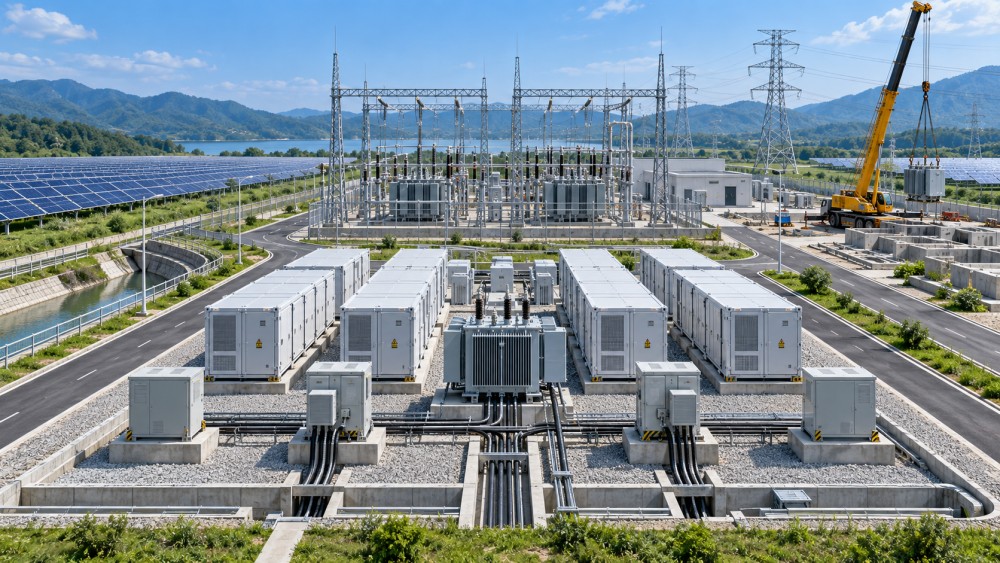
For photovoltaic installations, pile refusal or refusal depth can force predrilling, alternative foundations, or a revised table layout. For wind projects, blade and tower delivery may require road widening, bridge assessment, turning modifications, and temporary works that are absent from a preliminary site drawing. Energy storage containers add a different constraint: the final arrangement must allow equipment access, separation distances, firefighting access, drainage control, and replacement of major components without dismantling the surrounding installation.
Permitting is an evolving engineering cost
Permitting expenses are not confined to an application fee. Environmental surveys, visual studies, noise assessments, hydrology work, traffic plans, cultural-resource investigations, public consultation, legal review, and specialist design reports can all be required before construction starts. More importantly, permit conditions can convert into recurring operating obligations: vegetation management, water monitoring, noise verification, habitat timing restrictions, reporting, or site restoration requirements.
A common underestimate occurs when the design used for early approvals changes during procurement. A different inverter rating, taller transformer, altered battery chemistry, revised access road, or substitution in foundation materials can require an amendment or a new technical review. The relevant question is not simply whether the replacement component performs the same electrical function. Its dimensions, weight, thermal behavior, fire characteristics, noise profile, maintenance access, and control interface may alter the approved scheme.
Permitting risk also has a schedule dimension. Survey windows for ecological or seasonal conditions cannot always be moved to suit an engineering program. Where construction activities are limited during particular periods, crews and equipment may need to be remobilized. These costs are best treated as a linked scope-and-time allowance, rather than a single contingency line with no identified cause.
Storage integration creates costs at the interfaces
Battery energy storage is frequently budgeted around cells, racks, containers, power conversion systems, and a headline energy capacity. The integration cost sits at the interfaces: medium-voltage equipment, transformers, switchgear, protection systems, thermal management, fire detection and suppression arrangements, auxiliary power, cable containment, communications, control logic, and site civil works.
Energy capacity alone is insufficient for cost comparison. Duration, usable state-of-charge range, ambient temperature, expected cycling pattern, available power at different states of charge, and degradation assumptions affect the size and operating duty of the system. A system designed for short, high-power events places different demands on inverters, transformers, cables, and cooling equipment than a system intended for long-duration discharge. Two installations with similar megawatt-hour ratings can therefore have materially different balance-of-plant costs.
Control integration deserves early attention. The energy management system, battery management system, plant controller, metering, protection relays, and grid operator interface must exchange correct signals under normal, constrained, and fault conditions. Late changes in signal lists, communication protocols, cybersecurity requirements, or operating modes often lead to expensive field modifications. A commissioning delay can arise from a small unresolved issue, such as an incorrect measurement point, incompatible time synchronization, or an unclear priority between a local protection action and a remote dispatch command.
Procurement exposure is broader than component price
Supply-chain volatility affects more than the purchase order value. Long-lead items may require deposits, storage, factory acceptance testing, shipping insurance, port handling, customs documentation, specialist unloading, and inspection after delivery. Oversize components introduce route surveys and lifting constraints. Sensitive electrical equipment and battery systems may require controlled storage conditions, periodic inspection, energization procedures, or preservation measures if installation is postponed.
Substitution is another hidden-cost pathway. When an original component is unavailable, the replacement may change cable sizes, mounting details, enclosure ventilation, transformer selection, software configuration, spares inventory, or compliance documentation. A technically acceptable substitute is not automatically interchangeable at project level. Its impact should be assessed against the approved drawings, protection settings, construction method, operating envelope, and warranty responsibilities before the order is changed.
Material selection also affects lifetime expenditure. Galvanized steel, coated fasteners, aluminum structures, polymer cable insulation, concrete, seals, and protective coatings perform differently in humid, saline, polluted, high-temperature, or chemically aggressive environments. Corrosion protection that appears excessive for a sheltered inland installation may be necessary near salt spray or industrial emissions. Conversely, an unsuitable material choice can create inspection, recoating, replacement, and outage costs well before the primary equipment reaches the end of its expected service life.
Commissioning and performance verification are frequently under-scoped
Construction completion is not the same as operational readiness. Functional tests are needed for protection systems, controls, communications, metering, alarms, emergency shutdown, auxiliary systems, and grid-support functions. Renewable assets also need verification that the installed configuration matches the design assumptions: string layout and polarity for solar, turbine control behavior for wind, fuel quality and emissions performance for bioenergy, or charge-discharge limits for storage.
Testing requires access to specialist personnel, calibrated instruments, test power, communications availability, and a defined process for recording defects. If the grid interface, plant controller, and equipment supplier are tested in separate stages, the final integrated test may expose issues that none of the isolated tests could reveal. Repeated mobilization, revised control software, and retesting then become unplanned costs.
Performance guarantees can be misunderstood when the boundary conditions are vague. Output depends on irradiance, wind regime, temperature, fuel characteristics, grid availability, curtailment, parasitic consumption, and equipment availability. A guarantee should identify the measurement method, reference conditions, data quality rules, excluded events, and remedy process. Without those details, a shortfall can become a prolonged dispute rather than a clear corrective task.
Operating costs begin with design choices
Long-term maintenance is often understated because annual service allowances appear modest beside construction expenditure. Yet access layout, lifting provisions, spare-parts holdings, remote monitoring quality, warranty exclusions, vegetation control, cleaning needs, drainage maintenance, and cyber-security updates determine the practical cost of keeping an asset available.
Remote locations can turn routine service into a logistics event. A failed inverter, transformer component, cooling unit, relay, or sensor may require travel, site induction, isolation planning, lifting equipment, and a controlled restart. The loss is not limited to the repair invoice; it includes downtime and any contractual consequences of unavailable capacity. Designs that leave no practical replacement route for major equipment transfer cost into future outages.
For energy storage, auxiliary consumption deserves explicit treatment. Heating, ventilation, air conditioning, controls, pumps, and fire systems consume energy and require maintenance. Their load varies with climate and enclosure design, affecting both usable energy and operating expense. Battery augmentation or module replacement also requires planning for compatibility, controls updates, safe handling, transport, recycling or disposal, and the performance effect of mixing equipment from different production batches.
Decommissioning and restoration should be priced while the layout is still flexible
End-of-life obligations are easy to defer because they occur after the development and construction milestones. They remain real costs: dismantling, transport, waste classification, recycling arrangements, contaminated-soil treatment where relevant, cable treatment, foundation removal or treatment, and restoration of access routes and drainage features. Land agreements and permits may set a required restoration condition that differs from the minimum engineering approach.
A useful cost model assigns each material and asset a removal path rather than assuming a resale value. Steel structures, copper cable, aluminum frames, power electronics, composite materials, concrete, and battery components have different recovery routes and handling requirements. The value of recoverable materials can offset some expenditure, but it should not be used to conceal uncertain labor, transport, processing, or compliance costs.
The most reliable early estimates connect each major assumption to a physical condition, interface, or contractual obligation. When the grid point, site access, equipment arrangement, operating mode, and restoration condition are defined together, hidden costs become visible scope items instead of late-stage surprises.
Related News
- 00
0000-00
How to verify chemical manufacturing environmental standards compliance - 00
0000-00
How to evaluate data quality in a recycled plastics database - 00
0000-00
How to assess contamination risk in plastic recycling pellets - 00
0000-00
Can biofuels for industrial boilers reduce fuel costs at high load? - 00
0000-00
How to assess the reliability of offshore drilling safety systems
Weekly Insights
Stay ahead with our curated technology reports delivered every Monday.