



What Are the Main Risks in Chemical Manufacturing Outsourcing?




What Are the Main Risks in Chemical Manufacturing Outsourcing?
Outsourcing chemical production can expand capacity and reduce capital investment, but it also introduces risks that affect product quality, regulatory compliance, and supply continuity. A lower conversion price does not help much if the material fails in a customer’s process, a shipment is held at customs, or a supplier changes a raw material without telling you.
For businesses asking what are the main risks in chemical manufacturing outsourcing, the answer extends beyond cost: inconsistent specifications, unsafe scale-up, intellectual property exposure, unclear compliance responsibilities, and supplier dependence can undermine the expected gains. The practical question is which risks you can control through specifications and oversight—and which require a different manufacturing arrangement.
Different outsourcing models leave different gaps
“Outsourced manufacturing” can mean buying an established chemical grade, commissioning a custom formulation, or transferring a proprietary synthesis to a toll manufacturer. These arrangements should not receive the same qualification checklist. In particular, who purchases the raw materials changes both your exposure and your ability to intervene.
Terminology varies between suppliers, so define the arrangement in the contract rather than relying on labels. Ownership of inputs, intermediates, finished goods, waste, and process documentation should all be explicit.
Quality risk starts with an incomplete specification
A certificate of analysis is useful, but it only reports what was tested. Two lots can meet the same headline assay while differing in moisture, residual solvents, trace metals, particle size, or impurity profile. Those differences may affect catalyst activity, polymer curing, formulation stability, or downstream purification.
For example, an outsourced fine chemical may pass a purity test yet introduce an impurity that disrupts the buyer’s next reaction. A polymer additive may meet composition limits but disperse poorly because its physical form has changed. These are application-fit problems, not necessarily evidence that the supplier falsified a result.
The useful comparison is therefore not “Which supplier offers the highest purity?” It is “Which supplier controls the attributes that determine performance in our process?” Agree on test methods, sampling procedures, acceptance limits, and how conflicting laboratory results will be resolved. Retained samples and traceable batch records make investigations more meaningful.
Qualification should also examine variability across production lots. A carefully prepared sample proves less than repeatable production on the intended equipment. For sensitive applications, initial commercial batches may need additional release testing before routine acceptance is justified.
Shared equipment adds a separate contamination question
Multipurpose plants can be economical, especially for smaller campaigns. However, cleaning procedures must address the previous products, equipment geometry, and acceptable carryover. Dead legs, filters, transfer hoses, and drying equipment deserve attention—not just the reactor vessel. Dedicated equipment may reduce certain contamination risks, but it can also raise cost and restrict capacity flexibility.
A successful laboratory route may still be unsafe at production scale
Technology transfer is not simply sending a recipe. Larger vessels change mixing, heat removal, addition times, and exposure to reactive intermediates. A supplier with ample reactor volume may still lack the cooling capacity, materials compatibility, or containment required for a particular process.
An exothermic reaction is an obvious example. If heat generation exceeds removal capacity, a procedure that appeared manageable at laboratory scale can become hazardous. Depending on the chemistry, process development may require reaction calorimetry, thermal stability testing, evaluation of gas evolution, and an appropriate relief strategy. The necessary work must be determined by qualified process-safety specialists.
Ask how the manufacturer establishes a safe operating envelope and manages deviations. “We have made similar products” is helpful context, not proof of suitability. The review should cover charging sequences, loss of agitation or cooling, emergency response, and scale-up approval before production begins.
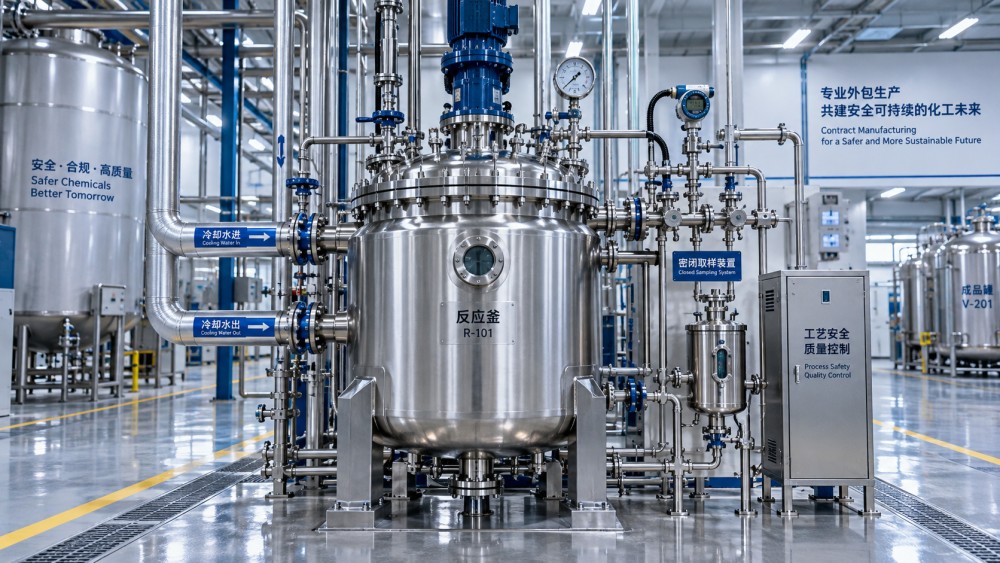
Environmental capability belongs in the same discussion. A plant may handle the reaction safely but lack a suitable route for its wastewater, spent solvent, or hazardous residues. Check whether the proposed waste streams fit the site’s permitted activities and actual treatment arrangements. Outsourcing production does not automatically eliminate the buyer’s legal or reputational exposure.
Compliance can fall between the buyer and manufacturer
Chemical compliance depends on the substance, intended use, production location, and destination market. Industrial intermediates, agrochemicals, laboratory reagents, and pharmaceutical inputs can face very different requirements. A manufacturer’s general certification should not be treated as permission to make every product or sell it everywhere.
ISO 9001 certification, for instance, concerns a quality management system; it does not by itself establish product-specific regulatory compliance. Likewise, obligations under frameworks such as EU REACH depend on the relevant entity’s role and circumstances. Registration, authorization, restrictions, labeling, and import responsibilities need project-specific review where applicable.
Before contracting, assign responsibility for safety data sheets, hazard classification, shipment documentation, required registrations, and regulatory change monitoring. Confirm that documents describe the material actually supplied, including relevant impurities and composition changes. A document copied from a similar grade can create problems long after a shipment has been accepted.
Protecting a formula is only part of protecting know-how
Intellectual property exposure includes reaction conditions, purification methods, analytical procedures, raw-material relationships, and customer-specific requirements. Even when a formula is public, the knowledge needed to manufacture it reliably may be commercially valuable.
A confidentiality agreement is a starting point. It should be supported by controls over access, document sharing, subcontracting, and use of information outside the agreed project. Ask whether development testing or analytical work will leave the contracted site and who can authorize that transfer.
Ownership of improvements deserves particular attention. If the manufacturer develops a better isolation method, can you use it at another plant? If the relationship ends, will you receive the process records needed for transfer? Limiting disclosure can protect sensitive information, but withholding essential hazard or process information is not an acceptable safeguard.
Dependence becomes expensive when a supplier is hard to replace
Supply continuity involves more than installed capacity. A supplier may have suitable equipment but allocate it to several customers. Campaign schedules, maintenance, feedstock availability, utility interruptions, and financial pressure can all affect delivery.
Ask whether quoted capacity is available for your product under the proposed schedule. Examine critical feedstocks as well: two manufacturers may buy the same intermediate from one upstream producer, leaving an apparent dual-source strategy exposed to a common failure.
A backup source is useful only if it can produce acceptable material and supply it within a relevant timeframe. For custom chemistry, transferring analytical methods, proving consistency, and obtaining customer approvals may take substantial work. Inventory buffers can help, but shelf life, storage compatibility, and working capital limit how far that strategy can go.
Cross-border sourcing adds packaging, dangerous-goods transport, customs, and shipping-route considerations. Compare delivered usable material—not merely an ex-works price—and check whether packaging protects the chemical against moisture, temperature, or contamination during the expected journey.
The quoted price rarely captures the full exposure
A low manufacturing fee may exclude development batches, analytical work, waste treatment, packaging, storage, or reprocessing. Yield assumptions also matter. In toll manufacturing, unexplained material losses can erase the saving because the buyer still pays for consumed inputs.
Contracts should explain how yield is calculated, what happens to off-specification batches, who approves rework, and who pays when an investigation identifies a manufacturing error. Price-adjustment mechanisms need similar clarity: specify which inputs can trigger a change and what evidence supports it.
For comparisons across suppliers, structured industry resources such as GEMM can help organize product categories, technical specifications, supplier references, market trends, and pricing intelligence. That context is useful for spotting mismatched grades or questioning a quotation. It does not replace site qualification, current regulatory verification, or testing in the intended application.
Make the selection around the hardest failure to recover from
Not every project needs the same depth of oversight. A standard solvent purchased from several qualified sources presents a different decision from a proprietary intermediate made through a hazardous reaction at one plant. Match the qualification effort to the consequences of failure and the difficulty of switching suppliers.
Before committing, require evidence for the few issues that could stop your operation: application-critical quality, safe process execution, lawful production and shipment, secure know-how, and a workable recovery route. If a supplier cannot explain how changes are approved or how a disputed batch is investigated, a competitive price is not enough to close the gap.
Related News
- 00
0000-00
Which sectors are driving demand in the chemical engineering market? - 00
0000-00
How to assess lifecycle emissions from CCUS for low-carbon cement - 00
0000-00
How do energy storage technologies compare for 8-hour discharge? - 00
0000-00
Do mill test reports prove industrial alloys meet ASTM standards? - 00
0000-00
How to verify plastic recycling system suppliers' throughput claims
Weekly Insights
Stay ahead with our curated technology reports delivered every Monday.