




How to verify plastic recycling system suppliers' throughput claims




A throughput claim is useful only when it states what material enters the line, what usable product leaves it, and how much operating time the measurement includes. When comparing plastic recycling systems suppliers, ask for a guaranteed rate of conforming output under agreed feedstock conditions. A peak feeding rate alone cannot establish whether a system will meet your production target.
The practical task is to connect the quoted capacity to a repeatable test. That requires a common measurement basis, representative material, a balanced production record, and acceptance criteria that cover both output quantity and quality.
Define what the quoted throughput actually measures
Suppliers may quote capacity at the shredder inlet, washing section, extruder feed, or pellet discharge. Each figure describes a different point in the process. Material removed as contamination, moisture, fines, or rejected polymer affects the relationship between input and finished output.
Before comparing offers, require each supplier to complete the same capacity definition:
Keep sustained output and material yield separate. A line may process feed quickly while losing too much recoverable polymer. Another may achieve good recovery but miss the required production rate. Neither measure substitutes for the other.
Make the trial feedstock match your purchasing reality
A demonstration using clean, uniform production scrap provides limited evidence for a line intended to process contaminated post-consumer material. Polymer type matters, but so do particle shape, bale compaction, film content, labels, adhesives, dirt, and the distribution of moisture.
Prepare a feedstock specification from the material you expect to receive. Define normal operating conditions and the more difficult conditions the line must handle. Where supply varies substantially, test representative batches separately; blending everything into an easy average can hide a recurring production problem.
Record how trial material is collected, sampled, stored, and prepared. If a supplier pre-shreds, dries, sorts, or cleans it before the test, those steps must be documented. Otherwise, the demonstration may depend on preparation equipment or labor absent from the proposed installation.
For lightweight film, feeding stability and bulk density deserve particular attention. For rigid packaging, contamination removal and separation may impose greater constraints. These are starting points for investigation; the actual limiting stage depends on the feedstock and line configuration.
Check the whole line for the limiting stage
Individual machine ratings do not add up to a guaranteed system capacity. A shredder may accept material faster than the washing section can clean it. A dryer may discharge sufficient mass while leaving moisture above the downstream requirement. An extruder may maintain output briefly while filter pressure rises toward a screen change.
Ask each supplier to explain the expected bottleneck for your feedstock and show the evidence behind that assessment. A credible explanation connects equipment sizing with material behavior and product requirements.
During a trial, follow material through the line and watch for:
- Feed interruptions, bridging, or repeated manual intervention at the inlet.
- Accumulation between stages that allows one machine to appear productive while another falls behind.
- Changes in washing conditions, drying performance, or output moisture as loading increases.
- Rising filtration pressure, frequent screen changes, unstable extrusion, or increasing product rejection.
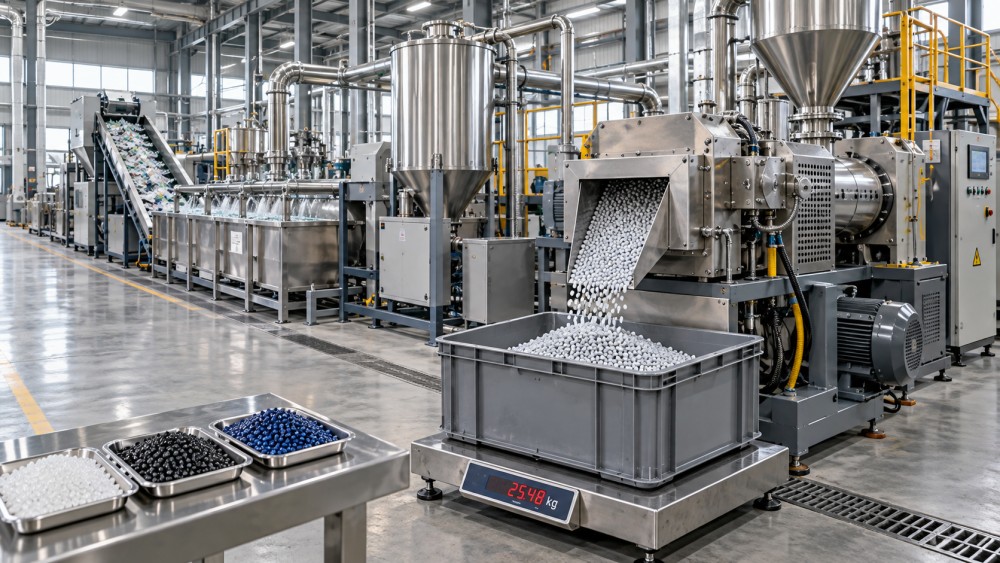
Intermediate storage can absorb short fluctuations, but it can also disguise an imbalance during a brief demonstration. Record buffer levels at the beginning and end of the measurement period. A line that finishes with substantially more unfinished material has not converted all recorded input into finished output.
Request production records that explain the headline number
A short video and a single output weight offer weak support for a capacity guarantee. Request time-stamped records covering feed quantities, finished product, rejected material, downtime, operating settings, and relevant quality measurements. Weighing equipment should have suitable capacity, resolution, and documented calibration.
Start measurement after the line reaches agreed stable conditions, but record startup separately so its commercial impact remains visible. The measured run should be long enough to reveal the constraints being evaluated, including material accumulation, thermal stability, and normal maintenance events. There is no universal test duration that proves every recycling process.
Two calculations make the evidence easier to compare:
Net conforming output rate = mass of product meeting the agreed specification ÷ elapsed measurement time.
Dry saleable yield = dry mass of conforming product ÷ dry mass of incoming feed.
Define the elapsed-time rule before testing. If routine screen changes, cleaning, or feed interruptions are excluded, the result describes performance during selected running time. Report a separate figure including those events to assess usable production capacity.
For yield, measure moisture at the relevant streams so water removal does not distort the comparison. For the overall mass balance, account for rejects, fines, other exits, and changes in material held inside the system. Washing processes also require attention to added water and wastewater; a dry-solids balance is often more informative than comparing wet weights.
If an integrated washing and pelletizing line has substantial residence time, establish how incoming batches correspond to collected output. Otherwise, pellets produced from earlier material may be incorrectly credited to the measured feed.
Tie throughput to product quality and resource use
A system has not met a useful capacity target if it achieves the quoted rate by producing material outside specification. Define quality limits around the intended application: relevant checks may include moisture, residual contamination, particle size, melt flow, color consistency, or pellet uniformity.
Sample output at agreed intervals throughout the run. A single selected sample can miss deterioration as wash water becomes loaded, filters accumulate contamination, or operating conditions change. Specify sampling locations, test methods, and how failed samples affect acceptance.
Keep product awaiting test results separate from confirmed conforming output. Reworked material should also be identified so it is not counted twice.
Measure electricity, water, consumables, and staffing alongside production. Their boundaries must match the throughput boundary: an extrusion-only energy figure cannot represent a complete washing and pelletizing line. Express resource consumption against conforming output to show the operating cost of usable material.
Turn the claim into an acceptance commitment
Agree the test protocol before placing the order. It should become part of the supply agreement, with clear responsibilities for feedstock, utilities, sampling, measurement, and records.
- Performance conditions: Define the feedstock range, utility conditions, equipment configuration, and permitted operating adjustments.
- Pass criteria: Set minimum conforming output, required quality, and any agreed yield or consumption limits.
- Interruption rules: State how stoppages, maintenance, rejected output, and external disruptions affect the result.
- Failure response: Define corrective work, retesting conditions, responsibilities, and the contractual remedy if performance remains below the guarantee.
A factory acceptance test can demonstrate operation with representative material before shipment. A site acceptance test establishes performance with the installed utilities, upstream preparation, material handling, and downstream arrangements. Factory testing alone does not establish that every site dependency has been satisfied.
For supplier selection, give greater weight to documented, repeatable performance within your operating conditions than to the largest advertised capacity. The next useful step is to send shortlisted suppliers one common feedstock specification and acceptance protocol. Their willingness to commit to that basis—and the evidence they provide—will make the offers meaningfully comparable.
Related News
- 00
0000-00
Which sectors are driving demand in the chemical engineering market? - 00
0000-00
How to assess lifecycle emissions from CCUS for low-carbon cement - 00
0000-00
How do energy storage technologies compare for 8-hour discharge? - 00
0000-00
Do mill test reports prove industrial alloys meet ASTM standards? - 00
0000-00
How to verify plastic recycling system suppliers' throughput claims
Weekly Insights
Stay ahead with our curated technology reports delivered every Monday.