




What Waste Treatment Is Required for Chemical Processing Effluent?




Chemical processing effluent requires treatment that matches its actual contaminant profile, flow pattern, and permitted discharge route. A stream containing only acidic or alkaline rinse water may need controlled neutralization and solids removal, while a mixed stream containing solvents, dissolved metals, emulsified oils, high organic loading, or toxic intermediates can require several treatment stages. The required system is therefore determined by analysis and segregation, not by selecting a single piece of equipment.
The first question is where the treated water will go. Discharge to a municipal sewer, release to a surface-water outfall, reuse in cooling or washing, and shipment off-site as liquid waste impose very different quality requirements. A treatment train designed for sewer discharge may leave dissolved salts that are unacceptable for reuse. Conversely, membrane treatment intended to produce reuse-quality water creates a concentrated reject stream that still needs disposal or further treatment.
Start with the wastewater streams, not the combined effluent
Chemical plants often generate wastewater from reactor washing, product purification, scrubbers, equipment cleaning, laboratory drains, cooling-water blowdown, tank rinsing, and spill-control areas. Combining these streams before understanding them can make treatment more difficult. A relatively small batch of solvent-rich water, chelated metal solution, or high-strength mother liquor can disrupt a biological unit or overload a separator when mixed with a much larger volume of dilute wastewater.
Useful characterization extends beyond pH and visible appearance. The treatment design needs to establish organic load, suspended solids, dissolved solids, oil and grease, metals, nitrogen forms, phosphorus where relevant, chloride or sulfate concentration, temperature, conductivity, color, toxicity, biodegradability, and likely flow variation. Screening for specific process chemicals is equally important when the chemistry includes fluorides, cyanides, phenols, halogenated compounds, surfactants, amines, oxidizers, or persistent specialty organics.
A clear liquid is not necessarily easy to treat. Dissolved salts, low-molecular-weight solvents, and metal ions may pass through basic clarification without changing the water's appearance. By contrast, a turbid stream may be largely removable by settling or filtration. Treatability testing is valuable where the stream has unusual chemistry, variable batches, or unknown interactions between additives.
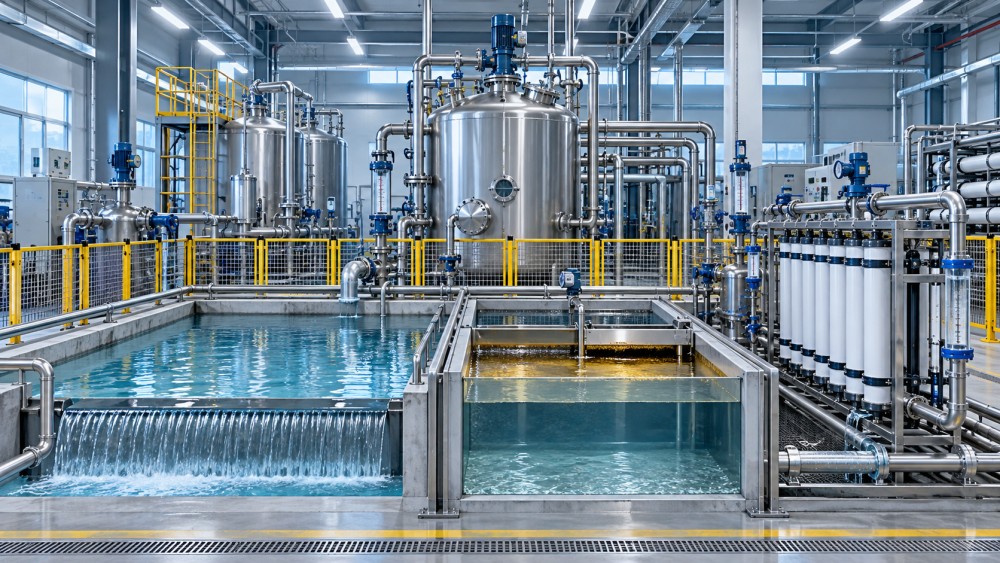
Neutralization and equalization often set the foundation
Many chemical effluents require pH adjustment before downstream treatment. Acidic wastewater can corrode equipment, interfere with precipitation, and damage biological processes. Strongly alkaline streams can also inhibit biology and keep certain metals in dissolved form. Neutralization is commonly performed in a mixed tank with measured acid or alkali dosing, pH monitoring, and sufficient residence time for the reaction to stabilize.
pH control should not be treated as a simple endpoint. Some metal hydroxides precipitate only within a narrow pH range, while amphoteric metals can redissolve if the pH is raised too far. A stream containing dissolved aluminum, zinc, chromium species, or mixed plating residues may need staged adjustment rather than one aggressive dose. Carbon dioxide evolution, heat release, foaming, and gas stripping also need consideration when concentrated acidic and alkaline streams are brought together.
Equalization tanks smooth short-term changes in flow, concentration, temperature, and pH. This is especially useful for batch production, where a vessel wash or campaign change can release a concentrated load over a short period. Mixing prevents settling and localized extremes, but it must be designed carefully when volatile compounds are present. In such cases, tank covers, vent treatment, and compatible materials of construction may be required.
Removing solids, oils, and phase-separated contaminants
Physical separation is appropriate when contaminants exist as settleable solids, floatable oil, free product, precipitated particles, or filterable flocs. Screens and strainers protect pumps and downstream equipment from debris. Gravity settling may remove dense solids, while oil-water separators address free oil that separates under quiescent conditions.
Free oil, dispersed oil, and stable emulsions require different responses. A simple separator can perform well on free hydrocarbon but has limited effect on a detergent-stabilized emulsion. Emulsified oil may need pH adjustment, demulsification chemistry, coagulant addition, dissolved-air flotation, or a combination of these steps. Adding coagulant without determining the emulsion chemistry can increase sludge production while leaving residual oil in the clarified water.
Coagulation and flocculation are commonly used to capture fine solids, metal hydroxide precipitates, pigments, and some colloidal organic matter. The selected coagulant, polymer, dose, mixing energy, and settling conditions should be established for the actual wastewater. Jar testing helps reveal whether a cloudy stream responds to chemical destabilization or whether the apparent turbidity comes from dissolved color or very fine material that needs a different approach.
Clarified solids must then be managed as sludge. Thickening, dewatering, and storage are part of the treatment system rather than an afterthought. Sludge from metal precipitation, activated carbon handling, or hazardous process residues can contain concentrated contaminants that determine its classification and disposal route. Sending poorly dewatered sludge to storage can create leachate, odor, handling difficulty, and unnecessary transport volume.
When biological treatment is suitable
Biological treatment is effective for many biodegradable organic compounds, particularly after the wastewater has been equalized and stripped of conditions that inhibit microorganisms. Aerobic treatment oxidizes biodegradable organics using oxygen, while anaerobic treatment can be useful for certain high-strength organic streams. The right choice depends on loading, biodegradability, salinity, toxicity, nutrient balance, temperature, and the consistency of the feed.
High chemical oxygen demand alone does not prove that biological treatment will work. Some organic compounds contribute heavily to oxygen demand but degrade slowly, inhibit biomass, or pass through largely unchanged. A wastewater with high salt content may also place osmotic stress on biological systems. Shock releases of biocide, solvent, oxidizer, or extreme pH can cause abrupt performance loss even when average wastewater data appears acceptable.
Segregating a concentrated toxic stream for separate treatment is often preferable to diluting it into the main biological feed. Dilution reduces an analytical concentration but does not remove contaminant mass, and it can spread a difficult waste through a larger treatment volume. Where a stream is intermittently inhibitory, controlled feed pacing and equalization may be more effective than attempting to treat each batch immediately.
Oxidation, adsorption, and advanced treatment
Some chemical processing wastewater contains compounds that are poorly removed by settling or conventional biological treatment. Oxidation may be used to transform these compounds into more manageable forms, reduce odor or color, destroy selected reactive species, or improve biodegradability before a biological stage. Oxidants must be selected with a full understanding of the wastewater chemistry because side reactions can consume reagent, create heat, release gas, or form undesirable by-products.
For example, sulfide-bearing wastewater needs controlled treatment because acidification can release hydrogen sulfide gas. Streams containing cyanide, sulfite, peroxide, or other reactive compounds require dedicated handling logic; mixing incompatible wastes can create a serious process hazard. Oxidation systems therefore need containment, monitoring, controlled reagent addition, and a defined response for abnormal chemistry.
Activated carbon adsorption is useful for polishing residual organics, color, odor-causing compounds, or trace contaminants after pretreatment has removed solids and bulk loading. Carbon is less effective when suspended solids rapidly foul the bed or when the influent contains large amounts of competing organics. Spent carbon then becomes a managed waste or requires regeneration through an approved route.
Air stripping can remove certain volatile compounds, but it transfers contaminants from water to an off-gas stream. The off-gas may require condensation, adsorption, thermal treatment, or another capture method. Treatment should be evaluated across all media so that water compliance is not achieved by creating an uncontrolled air-emission problem.
Membranes and dissolved-salt control
Membrane systems are used where low suspended solids, reduced dissolved solids, water reuse, or removal of specific dissolved constituents is required. Ultrafiltration is often applied to fine solids, macromolecules, and emulsified oils. Nanofiltration and reverse osmosis can reduce many dissolved salts and low-molecular-weight contaminants, although performance depends on the water chemistry and membrane compatibility.
Membranes need reliable pretreatment. Scaling, oil fouling, biological fouling, and chemical attack can reduce flux and shorten membrane life. Iron, hardness, silica, residual oxidants, and poorly removed organics should be assessed before selecting a membrane train. Cleaning restores performance only within limits; it does not correct an unsuitable upstream process.
The concentrate is a central design issue. Membrane treatment separates contaminants into a smaller liquid volume rather than eliminating them. That concentrate may be recycled to another process, further treated through evaporation or crystallization, managed as a liquid waste, or sent to a permitted disposal route. A reuse scheme is incomplete if the reject stream has no practical destination.
Typical treatment choices by contaminant behavior
Sampling errors can lead to the wrong treatment train
Effluent data is often distorted by unrepresentative samples. A single grab sample from a quiet period may miss a batch discharge, a cleaning event, or the first rinse after product changeover. Composite sampling over a relevant operating cycle provides a more useful picture of loading and variability. Separate samples should be preserved and analyzed appropriately when volatile compounds, reactive constituents, or metals are involved.
Flow measurement matters as much as concentration. A moderate concentration released at high flow can produce a large mass load, while a high concentration from a small intermittent stream may be best handled separately. Temperature should also be tracked because it affects reaction rates, oxygen transfer, solubility, settling, and membrane behavior.
Material compatibility deserves early attention. Corrosive streams, chlorides, solvents, oxidants, and abrasive solids influence the selection of tanks, pumps, pipework, seals, instruments, and linings. A treatment process can be chemically sound but unreliable if its wetted materials are unsuitable for the feed or the cleaning chemicals used during maintenance.
Control and residual management
Reliable treatment relies on monitoring points placed around the process, rather than one final discharge measurement. pH, flow, conductivity, turbidity, dissolved oxygen, oxidation-reduction potential, and pressure across filters or membranes can reveal deterioration before an out-of-specification discharge occurs. The relevant instruments depend on the treatment method, but alarms should distinguish a process upset from an instrument failure.
Residuals need a defined route from the beginning: primary sludge, flotation solids, spent filter media, exhausted carbon, membrane concentrate, recovered oil, and off-gas treatment media. Their volume and composition can change when production chemistry changes, so waste handling arrangements should be reviewed alongside new raw materials, formulations, cleaning agents, or operating campaigns.
The required treatment for chemical processing effluent is rarely a fixed sequence. It is a controlled arrangement of segregation, stabilization, contaminant removal, polishing, and residual management selected for the wastewater actually produced. A defensible design connects every treatment stage to a known contaminant or operating condition and accounts for the concentrated wastes created along the way.
- Last One:No more articles
- Next Article:How to assess contamination risk in plastic recycling pelletsOct 05, 2026
Related News
- 00
0000-00
How to assess contamination risk in plastic recycling pellets - 00
0000-00
Can biofuels for industrial boilers reduce fuel costs at high load? - 00
0000-00
How to assess the reliability of offshore drilling safety systems - 00
0000-00
How to verify quality systems at oil and gas industry suppliers - 00
0000-00
Which carbon capture materials grades suit high-humidity flue gas?
Related tags
Weekly Insights
Stay ahead with our curated technology reports delivered every Monday.