




How trade compliance solutions reduce export documentation errors




How Trade Compliance Solutions Reduce Export Documentation Errors
Export documentation errors rarely begin when someone types the wrong number into a commercial invoice. More often, the mistake starts earlier: a product description copied from an old order, an HS classification selected without checking the actual material grade, a missing end-user statement, or a certificate stored in an individual inbox rather than linked to the shipment record.
For operators moving chemicals, metals, polymers, industrial equipment, energy components, or technical materials across borders, these small gaps can become expensive very quickly. A customs hold may delay a vessel connection. A consignee may reject documents that do not match the packing list. A freight forwarder may have to pause a filing because the declared product value, origin, or commodity code is inconsistent. In controlled or regulated product categories, the consequences can be more serious than a late shipment.
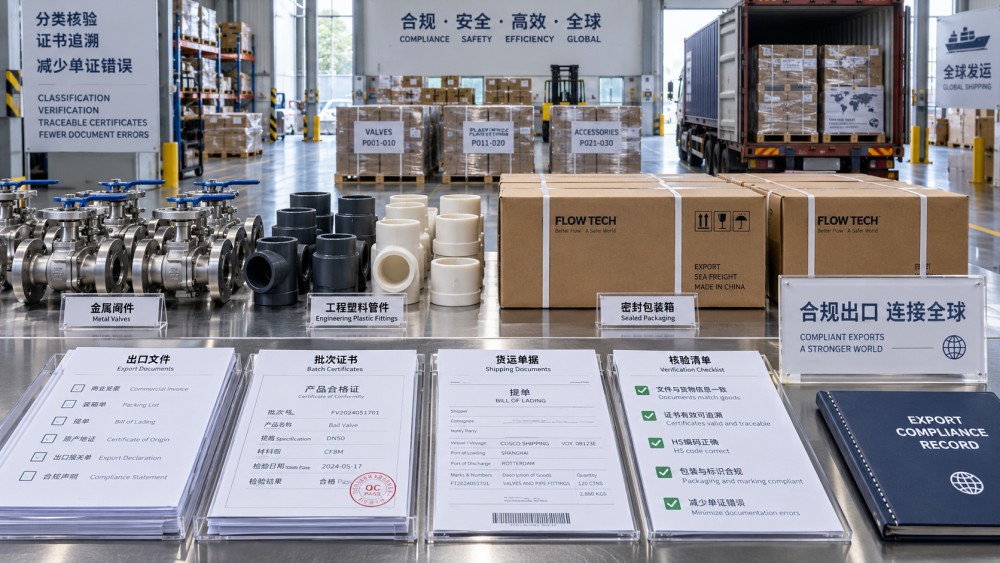
Well-designed trade compliance solutions reduce these errors by turning fragmented information into a controlled workflow. The useful systems are not simply document generators. They connect product data, classification decisions, customer records, shipment details, approvals, and supporting evidence before the goods leave the facility.
The real source of most documentation mistakes
An export document is only as reliable as the information feeding it. This is especially obvious in industrial trade. A steel product may be described internally by a commercial name while the export declaration requires a more precise product form, composition, or processing status. A laboratory reagent may need a different treatment from a general chemical intermediate. A package containing a pump, control unit, seals, and spare parts can create classification questions that a generic item description will not solve.
Operators often work under time pressure. Sales may release an order before engineering has finalized the specification. Warehouse staff may pack a substitute component that is operationally acceptable but carries a different origin or tariff classification. Procurement may source the same polymer or alloy from another producer, changing the supporting certificates available for the shipment. None of these events is unusual. The problem is that many teams still manage them through disconnected spreadsheets, email threads, shared folders, and manual document templates.
That approach makes it easy for old information to travel forward. The invoice may show the latest price, while the certificate of analysis refers to a previous batch. The packing list may be accurate in quantity but not in net weight. An export control review may have been completed for the customer last year, but no one can confirm whether the end use, destination, or product configuration remains unchanged.
A controlled data source prevents “document drift”
The most practical benefit of trade compliance software is a single, governed source for export-critical data. Instead of allowing every operator to enter product details from memory, the system can pull approved fields into the commercial invoice, packing list, shipping instructions, origin documentation, and internal review record.
The fields that deserve the most discipline are usually not the obvious ones. Product name, quantity, and price matter, but so do the legal manufacturer, country of origin, gross and net weight, Incoterms®, consignee details, commodity classification, and the description used for customs purposes. A useful workflow separates the marketing description from the controlled trade description. “High-performance industrial resin” may help a sales catalogue, but it is usually not enough for a declaration or classification review.
For complex goods, the product record should also show what has been checked and what remains uncertain. Classification is not always permanent. A change in material composition, coating, intended use, software content, or bundled accessories can justify a new review. Good trade compliance solutions make that change visible rather than silently reusing an old decision.
Classification checks need context, not just a code library
Many teams assume that selecting an HS code is the central compliance task. It is important, but the operational challenge is broader. HS classification can vary in detail by importing country, while export control classification may follow separate national rules. Origin analysis, preferential treatment, sanctions screening, licensing requirements, and dangerous goods documentation can each depend on facts that do not appear in a basic product master.
A compliance workflow should therefore ask the right questions at the right point. If an operator is exporting a pipeline component, for example, the review may need dimensions, material, pressure-related function, and whether it is shipped as a standalone item or part of a larger system. For a chemical shipment, the technical team may need to confirm the exact substance identity, concentration, physical form, and applicable safety documentation. These are not details that a freight booking screen can reliably infer.
This is where structured industry information becomes valuable. Platforms such as GEMM organize product categories, material knowledge, production processes, standards references, supplier information, market updates, and trade-related resources across energy, raw materials, chemicals, metals, plastics, rubber, and sustainable energy sectors. For an operator, the value is not a shortcut around compliance review. It is a clearer starting point for understanding what the item is, how it is used, which technical documents should be requested, and where classification or certification questions may need escalation.
Build exception handling into the shipment process
A common implementation mistake is to create a clean workflow only for standard orders. Real export operations are full of exceptions: split shipments, partial invoices, repaired goods, samples, replacement parts, returns, consolidated cargo, multi-country sourcing, and last-minute routing changes. If the compliance system cannot handle exceptions without forcing staff back into email, the control breaks at exactly the point it is needed.
The better approach is to define stop points. A shipment should not move automatically when a required certificate is expired, the declared origin conflicts with the item record, the buyer address changes after screening, or a product has no approved classification. Not every alert needs to block an export, but every exception should have an owner, a reason, and a visible decision trail.
For day-to-day operators, a short pre-release review is often more useful than a long policy document:
- Does the product description match the actual shipped configuration?
- Are quantity, unit of measure, value, weights, and package count consistent across documents?
- Has the commodity or export-control classification been approved for this version of the item?
- Do origin statements, test reports, safety documents, or certificates match the correct batch or production source?
- Has any change in consignee, destination, end use, or routing triggered a new review?
This type of check sounds basic, but it catches a large share of avoidable inconsistencies before they reach the carrier, broker, or border authority.
Document automation is useful only when approvals remain traceable
Automation reduces rekeying, which is one of the most persistent causes of export documentation errors. Once an approved shipment record exists, the system can populate repeated information across documents and preserve a version history when data changes. This is particularly helpful for frequent shipments of similar industrial goods, where teams otherwise recreate forms from prior transactions.
Still, automation should not hide responsibility. A generated document may look complete while relying on outdated master data. Operators need to see the source of key fields, the date of the last review, and the person or team that approved the underlying classification or restriction check. For high-risk items or destinations, an additional review may be appropriate even when the shipment appears routine.
The goal is not to make every export process slower. It is to concentrate human attention where it has the highest value: unclear product scope, changing technical specifications, unusual destinations, incomplete certificates, and transactions that do not fit the normal pattern.
Choose a solution around the work operators actually do
When evaluating trade compliance solutions, start with the shipment path rather than a feature checklist. Map how product data moves from engineering or procurement to sales, warehouse, logistics, and the external customs or freight partner. The most important question is usually simple: where does staff currently have to copy, guess, search, or ask someone for confirmation?
A useful system should accommodate approved product records, document templates, screening and review steps, certificate management, audit history, and integration with the business systems already used for orders and inventory. It should also allow controlled updates. A database that is technically complete but difficult to maintain will soon become another source of stale information.
Export compliance is not solved by a single template or a one-time classification exercise. It is maintained through reliable product intelligence, clear ownership, and workflows that detect change before a shipment is released. For industrial exporters dealing with technically varied goods, that discipline is what turns documents from a last-minute administrative task into a dependable part of delivery control.
Related News
- 00
0000-00
How trade compliance solutions reduce export documentation errors - 00
0000-00
How material intelligence is reshaping sourcing decisions in Southeast Asia - 00
0000-00
What Is the Typical Lifespan of Grid-Scale Energy Storage? - 00
0000-00
How to Test Metal Alloys for Marine Corrosion Resistance - 00
0000-00
How to vet suppliers in a process technology supplier directory
Related tags
Weekly Insights
Stay ahead with our curated technology reports delivered every Monday.