




What Is the Typical Lifespan of Grid-Scale Energy Storage?




A grid-scale energy storage system is often discussed as if it has one fixed life expectancy. It does not. For lithium-ion battery energy storage systems, a practical planning range is commonly around 10 to 20 years, but the usable energy capacity may require augmentation or module replacement before the full project reaches the end of its service life. Other technologies can have materially different profiles: flow batteries may support longer-duration cycling with fewer concerns about cycle wear, while mechanical storage assets can remain in service for decades if their major equipment is maintained.
For a utility, developer, industrial site, or investor, the more useful question is not simply “How many years will it last?” It is: how much dependable capacity will remain at the required operating point, and what work will be needed to preserve it? A system designed for daily renewable shifting will age differently from one held mainly for reserve capacity. A project earning revenue from frequent dispatch must be evaluated differently from a resilience asset that cycles only during outages.
The typical lifespan of grid-scale energy storage systems therefore has two dimensions: the physical life of the plant and the performance life of its storage medium. Treating them as the same can lead to optimistic financial models, poorly timed replacement budgets, or a system that no longer meets its contracted capacity obligation.
Service life is more than the battery warranty period
Battery warranties are often the first reference point in a procurement process, but they are not a complete answer to lifetime. A warranty may cover a defined term, a throughput limit, a retention threshold, or a combination of those conditions. It may also specify required operating temperatures, state-of-charge limits, maintenance practices, data access, and dispatch assumptions. If those conditions are not aligned with the planned operating profile, the warranty may provide less practical protection than expected.
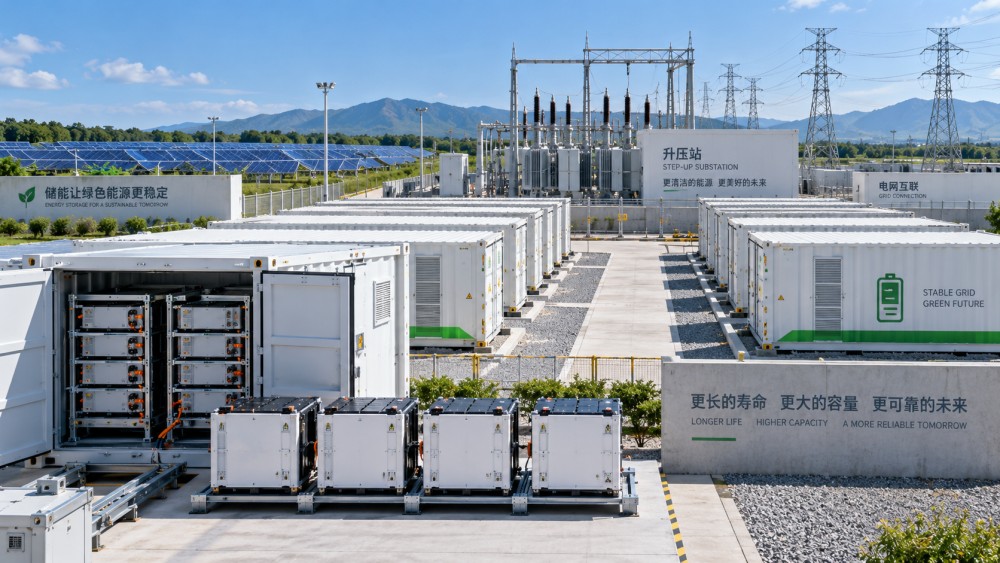
A grid storage project has several assets with different replacement cycles:
- Battery cells and modules gradually lose available capacity and may eventually need replacement or augmentation.
- Power conversion equipment, including inverters and transformers, has its own reliability and maintenance profile.
- Thermal management, fire protection, controls, and communications systems can require refurbishment or upgrades during the project term.
- Containers, foundations, cabling, switchgear, and site infrastructure may remain usable longer than the original battery blocks.
As a result, a 20-year storage site does not necessarily mean that the original battery inventory will still be installed in year 20. In many cases, the project is built and financed around planned augmentation. Additional battery capacity is installed during operation so that the facility can continue delivering its required usable energy and power output as the original cells degrade.
This distinction matters when comparing proposals. One supplier may quote a lower initial cost with a narrower guaranteed energy profile. Another may include more initial capacity, a different battery chemistry, or an augmentation plan. Comparing nameplate megawatt-hours alone can obscure the difference. Buyers need to compare the guaranteed usable capacity at the relevant years of operation, under the intended dispatch conditions.
How different technologies age
Lithium-ion systems dominate many grid-scale installations because they offer a compact footprint, high round-trip efficiency, and an established supply base. Within lithium-ion, however, chemistry selection changes the life and operating trade-off. Lithium iron phosphate, commonly called LFP, is generally favored where frequent cycling, thermal robustness, and long operational life are priorities. Nickel manganese cobalt, or NMC, can offer higher energy density, which may matter where site area is constrained, but its operating and thermal management requirements should be assessed carefully for stationary use.
Neither chemistry should be judged by a simple cycle-life figure in isolation. A quoted number of cycles may be based on laboratory conditions that do not replicate the project’s discharge depth, ambient climate, charge rate, reserve requirements, or time spent at high state of charge. Calendar aging can be significant even when a system is rarely dispatched. Heat, prolonged high charge levels, and long exposure to demanding operating conditions can reduce capacity without a proportional number of full cycles.
Flow batteries follow a different lifetime logic. Their energy is stored in liquid electrolyte, while the electrochemical conversion hardware is separate. This architecture can make them attractive for long-duration applications and high numbers of deep cycles. The electrolyte may retain value over a long period, while components such as pumps, membranes, and stacks have their own maintenance or replacement needs. Their trade-off is typically lower energy density and a larger physical footprint than lithium-ion systems, alongside project-specific balance-of-plant requirements.
Mechanical systems, including pumped hydro and compressed-air configurations, should not be assessed on battery degradation terms. Their civil works and rotating equipment can potentially operate for much longer periods, but site development, permitting, geology, water availability, construction risk, and maintenance requirements carry much more weight in the lifetime calculation. They may suit multi-decade infrastructure planning, yet they are rarely interchangeable with a containerized battery project.
Thermal storage also belongs in the comparison where the required output is heat, cooling, or a thermal process rather than direct electrical discharge. Its useful life depends on the storage medium, insulation quality, heat exchangers, operating temperature, and integration design. Comparing it directly with electrochemical storage on a single “years of life” basis can be misleading because the service delivered is different.
The operating profile often determines the outcome
A system that performs one moderate cycle per day is not exposed to the same wear pattern as one responding continuously to market signals, providing high-frequency ancillary services, or operating in multiple stacked revenue markets. More activity can generate more revenue, but it can also increase throughput and accelerate degradation. The economics must account for both effects.
Depth of discharge is especially important. Repeatedly using nearly all available battery capacity can provide more energy per cycle, but it may place greater stress on cells than operating within a narrower state-of-charge window. A project that is contractually required to deliver a fixed duration may therefore preserve part of its nominal capacity as an operating reserve, particularly as the system ages.
Charge and discharge rates matter as well. High-power operation can increase heat generation and impose additional electrochemical stress. This does not mean fast response is unsuitable for batteries. Rapid response is one of their principal advantages. It does mean that a battery designed around short-duration, high-power service should not automatically be expected to retain capacity on the same curve as a more gently operated energy-shifting asset.
Ambient conditions can alter the gap between an expected and actual lifespan. Hot climates increase the burden on cooling systems and can accelerate degradation if temperature control is inadequate. Cold conditions may restrict charge acceptance or reduce available power unless the system is properly conditioned. In coastal, desert, or industrial environments, corrosion, dust, humidity, and contamination can also affect enclosures, HVAC equipment, electrical connections, and controls.
What buyers should compare in a lifetime model
When evaluating grid-scale energy storage, the most useful comparison is a project-specific degradation and replacement model rather than a headline life claim. The model should use the intended dispatch pattern and clearly state its assumptions. It should show when the project is expected to fall below its usable-energy target, what capacity is reserved for operating constraints, and how augmentation restores performance.
Several questions help expose whether a lifetime proposal is genuinely comparable:
- What usable energy is guaranteed at commissioning and at each major point during the operating term?
- Is the stated capacity measured at the battery terminals, at the inverter output, or at the grid interconnection point?
- What cycle count, annual throughput, depth of discharge, charge rate, and state-of-charge window underpin the guarantee?
- How does the model account for calendar aging in a low-cycling or reserve-focused project?
- What ambient temperature range is assumed, and how much auxiliary energy is required for cooling, heating, and controls?
- When is augmentation expected, what technology compatibility is required, and who carries the cost and performance risk?
- Which equipment is covered by separate warranties, and what happens if battery performance is affected by inverter, HVAC, or control-system faults?
These questions also prevent a common procurement error: comparing one project’s beginning-of-life capacity with another project’s end-of-warranty capacity. The lower initial price may not represent the lower lifetime cost if it leaves the owner funding earlier augmentation, accepting lower dispatchable energy, or missing availability commitments.
Financial models should distinguish energy degradation from availability loss. Capacity degradation is the gradual reduction in the amount of energy a system can store and discharge. Availability measures whether the asset is ready to operate when called upon. A facility may still have acceptable remaining battery capacity but fail to earn expected revenue if auxiliary equipment, controls, grid interfaces, or replacement logistics keep it offline. Both need explicit treatment in operating and reserve budgets.
Augmentation is a planning decision, not a failure signal
In battery projects, augmentation is frequently portrayed as an unwelcome surprise. It is more accurately a lifecycle strategy. The owner may install extra capacity at the outset, add modules later, or accept a declining energy duration where the commercial arrangement permits it. The right choice depends on the project’s revenue obligations, expected technology costs, site space, interconnection limit, and future compatibility requirements.
Later augmentation may appear attractive because it defers capital spending. Yet it introduces practical questions. Will compatible cells, racks, battery management systems, and software interfaces still be available? Can new and aged batteries operate efficiently together? Does the facility have physical room, cooling capacity, electrical capacity, and fire-protection coverage for the added equipment? Could changes in codes, transport rules, or insurer requirements affect the scope of the work?
Overbuilding at the start reduces some of those uncertainties, but it ties up capital in capacity that may not be needed immediately. There is no universal preference. Assets with strict long-term delivery obligations often need a more conservative capacity-retention plan than merchant assets whose dispatch strategy can adapt as performance changes.
Maintenance protects usable life, but cannot reverse degradation
Good operations and maintenance practices can protect a storage system’s expected service life. They cannot restore the original electrochemical capacity of aging cells, but they can reduce avoidable losses and identify developing faults early. This includes maintaining thermal systems, monitoring cell-level behavior, checking electrical connections, testing safety systems, managing software updates, and reviewing operating data against the assumptions used in the lifetime model.
Performance data should be interpreted with care. A reduction in delivered energy can arise from cell degradation, changed operating limits, auxiliary consumption, temperature conditions, inverter constraints, or control settings. Without clear measurement boundaries, an owner may struggle to determine whether a shortfall is a battery issue, a balance-of-plant issue, or a dispatch configuration issue.
For that reason, the handover package should include a defensible baseline for capacity testing, efficiency measurement, operating limits, and fault reporting. The project team also needs access to enough operational data to verify performance independently over time. A lifetime guarantee is more useful when its measurement method, exclusions, and remedies are understood before commissioning rather than debated after degradation has become visible.
A more useful way to state expected life
For grid-scale storage, “lasts 15 years” is usually too vague to support a purchasing or investment decision. A stronger statement would describe the system’s expected operating term, required annual service, guaranteed usable capacity trajectory, permitted dispatch profile, augmentation assumptions, and major component replacement plan.
That framing turns lifespan from a marketing number into an operating decision. A short-duration lithium-ion system may be a strong fit for fast-response services even if it needs planned augmentation. A flow battery may justify its footprint where long-duration daily cycling is central to the project. A mechanical storage asset may fit a multi-decade infrastructure strategy where suitable geography and development conditions exist.
The question is therefore not which technology has the longest abstract life. It is which system can continue delivering the required service, at the required reliability and cost, throughout the period the project is expected to operate.
- Last One:No more articles
- Next Article:How trade compliance solutions reduce export documentation errorsOct 10, 2026
Related News
- 00
0000-00
How trade compliance solutions reduce export documentation errors - 00
0000-00
How material intelligence is reshaping sourcing decisions in Southeast Asia - 00
0000-00
What Is the Typical Lifespan of Grid-Scale Energy Storage? - 00
0000-00
How to Test Metal Alloys for Marine Corrosion Resistance - 00
0000-00
How to vet suppliers in a process technology supplier directory
Weekly Insights
Stay ahead with our curated technology reports delivered every Monday.