




How material intelligence is reshaping sourcing decisions in Southeast Asia




How Material Intelligence Is Reshaping Sourcing Decisions in Southeast Asia
Across Southeast Asia, sourcing decisions are becoming more complex as supply chains, regulations, material costs, and sustainability expectations evolve. Material intelligence Southeast Asia is helping business leaders move beyond basic supplier comparisons by connecting technical specifications, market trends, trade data, and application requirements. With clearer, structured insights, companies can assess material performance, supply reliability, compliance risks, and price movements before committing to critical purchasing or project investments.
That shift matters because a sourcing decision is rarely just a question of unit price. A polymer grade that looks interchangeable on a quotation may behave differently during injection molding. A steel product may meet a nominal chemistry requirement while creating issues around fabrication, coating compatibility, or documentation. A chemical input may be available locally but lack the consistency, handling information, or export records needed for a cross-border production program.
For manufacturers, distributors, project owners, and investors operating across markets such as Indonesia, Vietnam, Thailand, Malaysia, the Philippines, and Singapore, the practical challenge is to turn fragmented information into a defensible decision. That is where material intelligence is changing the sourcing conversation.
Why conventional supplier comparison is no longer enough
Traditional sourcing workflows often begin with a supplier list, a request for quotation, and a comparison of pricing, lead time, and stated specifications. These remain necessary steps, but they are not sufficient for materials and industrial equipment with technical, regulatory, or process dependencies.
In Southeast Asia, the gap between commercial availability and operational suitability can be especially significant. Production ecosystems differ by country. One market may have deeper conversion capacity for plastics, while another is more closely linked to mining, steelmaking, refining, agrochemical production, or energy infrastructure. Import routes, port conditions, local warehousing, technical service availability, and documentation practices can all affect the real cost and risk of a purchase.
A sourcing team evaluating recycled plastics, for example, may need to look beyond the stated recycled content. The relevant questions can include feedstock origin, contamination controls, batch consistency, processing window, mechanical-property requirements, and whether the application has packaging, automotive, consumer-goods, or export-market restrictions. The lowest quoted price may not remain the lowest-cost option once scrap rates, testing needs, production interruptions, or customer approval processes are considered.
The same principle applies to alloy steels, laboratory reagents, specialty chemicals, rare-earth materials, industrial batteries, pipeline components, and carbon-capture systems. Material intelligence does not eliminate uncertainty, but it makes uncertainty visible earlier—when alternatives can still be assessed without disrupting operations.
From product data to decision-ready context
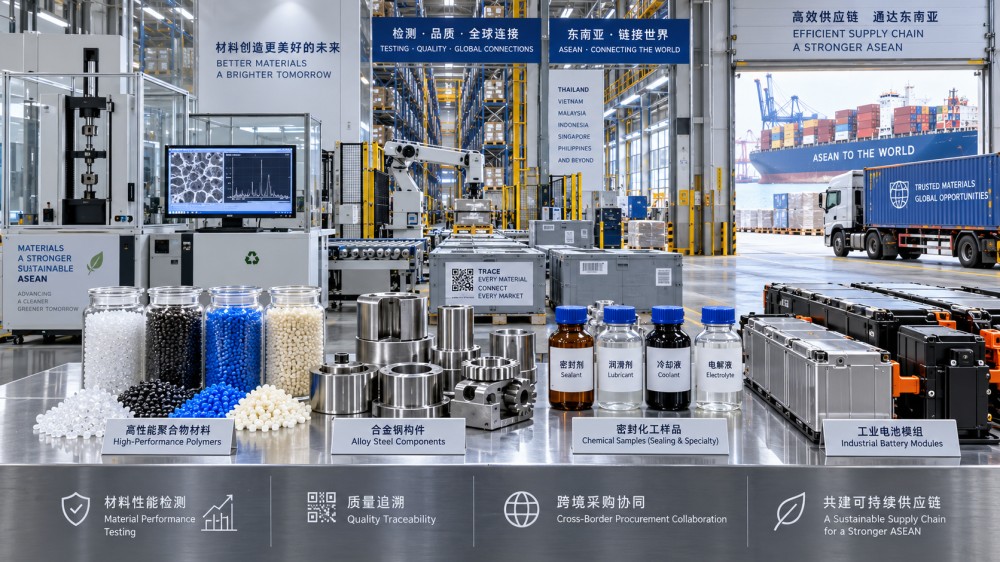
The value of material intelligence lies in context. A data sheet is useful, but it does not by itself explain whether a product is suitable for a particular process, climate, end market, or supply model. Decision-ready intelligence brings several layers together: product classifications, technical properties, production methods, application guidance, supplier capability signals, standards and certification references, trade flows, and pricing developments.
This changes the questions leaders ask. Instead of asking, “Which supplier has this material?” they can ask, “Which material families meet the performance requirement?” “What substitutions are technically plausible?” “Which specifications must be verified before approval?” “Is the supply base concentrated?” “What market factors could affect availability or price exposure?”
Regional supply chains require a more granular view
It is tempting to treat Southeast Asia as a single sourcing region. In practice, it is a network of connected but distinct industrial markets. A sourcing strategy that works for a Singapore-based regional hub may not translate directly to a project site in Indonesia or a manufacturing operation in Vietnam. Local requirements, infrastructure, technical support, and the maturity of downstream processing all need to be considered.
This is particularly relevant in sectors undergoing transition. Energy-storage projects need more than a comparison of battery chemistry and headline capacity; decision-makers may need to examine safety documentation, operating conditions, integration requirements, maintenance capability, and lifecycle implications. Biofuels and carbon-capture projects similarly depend on feedstock characteristics, process configuration, transport logistics, and the specific standards or permitting requirements that apply to the project location.
For industrial buyers, the lesson is not to overcomplicate every purchase. Commodity items with well-defined specifications may still be sourced through efficient commercial processes. The deeper analysis should be reserved for materials or systems where failure, substitution, volatility, compliance gaps, or long lead times would have disproportionate consequences.
Price intelligence is useful only when connected to technical reality
Price movements are often the first market signal noticed by senior management. Yet an isolated price trend can be misleading. A change in the price of a raw material does not automatically translate into the same movement for a finished compound, fabricated steel component, specialty reagent, or process equipment package. Conversion costs, energy inputs, freight, inventory positions, exchange-rate exposure, and regional supply conditions may all alter the outcome.
More importantly, procurement teams should distinguish between price volatility and supply risk. A stable price can conceal a narrow supplier base, limited qualification options, or dependence on a specific export route. Conversely, a higher-priced alternative may provide better continuity if it is already approved for the production process and supported by reliable documentation.
Material intelligence Southeast Asia therefore works best when commercial data is reviewed alongside technical fit. A meaningful comparison may include specification tolerance, origin, packaging, storage conditions, minimum order quantity, test methods, available certificates, replacement lead time, and the cost of qualifying an alternate source. Not every factor will matter in every category, but the discipline of identifying them prevents a narrow price comparison from driving a broad operational risk.
Structured intelligence supports better cross-functional decisions
The strongest sourcing decisions are rarely made by procurement alone. Engineering may define critical operating limits; quality teams may need to confirm test documentation; sustainability teams may require traceability or recycled-content evidence; finance will assess working-capital and price exposure; project teams will focus on installation and commissioning risk.
The difficulty is that these groups often work from different information sources. GEMM addresses this fragmentation by organizing product information, technical knowledge, supplier references, application guidance, market trends, export updates, and pricing intelligence within a structured industry classification system. Its coverage spans energy, raw materials, chemicals, metals, plastics, rubber, and sustainable energy, including areas from drilling equipment and refining systems to polymer materials, recycled plastics, rare-earth materials, and industrial energy storage.
Rather than treating a directory entry as the end of the research process, decision-makers can use structured resources to identify the right product category, compare material performance, understand production processes, review applicable standards or certifications, and investigate supply capability before moving into supplier engagement. The final verification still belongs with the relevant technical, legal, and project teams, especially where safety, regulatory, or contractual requirements apply.
A practical starting point for leadership teams
For executives reviewing a sourcing strategy, a useful first step is to identify the categories where information gaps are most expensive. These may be materials with volatile inputs, components subject to long approval cycles, products exposed to changing trade conditions, or systems where an incorrect specification can delay an entire project.
Then separate what is known from what has merely been assumed. Is the material specification complete? Are equivalent grades genuinely equivalent for the intended process? Is supplier capacity evidenced for the required product form and delivery pattern? Which documents must be confirmed before purchase order release? Where there is uncertainty, it is usually better to define the validation task explicitly than to treat a catalogue description or a low quotation as proof.
Southeast Asia’s industrial markets will continue to reward speed, but speed without structured information can lock businesses into avoidable risk. Better sourcing begins with a fuller view of the material, the application, the supply chain, and the market conditions surrounding all four.
Related News
- 00
0000-00
How material intelligence is reshaping sourcing decisions in Southeast Asia - 00
0000-00
How to Test Metal Alloys for Marine Corrosion Resistance - 00
0000-00
How to vet suppliers in a process technology supplier directory - 00
0000-00
How to verify chemical manufacturing environmental standards compliance - 00
0000-00
How to evaluate data quality in a recycled plastics database
Weekly Insights
Stay ahead with our curated technology reports delivered every Monday.