




How to Test Metal Alloys for Marine Corrosion Resistance




Selecting an alloy for seawater exposure cannot be reduced to a single corrosion rating or a salt-spray result. Marine service combines chloride-rich electrolyte, wet-dry cycling, oxygen gradients, marine deposits, crevices, mechanical damage, temperature changes, and contact with dissimilar metals. An alloy that remains bright in a laboratory cabinet may still pit beneath a gasket, suffer galvanic attack at a fastener, or corrode rapidly in a hot, stagnant seawater circuit.
For anyone asking how to test metal alloys for corrosion resistance in marine use, the practical answer is to build a test program around the anticipated failure mode. The program should compare candidate alloys under conditions that resemble the component's real duty: splash zone versus full immersion, flowing versus stagnant seawater, ambient versus elevated temperature, clean surfaces versus creviced joints, and isolated material versus an assembled system.
A useful test sequence normally starts with material verification and controlled laboratory screening, then moves to electrochemical and immersion testing, followed by assembly-level or site-representative exposure where the consequence of failure justifies it. Each method answers a different question. Treating them as interchangeable is one of the most common causes of misleading material decisions.
Start by defining the marine exposure, not the alloy list
Before selecting a test, define what the metal will actually experience. “Marine environment” is too broad to produce a reliable specification. A handrail above the waterline, a subsea valve body, a heat-exchanger tube, a deck fastener, and a seawater pump impeller can all face different corrosion mechanisms even when installed on the same vessel or offshore facility.
The first distinction is exposure zone:
- Atmospheric coastal exposure: Salt deposition and intermittent wetting dominate. Coating damage, crevice retention, and wet-dry cycles can matter more than continuous immersion behavior.
- Splash and tidal zones: These are often severe because repeated wetting and drying concentrate salts while oxygen remains available. Mechanical impact and coating degradation may also be relevant.
- Full immersion: General corrosion, pitting, crevice corrosion, galvanic interaction, erosion-corrosion, and biofouling become more important. Water velocity and oxygen content can change results substantially.
- Seawater process systems: Pumps, piping, desalination equipment, and heat exchangers require attention to temperature, flow, sediment, deposits, cleaning chemicals, and periods of stagnation.
The component geometry should be documented at the same time. A flat, polished coupon has no bolted overlap, threaded connection, gasketed flange, lap joint, deposit trap, or weld heat-affected zone. If the finished part contains these features, a coupon-only program can miss the condition most likely to initiate localized corrosion.
Material condition also needs to be fixed. Alloy designation alone is insufficient where corrosion depends on welding, heat treatment, cold work, surface finish, weld filler, or fabrication contamination. Test pieces should represent the supplied or fabricated condition that will enter service. Otherwise, the test may qualify a material state that the production component never achieves.
Use screening tests for comparison, not as a service-life promise
Salt fog testing is widely recognized because it is fast, standardized, and easy to compare across specimens. Standards such as ASTM B117 define a controlled salt-spray environment. It can be useful for comparing coatings, finishes, fabrication quality, and relative behavior of assemblies exposed to salt deposition.
It is less reliable as a stand-alone predictor of immersed seawater performance. Continuous salt fog does not reproduce tidal cycling, natural deposit formation, water flow, crevice chemistry, cathodic protection, or the temperature profile of a process system. A high number of salt-spray hours should therefore not be translated directly into years of marine life.
For bare corrosion-resistant alloys, salt spray can also produce a misleading ranking. Stainless steels and nickel alloys rely on passive films whose behavior depends on oxygen availability, chloride concentration, surface condition, and local chemistry. A test that does not reproduce the crevice or thermal conditions of service may show little differentiation between alloys that would diverge sharply in a real joint.
Salt fog remains valuable when used for the question it can answer: whether one coating system, fastener finish, fabrication method, or surface preparation performs better than another under a controlled salt-deposition exposure. It is a screening tool, not final evidence that an alloy is suitable for all marine service.
Immersion testing shows metal loss, but localized attack needs separate attention
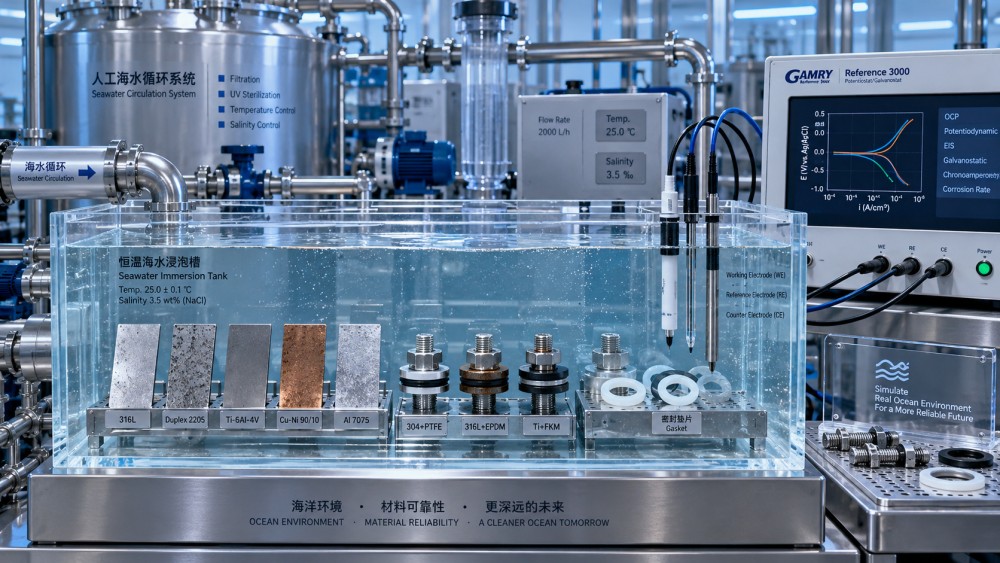
Immersion testing exposes prepared specimens to natural or synthetic seawater for a defined period, often with controlled temperature, aeration, and flow conditions. ASTM G31 is commonly used as a general framework for laboratory immersion corrosion testing. After exposure, specimens are cleaned using an appropriate procedure, weighed, examined, and compared with unexposed controls.
This method is effective for identifying general corrosion trends and for observing changes in surface condition. It can help compare carbon steel, aluminum alloys, copper alloys, stainless steels, duplex stainless steels, and nickel alloys under the same solution chemistry. It also allows researchers to vary temperature, oxygenation, flow, or chemical contamination in a controlled way.
Weight loss alone, however, can obscure the failure mode that matters most. An alloy may have very low average metal loss but develop a few deep pits. For a pressure boundary, thin-wall tube, or machined sealing surface, one deep pit may be more serious than uniform thinning across the entire sample.
Immersion specimens should therefore be evaluated for:
- Maximum pit depth and pit density, not only average mass loss.
- Crevice attack beneath washers, polymer strips, seals, or purpose-built crevice formers.
- Attack near welds, heat-affected zones, and mechanically worked areas.
- Surface deposits, under-deposit corrosion, and evidence of differential aeration.
- Changes in corrosion morphology when water is stagnant, aerated, heated, or flowing.
For components that operate intermittently, include a stagnation phase. Flowing seawater may support a passive film on some alloys, while a shutdown period can create oxygen-depleted crevices and concentrated chloride conditions. Conversely, high flow may introduce erosion-corrosion or remove protective films. A static beaker test cannot resolve either issue on its own.
Electrochemical tests are often the fastest way to rank pitting risk
Electrochemical testing provides a more sensitive view of passive-film stability than simple mass-loss measurements. Potentiodynamic polarization, cyclic polarization, electrochemical impedance spectroscopy, and open-circuit potential monitoring are among the tools used to compare alloy behavior in chloride solutions.
For alloy selection, cyclic polarization is particularly useful because it can indicate susceptibility to localized breakdown and the ability of the surface to repassivate after an aggressive potential excursion. A lower resistance to breakdown or poor repassivation behavior can flag a risk of pitting or crevice corrosion under the chosen test conditions.
These results need careful interpretation. Electrochemical response depends heavily on solution composition, temperature, pH, scan rate, specimen preparation, aeration, and the reference electrode arrangement. Two tests with different parameters may not be directly comparable even when they use the same alloy. A result should be reported with its full method and exposure conditions, rather than reduced to a single “corrosion resistance” score.
Electrochemical testing is especially useful when comparing closely related grades, assessing surface treatments, examining weld regions, or determining how a change in temperature shifts the pitting margin. It is also valuable for narrowing a long candidate list before committing to slower, more expensive exposure work.
It does not replace physical exposure of creviced or assembled parts. Small electrochemical cells generally test a limited, carefully prepared surface. The method identifies tendencies; it does not automatically capture the geometry, deposits, stress state, and electrical connections of field hardware.
Test pitting and crevice corrosion at the temperatures that matter
Chloride-induced localized corrosion becomes more likely as temperature rises, and service temperature can be the dividing line between acceptable and unacceptable performance. This matters for heat exchangers, firewater loops near hot equipment, thermal desalination systems, and seawater circuits exposed to warm shutdown conditions.
Tests based on critical pitting temperature or critical crevice temperature can help establish a practical ranking among stainless steel, duplex stainless steel, super duplex, and nickel-based candidates. ASTM G48 is often used for evaluating pitting and crevice corrosion resistance of stainless steels and related alloys in ferric chloride solutions. The environment is deliberately severe and is not a literal substitute for seawater, but it can reveal relative sensitivity to localized attack under controlled conditions.
The limitation is important: passing a severe laboratory method does not eliminate the need to assess the actual seawater system. Ferric chloride testing is a comparative, accelerated exposure. The required acceptance temperature, specimen configuration, surface condition, and evaluation criteria should be tied to the intended duty, not copied from an unrelated material specification.
Crevice testing deserves more attention than it often receives. Many marine failures begin where seawater becomes trapped under a gasket, deposit, clamp, washer, sleeve, barnacle layer, or bolted overlap. Use representative crevice formers or actual joint geometry. Include fastener materials, insulating washers, sealants, and coating edges where these will be part of the production assembly.
Galvanic corrosion must be evaluated as a system problem
An alloy can be corrosion-resistant in isolation and still be the wrong choice when electrically connected to another metal in seawater. Galvanic corrosion occurs when dissimilar metals are electrically coupled through an electrolyte. The less noble member may corrode faster, particularly when its exposed area is small relative to the more noble material.
Common risk situations include stainless steel fasteners in aluminum structures, copper-alloy components coupled to steel, titanium connected to less noble alloys, and repair hardware installed without considering the original material system. Coatings can complicate the picture: coating only the more active metal may reduce exposure, while damage to a coated noble component can create an unfavorable cathode-to-anode area relationship.
A credible evaluation combines galvanic potential data with a representative couple test. Test the actual pair in the intended seawater chemistry and temperature, with realistic exposed-area ratios. Measure couple current where possible, inspect both metals, and consider the effect of insulation, sacrificial anodes, cathodic protection, and coating damage. The corrosion engineer should evaluate whether protection systems might overprotect a susceptible alloy and introduce a different failure concern, such as hydrogen-related damage in certain high-strength materials.
Natural seawater exposure is the final reality check for critical service
Where failure would create safety, environmental, production, or high-repair-cost consequences, natural seawater testing can justify its longer duration. Raft, harbor, coastal, or site-specific exposure can reveal marine growth, sediment accumulation, seasonal temperature shifts, biological activity, tidal effects, and water chemistry variations that laboratory tests simplify.
The test site must resemble the service environment closely enough to be meaningful. Open-ocean immersion does not necessarily represent a warm intake basin, a polluted port, a brackish estuary, or a chlorinated seawater system. Record water temperature, salinity, oxygen conditions, flow characteristics, immersion depth, orientation, and cleaning or maintenance events. Without this context, a field result is difficult to transfer to another site.
Natural exposure is most useful after laboratory work has narrowed the candidates. Sending every possible alloy into a multi-season field test is expensive and often unnecessary. A focused field program should test the most credible alternatives, relevant welds and surface finishes, creviced configurations, and material couples that will exist in the final design.
Build acceptance criteria before testing begins
Testing can generate large amounts of information without producing a selection decision unless pass/fail criteria are agreed in advance. The criteria should reflect the function of the part. A decorative enclosure may tolerate staining; a thin-wall heat-exchanger tube may have strict pit-depth limits; a structural item may require limits on section loss; a sealing face may need a defect-free surface within a defined area.
Specify the required evidence before issuing a laboratory request or supplier qualification plan: alloy chemistry and product form, specimen count, fabrication condition, weld procedure where applicable, test solution, temperature, duration, aeration or flow, crevice arrangement, cleaning method, inspection method, and reporting format. Require photographs and morphology observations alongside numerical results. A corrosion rate without images or localized-attack measurements may conceal the mechanism that drives failure.
The best marine alloy test is therefore rarely one test. Use salt fog or electrochemical methods to screen efficiently, immersion and crevice exposures to examine relevant degradation, galvanic testing for mixed-metal assemblies, and natural seawater exposure when the decision carries material operational risk. The resulting evidence will be slower to collect than a single headline test result, but it is far more likely to support a material choice that survives the actual marine environment.
- Last One:No more articles
- Next Article:How material intelligence is reshaping sourcing decisions in Southeast AsiaOct 09, 2026
Related News
- 00
0000-00
How material intelligence is reshaping sourcing decisions in Southeast Asia - 00
0000-00
How to Test Metal Alloys for Marine Corrosion Resistance - 00
0000-00
How to vet suppliers in a process technology supplier directory - 00
0000-00
How to verify chemical manufacturing environmental standards compliance - 00
0000-00
How to evaluate data quality in a recycled plastics database
Weekly Insights
Stay ahead with our curated technology reports delivered every Monday.