




How to compare hazard classifications on industrial chemical safety data sheets




Two safety data sheets can describe the same industrial chemical differently without either document necessarily being wrong. The difference may come from formulation, available test data, the supplier’s interpretation of classification criteria, or the GHS-based rules applicable in each jurisdiction. Before treating one product as safer, establish that the sheets cover comparable materials and regulatory frameworks, then examine the specific hazards behind each classification.
An effective industrial chemicals safety data sheet comparison starts in Section 2, but it should not end there. Sections 3, 8, 9, 11 and 12 can help explain differences and show whether they affect exposure controls, storage or environmental management. An SDS is a starting point for those decisions; it does not replace an assessment of how the chemical will actually be used.
Start with the product and regulatory context
First check the product identifier, supplier, revision date and intended use in Section 1. A trade name alone is not enough: products sold for the same application may differ in concentration, impurities or additives. Compare the physical form as well. A powder, solution and aerosol containing the same substance can present different exposure or physical hazards.
Next, establish the jurisdiction for which each SDS was prepared. GHS provides a common classification framework, but jurisdictions adopt and implement it through their own rules. Differences in adopted provisions, hazard categories, supplemental requirements or implementation dates can affect what appears on a sheet. A missing classification on one document should not automatically be interpreted as evidence that the product lacks that hazard.
Revision dates matter for a different reason. An older sheet may reflect earlier data or criteria, while a newer sheet may describe a changed formulation. The date alone does not identify which explanation applies. If a change could affect site controls, ask the supplier whether the product composition, classification basis or applicable regulatory framework has changed.
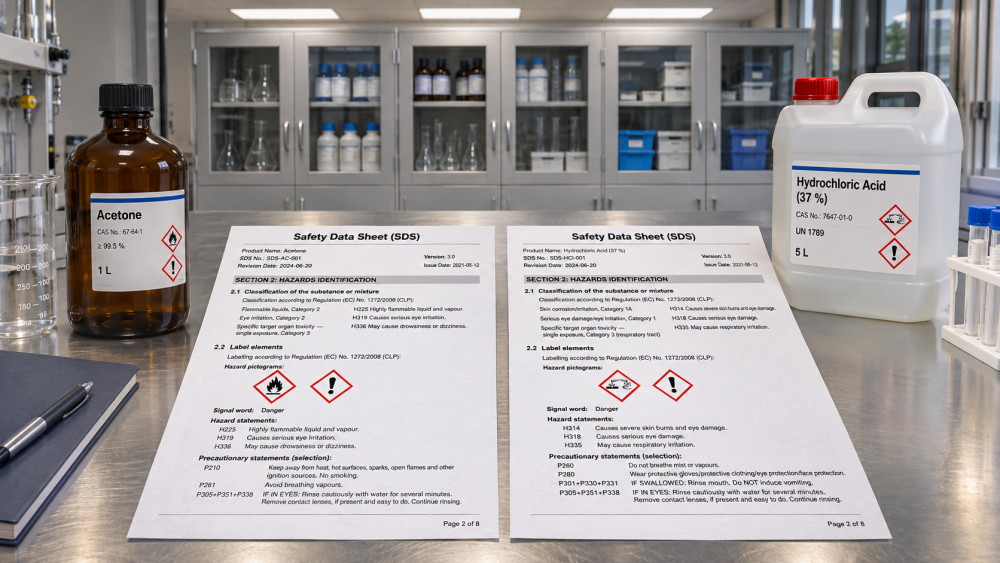
Compare Section 2 hazard by hazard
Read the hazard classification, category and associated hazard statement together. Pictograms and signal words provide a useful warning, but they compress information: two products may display the same symbol while differing in severity, exposure route or target organ. Conversely, different label elements can arise from classifications that need closer review before operational significance is clear.
For many GHS hazard classes, a lower category number represents a more severe hazard, but category scales are specific to each class. Do not compare category numbers across different hazards or assume a single number ranks the product as a whole. A mixture classified for skin corrosion and another classified for acute inhalation toxicity present different problems even if both have a Category 1 entry.
Check the route and duration of exposure in health hazard statements. A classification for acute toxicity after inhalation calls for different scrutiny from one related to skin contact. Similarly, a chronic health hazard should not be treated as interchangeable with an immediate irritation warning. For physical hazards, distinguish flammability from oxidizing properties or reactivity: each can affect storage and emergency planning in a different way.
Trace differences back to composition and evidence
Section 3 lists relevant ingredients and concentrations or concentration ranges, subject to applicable disclosure rules. Compare chemical identifiers where available, not just ingredient names. A change in concentration may explain a different mixture classification, but a listed range does not necessarily reveal the exact formulation. Ingredients below disclosure thresholds, confidential business information and other disclosure limits can also leave an incomplete picture.
Do not calculate a definitive mixture classification from the SDS alone unless the necessary data and applicable rules are available. Classification may rely on testing of the mixture, bridging principles or calculation methods, depending on the hazard and regulatory framework. Ask the supplier to explain a material discrepancy, particularly when composition ranges overlap but the assigned hazards differ substantially.
Sections 9 and 11 provide useful cross-checks. Physical properties such as flash point, where reported and relevant, can help explain a flammability classification. Toxicological information may identify the exposure route, observed effects or data gaps behind a health classification. Section 12 can provide supporting information for environmental hazards. These sections do not always contain the full evidence used by the supplier, and missing test results should not be read as proof of no hazard.
When comparing an old and a new SDS for one product, document the changed classifications alongside any changes in composition and supporting information. Ask whether existing stock and new deliveries have the same formulation before applying the revised sheet uniformly to both.
Translate the comparison into site decisions
A classification difference matters most when it changes a control or exposes a gap in the existing assessment. Use Section 7 for handling and storage guidance and Section 8 for exposure controls and personal protection. Check any occupational exposure limits against the rules applicable at the workplace; a limit shown on a sheet prepared for another jurisdiction may not be the one that governs the site.
- Storage: Review segregation and fire protection when flammability, oxidizing or other physical hazard classifications differ. Confirm compatibility using the available stability and reactivity information in Section 10.
- Worker exposure: Compare inhalation and skin hazards against the task, including whether the material is heated, sprayed, transferred or handled in an enclosed system. PPE selection depends on the substance, exposure and equipment compatibility, not the pictogram alone.
- Emergency response: Check whether first-aid measures, spill response or firefighting guidance differ in ways that require changes to local procedures.
- Environmental controls: Where aquatic hazards or disposal guidance differ, review containment and waste handling under applicable local requirements.
A lower hazard category or fewer pictograms on one SDS is not, by itself, proof that the product is safer for a particular operation. Exposure potential, quantity, process conditions and control effectiveness all influence risk. Record unresolved differences and obtain clarification from the supplier before substituting a product when the answer could change protective measures or regulatory obligations.
Related News
- 00
0000-00
How to verify product purity claims from chemical feedstock distributors - 00
0000-00
Will feedstock availability constrain biofuel production in 2026? - 00
0000-00
How to select corrosion-resistant agrochemical manufacturing reactors - 00
0000-00
How to verify an injection molding supplier in China - 00
0000-00
How to account for supplier lead times in raw material supply chain planning
Related tags
Weekly Insights
Stay ahead with our curated technology reports delivered every Monday.