




What makes mineral resources critical to a country?




A mineral resource becomes critical to a country when its economy or security depends on reliable access to it and that access is vulnerable to disruption. A material used in essential manufacturing may be readily available from several dependable sources; another may be difficult to obtain but have limited national importance. Criticality usually emerges where importance and supply risk overlap.
That judgment is specific to the country and the time. Critical mineral resources for a manufacturer with a large battery industry may differ from those for a country focused on steelmaking or defense production. Governments also use different assessment methods, so their lists do not always match.
Economic importance is the starting point
A mineral matters economically when industries rely on it to produce goods or provide services that are difficult to replace. The relevant question is not simply how much of the material a country consumes. A small quantity can be important if it performs a function that determines whether a product can be made at all.
Consider a metal used in a specialized alloy. The metal may represent only a small share of the finished product’s weight, yet changing the alloy could require redesign, testing and customer approval. An interruption can therefore affect production well beyond the cost of the missing ingredient.
Governments may assess importance through the industries that use a material, their contribution to the economy and the consequences of a shortage. They may also consider strategic uses, such as equipment for national defense, electricity networks or communications. A mineral can be significant for security even if its direct contribution to national output is relatively modest.
Use alone, however, does not establish criticality. A widely consumed mineral may receive less attention if supply is diverse, markets function reliably and users can switch materials without major difficulty.
Supply risk extends beyond the mine
Supply risk is the likelihood and potential impact of an interruption in access to a usable material. Mining is only one part of that assessment. Ore may need to be concentrated, refined and converted into a specified chemical or metal before a manufacturer can use it. A country can have access to mined material while depending heavily on a limited number of processors for the form its industries need.
Several conditions can make supply more vulnerable:
- Concentrated production or processing: A disruption affecting a small group of producing countries or facilities can be difficult to offset.
- Dependence on imports: A country with few domestic alternatives may be exposed to trade restrictions, transport interruptions or changes in overseas policy.
- Slow capacity expansion: New mines, processing plants and associated infrastructure can take substantial time and investment to develop.
- By-product supply: Some minerals are recovered mainly alongside another metal. Their output may depend more on the economics of the primary metal than on demand for the by-product.
- Quality and processing constraints: A substitute source must be able to deliver the required purity, chemical form and consistency, not merely contain the same element.
A country’s exposure also depends on where a disruption occurs. Losing access to a mine and losing access to a refinery create different problems. The first may be addressed by finding another source of raw material; the second requires suitable processing capacity, which may be harder to replace quickly.
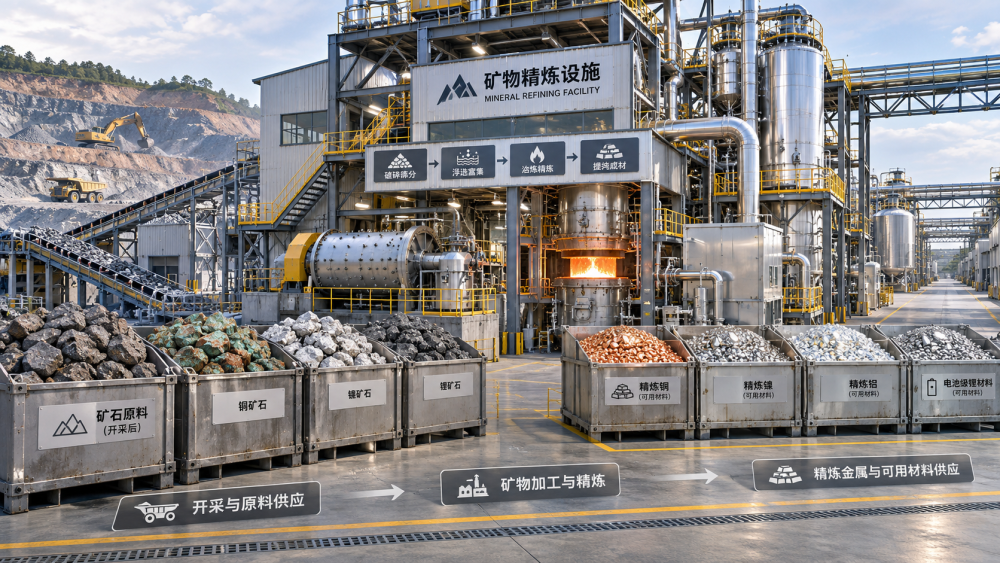
Geological abundance offers only part of the answer. A mineral may exist in many places but be commercially recoverable at relatively few sites. Conversely, a country with limited domestic deposits may face manageable risk if it can obtain processed material from diverse, reliable sources.
Substitution and recycling can reduce vulnerability
When a mineral is scarce or its supply is disrupted, the practical question is how quickly users can adjust. Possible responses include switching materials, changing a product design, improving manufacturing efficiency or recovering material from scrap and used products. Each option has limits.
A substitute must perform adequately in the intended application. It may also require changes to equipment, qualification procedures or product specifications. For an established industrial component, a technically feasible alternative may still take time to validate and introduce. A temporary shortage can therefore cause disruption even when a longer-term substitute exists.
Recycling can provide another source of supply, but its contribution depends on the quantity and quality of material available for recovery, collection systems and processing economics. Materials incorporated into long-lived products may remain in use for years before they become available as scrap. Recycled feedstock can ease exposure without necessarily covering demand during a sudden interruption.
Stockpiles offer a different form of resilience: they can bridge a temporary shortfall. Their value depends on whether the stored material is in a usable form, whether users can access it and how long the disruption lasts. They do not by themselves create mining or refining capacity.
Why countries reach different conclusions
National criticality assessments reflect national circumstances. Two countries may import the same mineral but assign it different priority because their industrial uses, supplier relationships and ability to respond to shortages differ.
A country with extensive manufacturing that depends on a particular processed material may see a major economic exposure. Another country may consume little of it, produce it domestically or have access to several sources. Even when both identify a risk, they may use different thresholds for adding the mineral to an official list.
Definitions also vary. Some assessments emphasize economic importance and supply disruption; others give particular weight to strategic industries, defense needs or domestic production policy. Official designations can influence research, investment and policy priorities, but appearing on a list does not guarantee that a mineral is scarce everywhere or that its price will rise.
The reverse is also possible: a material absent from one country’s list can still present a serious risk to an individual company. A manufacturer may rely on a single qualified supplier for a specialized grade, even when national supply appears diverse. National assessments are useful for understanding broad exposure, while company-level decisions require a closer look at the material’s form, suppliers and application.
How criticality can change
Criticality is a continuing assessment rather than a permanent property of a mineral. A new technology can increase demand for a material; a design change can reduce it. New production or processing capacity may improve supply diversity, while a facility closure, trade restriction or disruption can increase exposure.
Researchers comparing materials should therefore look beyond the name on a list. Identify the country making the assessment, the industrial uses it considers, the stage of supply under review and the availability of alternatives. Then examine how much time users would need to respond to a shortage. Those details explain why the same mineral can be a national priority in one setting and a manageable concern in another.
- Last One:No more articles
- Next Article:How to verify product purity claims from chemical feedstock distributorsNov 24, 2026
Related News
- 00
0000-00
What makes mineral resources critical to a country? - 00
0000-00
How to verify product purity claims from chemical feedstock distributors - 00
0000-00
Will feedstock availability constrain biofuel production in 2026? - 00
0000-00
How to select corrosion-resistant agrochemical manufacturing reactors - 00
0000-00
How to verify an injection molding supplier in China
Related tags
Weekly Insights
Stay ahead with our curated technology reports delivered every Monday.